Department of Chemistry , Boston College , 2609 Beacon Street , Chestnut Hill , Massachusetts 02467 , United States.
Acc Chem Res. 2018 Sep 18;51(9):2198-2206. doi: 10.1021/acs.accounts.8b00154. Epub 2018 Aug 15.
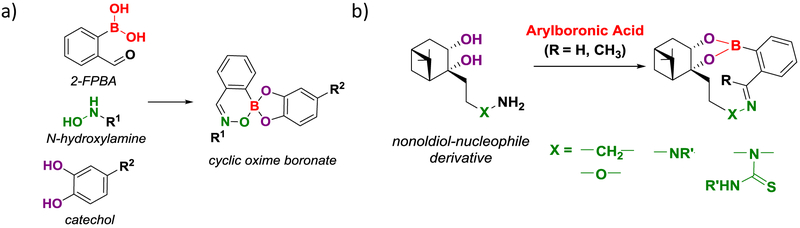
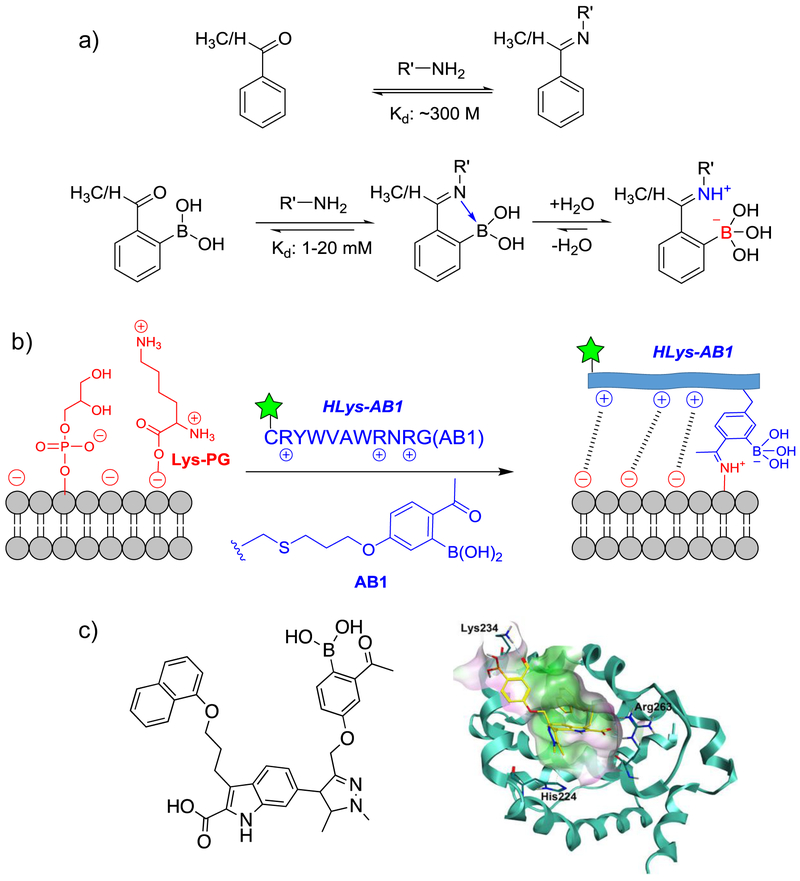
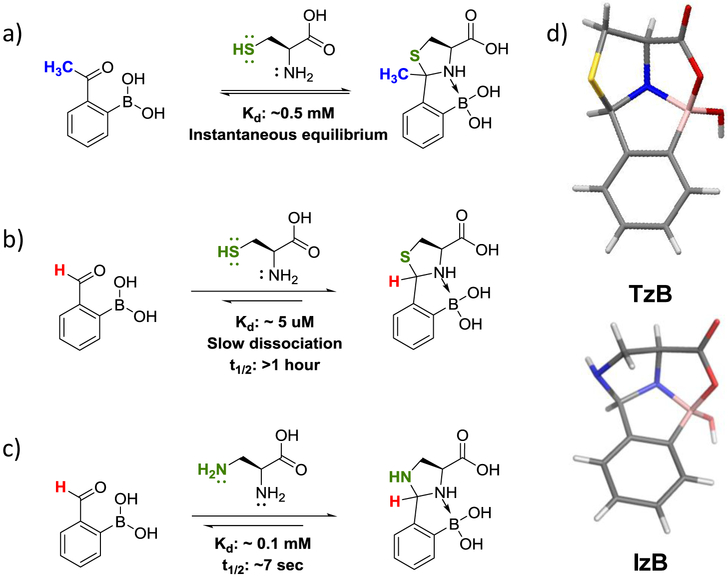
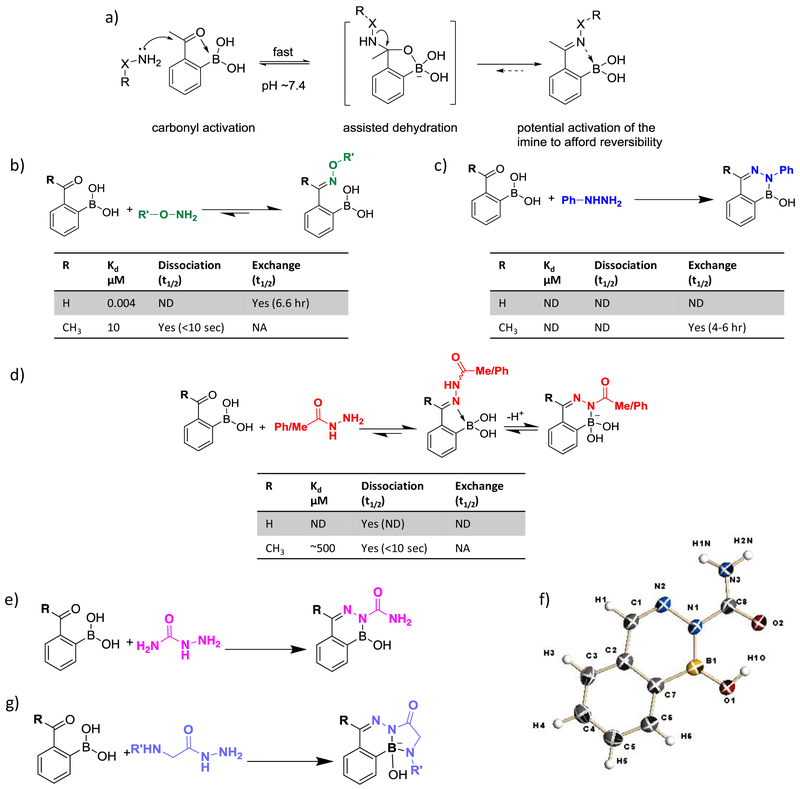
Biocompatible and bioorthogonal conjugation reactions have proven to be powerful tools in biological research and medicine. While the advent of bioorthogonal conjugation chemistries greatly expands our capacity to interrogate specific biomolecules in situ, biocompatible reactions that target endogenous reactive groups have given rise to a number of covalent drugs as well as a battery of powerful research tools. Despite the impressive progress, limitations do exist with the current conjugation chemistries. For example, most known bioorthogonal conjugations suffer from slow reaction rates and imperfect bioorthogonality. On the other hand, covalent drugs often display high toxicity due to off-target labeling and immunogenicity. These limitations demand continued pursuit of conjugation chemistries with optimal characteristics for biological applications. A spate of papers appearing in recent literature report the conjugation chemistries of 2-formyl and 2-acetyl phenylboronic acids (abbreviated as 2-FPBA and 2-APBA, respectively). These simple reactants are found to undergo fast conjugation with various nucleophiles under physiological conditions, showing great promise for biological applications. The versatile reactivity of 2-FPBA and 2-APBA manifests in dynamic conjugation with endogenous nucleophiles as well as conjugation with designer nucleophiles in a bioorthogonal manner. 2-FPBA/APBA conjugates with amines in biomolecules, such as lysine side chains and aminophospholipids, in a highly dynamic manner to give iminoboronates. In contrast to typical imines, iminoboronates enjoy much improved thermodynamic stability, yet are kinetically labile for hydrolysis due to imine activation by the boronic acid. Dynamic conjugations as such present a novel binding mechanism analogous to hydrogen bonding and electrostatic interactions. Implementation of this covalent binding mechanism has yielded reversible covalent probes of prevalent bacterial pathogens. It has also resulted in reversible covalent inhibitors of a therapeutically important protein Mcl-1. Such covalent probes/inhibitors with 2-FPBA/APBA warheads avoid permanent modification of their biological target, potentially able to mitigate off-target labeling and immunogenicity of covalent drugs. The dynamic conjugation of 2-FPBA/APBA has been recently extended to N-terminal cysteines, which can be selectively targeted via formation of a thiazolidino boronate (TzB) complex. The dynamic TzB formation expands the toolbox for site-specific protein labeling and the development of covalent drugs. On the front of bioorthogonal conjugation, 2-FPBA/APBA has been found to conjugate with α-nucleophiles under physiologic conditions with rate constant ( k) over 1000 M s, which overcomes the slow kinetics problems and rekindles the interest of using the conjugation of α-nucleophiles for biological studies. With fast kinetics being a shared feature, this family of conjugation chemistries gives remarkably diverse product structures depending on the choice of nucleophile. Importantly, both dynamic and irreversible conjugations have been developed, which we believe will enable a wide array of applications in biological research. In this Account, we collectively examine this rapidly expanding family of conjugation reactions, seeking to elucidate the unifying principles that would guide further development of novel conjugation reactions, as well as their applications in biology.
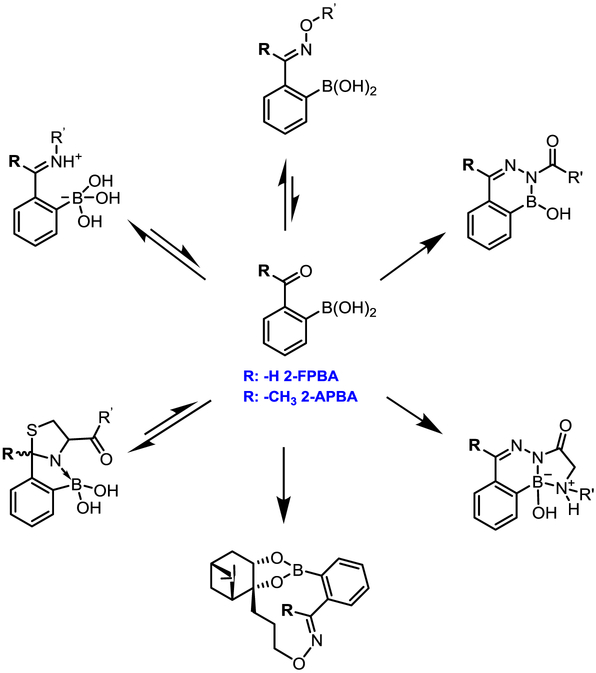
生物相容和生物正交的偶联反应已被证明是生物研究和医学领域的有力工具。虽然生物正交偶联化学的出现极大地扩展了我们原位检测特定生物分子的能力,但靶向内源性反应基团的生物相容反应已经产生了许多共价药物和一系列强大的研究工具。尽管取得了令人印象深刻的进展,但目前的偶联化学仍存在一些局限性。例如,大多数已知的生物正交偶联反应速率较慢,生物正交性不完美。另一方面,共价药物由于脱靶标记和免疫原性往往具有较高的毒性。这些局限性要求继续寻求具有生物应用最佳特性的偶联化学。最近文献中的一系列论文报告了 2-甲酰基和 2-乙酰基苯硼酸(分别缩写为 2-FPBA 和 2-APBA)的偶联化学。这些简单的反应物在生理条件下与各种亲核试剂快速偶联,显示出在生物应用中的巨大前景。2-FPBA 和 2-APBA 的多功能反应性表现为与内源性亲核试剂的动态偶联,以及与生物正交设计的亲核试剂的偶联。2-FPBA/APBA 与生物分子中的胺(如赖氨酸侧链和氨基磷脂)高度动态地形成亚氨硼酸盐。与典型的亚胺不同,亚氨硼酸盐具有更高的热力学稳定性,但由于硼酸对亚胺的激活,动力学上不稳定,易于水解。这种动态偶联提供了一种类似于氢键和静电相互作用的新型结合机制。这种共价结合机制的实现为常见细菌病原体的可逆共价探针提供了可能。它还产生了一种治疗上重要的蛋白质 Mcl-1 的可逆共价抑制剂。带有 2-FPBA/APBA 弹头的这些共价探针/抑制剂避免了对其生物靶标的永久性修饰,有可能减轻共价药物的脱靶标记和免疫原性。2-FPBA/APBA 的动态偶联最近已扩展到 N-末端半胱氨酸,可通过形成噻唑啉硼酸(TzB)复合物选择性靶向。动态 TzB 形成扩大了用于定点蛋白质标记和共价药物开发的工具包。在生物正交偶联方面,2-FPBA/APBA 在生理条件下与 α-亲核试剂以超过 1000 M s 的速率常数(k)偶联,克服了缓慢动力学问题,重新激发了使用 α-亲核试剂进行生物学研究的兴趣。由于具有快速动力学是一个共同的特征,这一系列偶联化学根据亲核试剂的选择,产生了非常不同的产物结构。重要的是,已经开发出了动态和不可逆的偶联,我们相信这将使生物研究中的广泛应用成为可能。在本报告中,我们综合考察了这一快速发展的偶联反应家族,旨在阐明指导新型偶联反应进一步发展及其在生物学中的应用的统一原则。