Clinic of Small Animal Medicine, LMU University of Munich, Munich, Germany.
Gastrointestinal Laboratory, Department of Small Animal Clinical Sciences, College of Veterinary Medicine and Biomedical Sciences, Texas A&M University, College Station, Texas, United States of America.
PLoS One. 2018 Aug 15;13(8):e0201279. doi: 10.1371/journal.pone.0201279. eCollection 2018.
Feeding a Bones and Raw Food (BARF) diet has become an increasing trend in canine nutrition. Bones and Raw Food diets contain a high amount of animal components like meat, offal, and raw meaty bones, combined with comparatively small amounts of plant ingredients like vegetables and fruits as well as different sorts of oil and supplements. While many studies have focused on transmission of pathogens via contaminated meat and on nutritional imbalances, only few studies have evaluated the effect of BARF diets on the fecal microbiome and metabolome. The aim of the study was to investigate differences in the fecal microbiome and the metabolome between dogs on a BARF diet and dogs on a commercial diet (canned and dry dog food).
Naturally passed fecal samples were obtained from 27 BARF and 19 commercially fed dogs. Differences in crude protein, fat, fiber, and NFE (Nitrogen-Free Extract) between diets were calculated with a scientific nutrient database. The fecal microbiota was analyzed by 16S rRNA gene sequencing and quantitative PCR assays. The fecal metabolome was analyzed in 10 BARF and 9 commercially fed dogs via untargeted metabolomics approach.
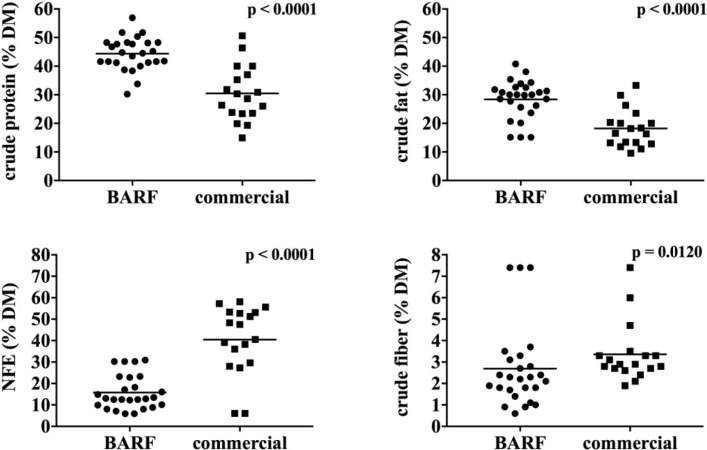
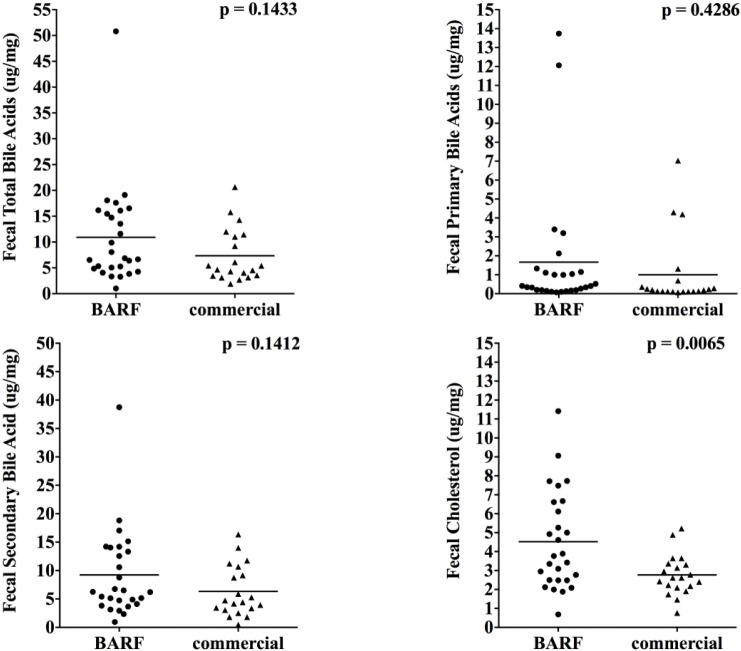
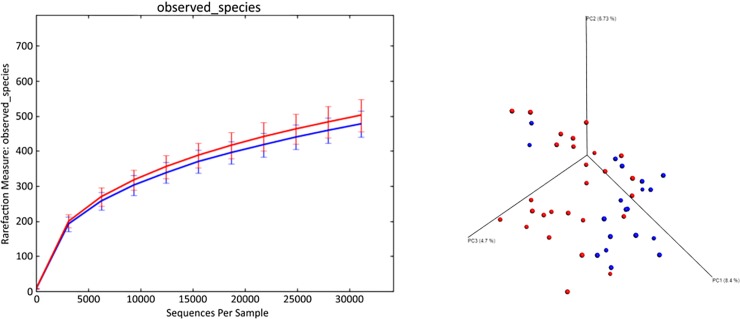
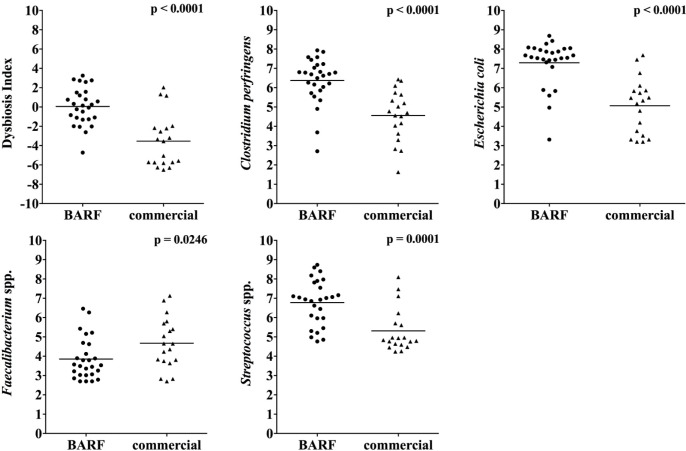
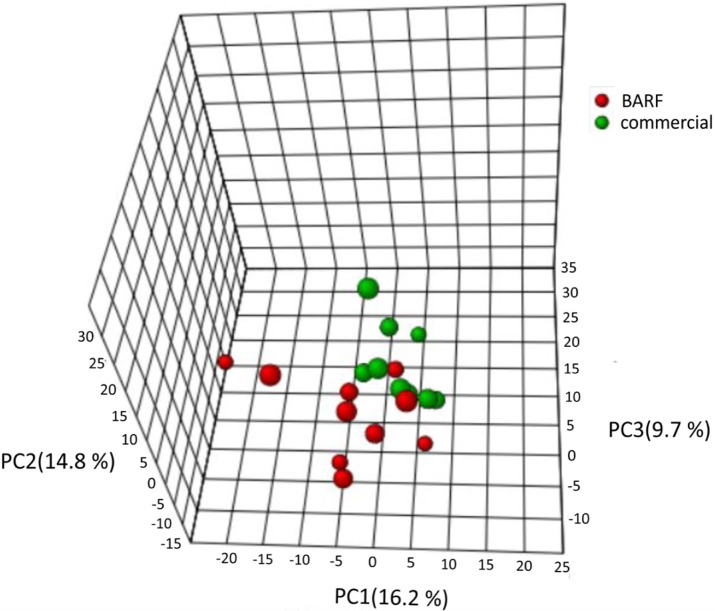
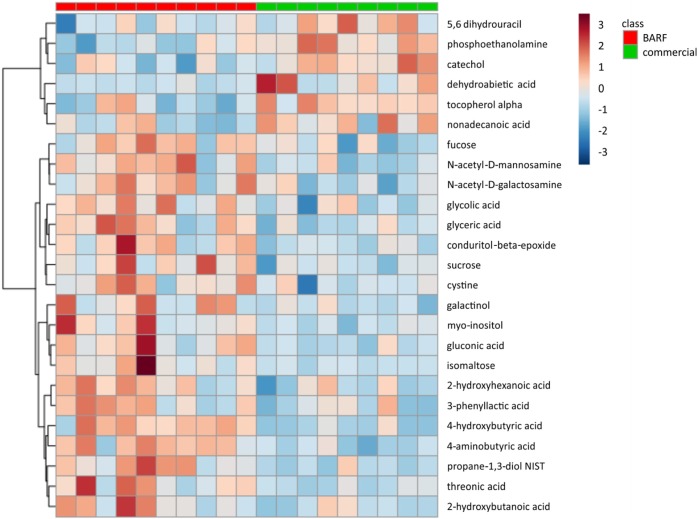
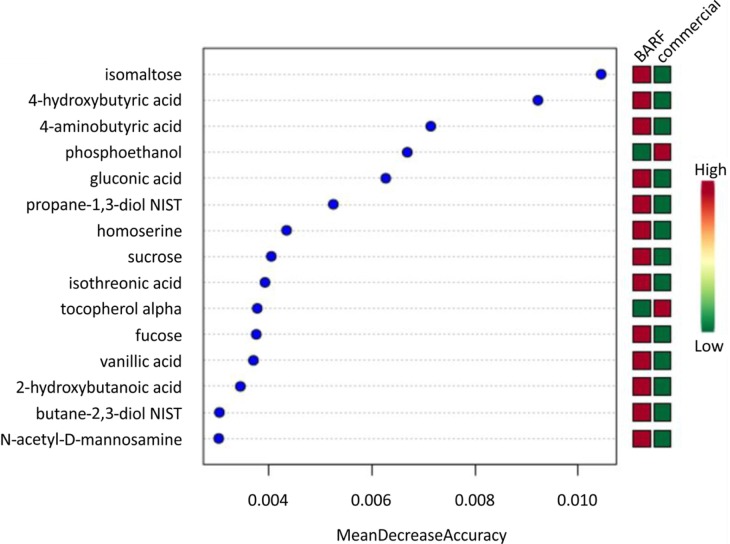
Dogs in the BARF group were fed a significantly higher amount of protein and fat and significantly lower amount of NFE and fiber. There was no significant difference in alpha-diversity measures between diet groups. Analysis of similarity (ANOSIM) revealed a significant difference in beta-diversity (p < 0.01) between both groups. Linear discriminant analysis effect size (LefSe) showed a higher abundance of Lactobacillales, Enterobacteriaceae, Fusobacterium and, Clostridium in the BARF group while conventionally fed dogs had a higher abundance of Clostridiaceae, Erysipelotrichaceae, Ruminococcaceae, and Lachnospiraceae. The qPCR assays revealed significantly higher abundance of Escherichia coli (E. coli) and Clostridium (C.). perfringens and an increased Dysbiosis Index in the BARF group. Principal component analysis (PCA) plots of metabolomics data showed clustering between diet groups. Random forest analysis showed differences in the abundance of various components, including increased 4-hydroxybutryric acid (GBH) and 4-aminobutyric acid (GABA) in the BARF group. Based on univariate statistics, several metabolites were significantly different between diet groups, but lost significance after adjusting for multiple comparison. No differences were found in fecal bile acid concentrations, but the BARF group had a higher fecal concentration of cholesterol in their feces compared to conventionally fed dogs.
Microbial communities and metabolome vary significantly between BARF and commercially fed dogs.
喂养骨头和生食(BARF)饮食已成为犬类营养的一种日益流行的趋势。骨头和生食饮食中含有大量的动物成分,如肉、内脏和生骨肉,同时还含有相对较少的植物成分,如蔬菜和水果,以及各种油和补充剂。尽管许多研究都集中在受污染的肉类传播病原体以及营养失衡上,但只有少数研究评估了 BARF 饮食对粪便微生物组和代谢组的影响。本研究的目的是调查 BARF 饮食组和商业饮食(罐装和干粮)组犬之间粪便微生物组和代谢组的差异。
从 27 只 BARF 饮食组和 19 只商业饮食组犬中获得自然排出的粪便样本。使用科学营养数据库计算饮食中粗蛋白、脂肪、纤维和无氮提取物(Nitrogen-Free Extract,NFE)的差异。通过 16S rRNA 基因测序和定量 PCR 检测分析粪便微生物群。通过非靶向代谢组学方法分析了 10 只 BARF 饮食组和 9 只商业饮食组犬的粪便代谢组。
BARF 组的犬摄入的蛋白质和脂肪显著增加,而 NFE 和纤维的摄入量显著减少。两组的 alpha 多样性测量值没有显著差异。相似性分析(ANOSIM)显示两组之间的 beta 多样性存在显著差异(p < 0.01)。线性判别分析效应量(LefSe)显示,BARF 组中乳杆菌科、肠杆菌科、梭菌属和梭菌属的丰度较高,而传统喂养的犬中梭菌科、真杆菌科、瘤胃球菌科和lachnospiraceae 的丰度较高。qPCR 检测显示,BARF 组中大肠杆菌(E. coli)和梭菌(C.)的丰度显著增加。perfringens 和肠道失调指数增加。代谢组学数据的主成分分析(PCA)图显示了饮食组之间的聚类。随机森林分析显示了各种成分丰度的差异,包括 BARF 组中 4-羟基丁酸(GBH)和 4-氨基丁酸(GABA)的增加。基于单变量统计,两组之间有几个代谢物存在显著差异,但在进行多重比较调整后,这些差异失去了统计学意义。粪便胆汁酸浓度无差异,但 BARF 组犬的粪便胆固醇浓度高于传统喂养的犬。
BARF 饮食组和商业饮食组犬的微生物群落和代谢组存在显著差异。