Zeng Guanghong, Dirscherl Kai, Garnæs Jørgen
DFM A/S (Danish National Metrology Institute), Kogle Alle 5, 2970 Hørsholm, Denmark.
Nanomaterials (Basel). 2018 Aug 14;8(8):616. doi: 10.3390/nano8080616.
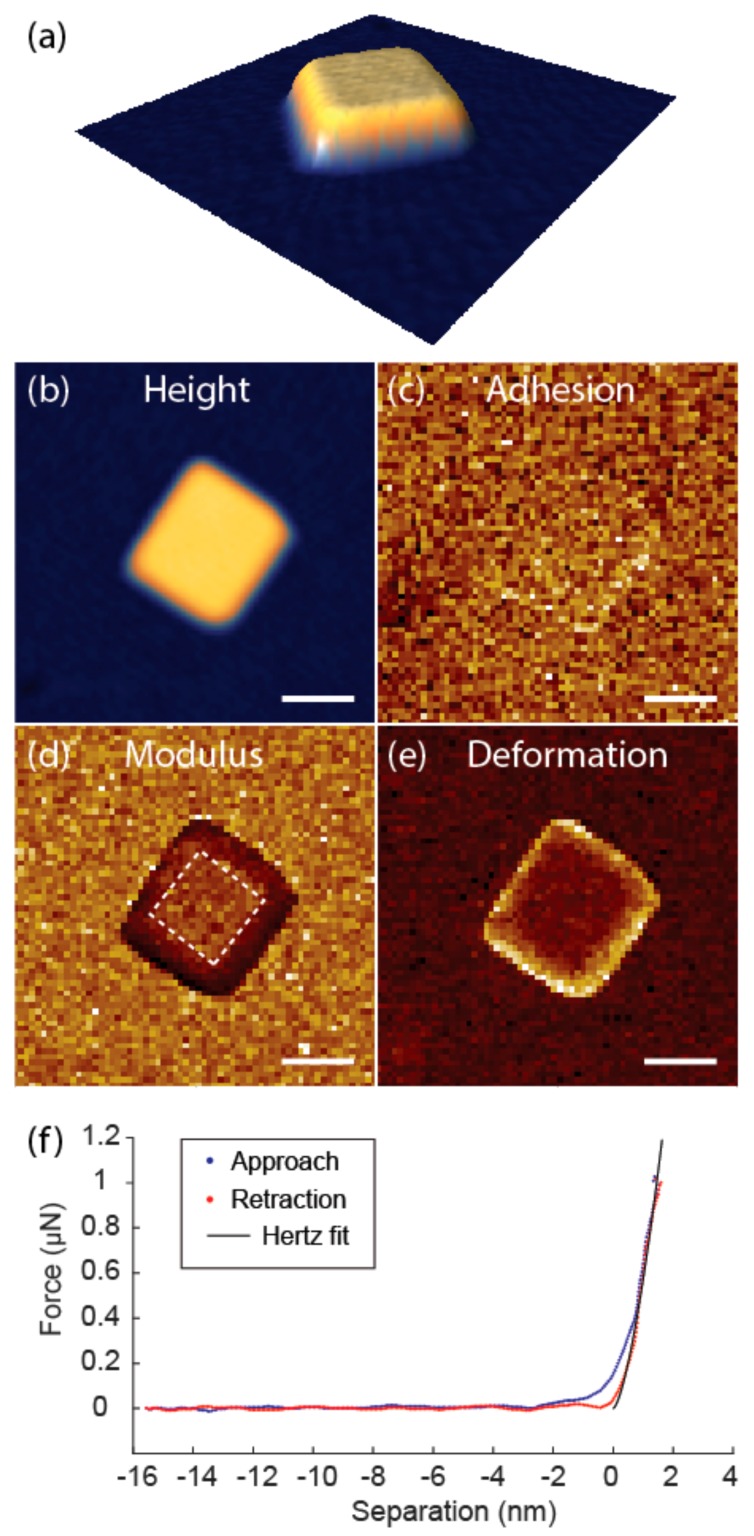
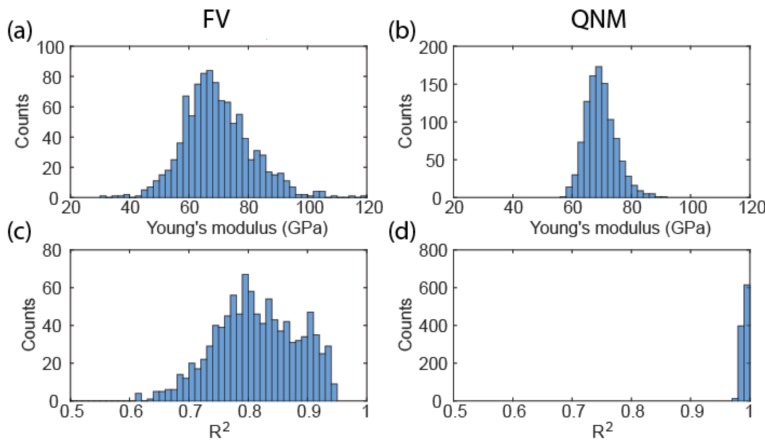
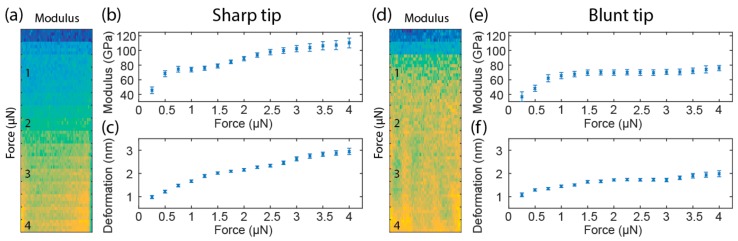
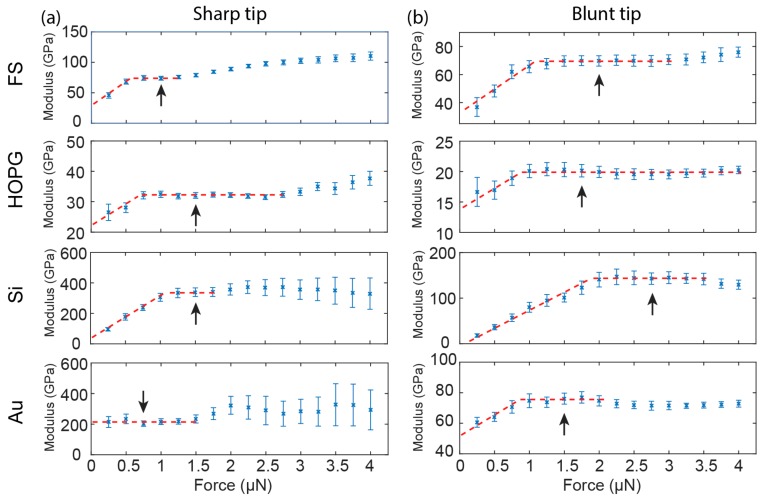
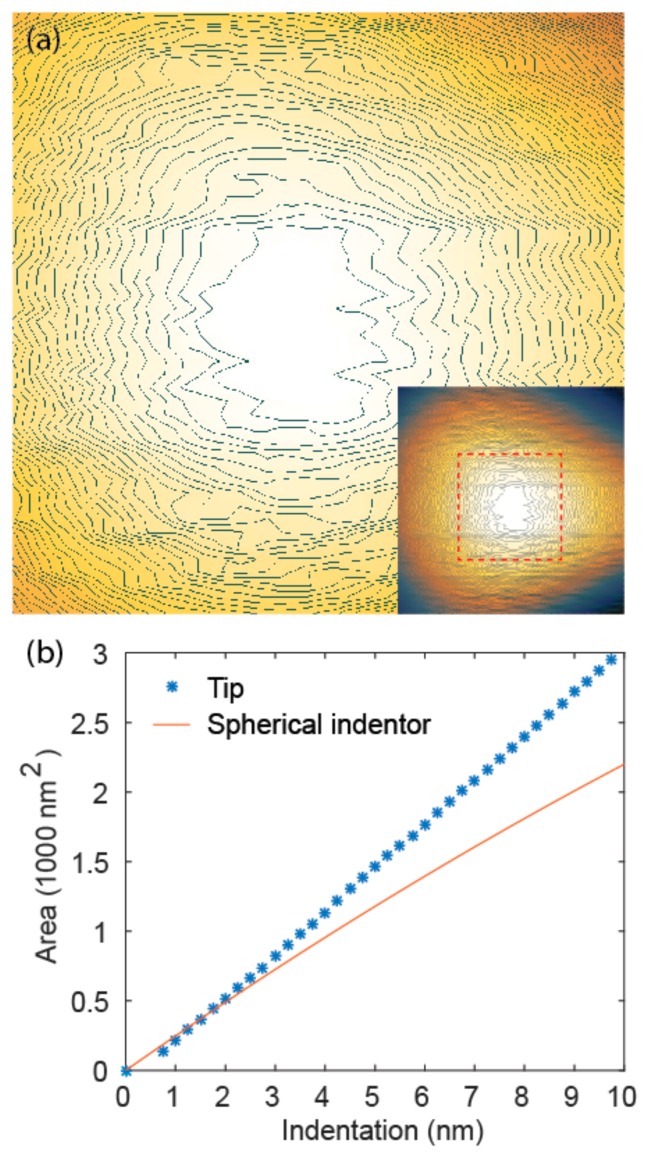
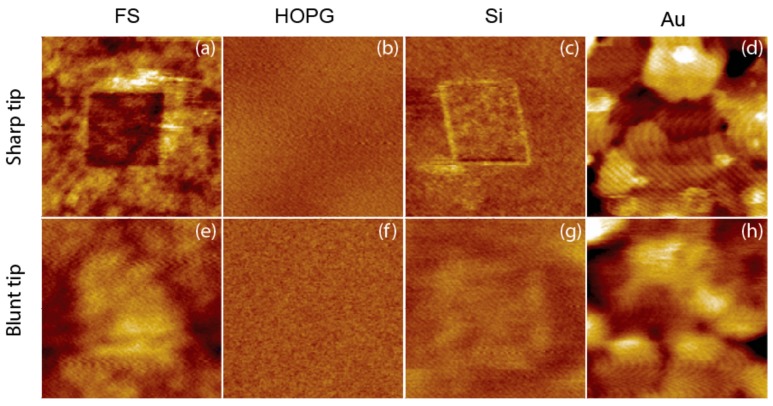
Atomic force microscopy (AFM) has emerged as a popular tool for the mechanical mapping of soft nanomaterials due to its high spatial and force resolution. Its applications in rigid nanomaterials, however, have been underexplored. In this work, we studied elasticity mapping of common rigid materials by AFM, with a focus on factors that affect the accuracy of elasticity measurements. We demonstrated the advantages in speed and noise level by using high frequency mechanical mapping compared to the classical force volume mapping. We studied loading force dependency, and observed a consistent pattern on all materials, where measured elasticity increased with loading force before stabilizing. Tip radius was found to have a major impact on the accuracy of measured elasticity. The blunt tip with 200 nm radius measured elasticity with deviation from nominal values up to 13% in different materials, in contrast to 122% by the sharp tip with 40 nm radius. Plastic deformation is believed to be the major reason for this difference. Sharp tips, however, still hold advantages in resolution and imaging capability for nanomaterials.
原子力显微镜(AFM)因其高空间分辨率和力分辨率,已成为用于软纳米材料力学映射的常用工具。然而,其在刚性纳米材料中的应用尚未得到充分探索。在这项工作中,我们通过AFM研究了常见刚性材料的弹性映射,重点关注影响弹性测量准确性的因素。与经典的力体积映射相比,我们通过高频机械映射展示了在速度和噪声水平方面的优势。我们研究了加载力依赖性,并在所有材料上观察到一致的模式,即测量的弹性在稳定之前随加载力增加。发现尖端半径对测量弹性的准确性有重大影响。半径为200 nm的钝尖端在不同材料中测量的弹性与标称值的偏差高达13%,相比之下,半径为40 nm的尖锐尖端的偏差为122%。塑性变形被认为是造成这种差异的主要原因。然而,尖锐尖端在纳米材料的分辨率和成像能力方面仍具有优势。