Yang Dong-Kun, Kim Ha-Hyun, Cho In-Soo
OIE Reference Lab for Rabies, Viral Disease Research Division, Animal and Plant Quarantine Agency, Ministry of Agriculture, Food and Rural Affairs, Gimcheon, Korea.
Clin Exp Vaccine Res. 2018 Jul;7(2):87-92. doi: 10.7774/cevr.2018.7.2.87. Epub 2018 Jul 31.
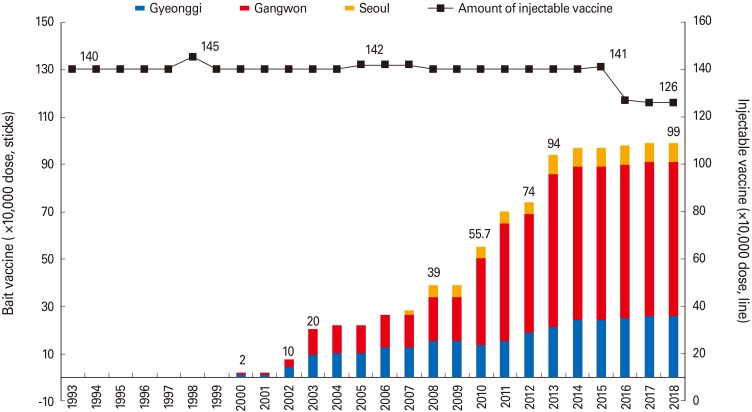
Endemic animal rabies causes >99% of all human rabies cases; elimination of animal rabies reduces the rate of human infections. The most recent animal rabies cases in the Gangwon and Gyeonggi provinces of Korea occurred in November 2012 and February 2013, respectively. Here we explore ways to ensure that Korea remains animal rabies non-occurrence. The government must prevent rabies recurrence by vaccinating dogs, distributing bait vaccine in regions with a high rabies risk, performing laboratory-based surveillance, preventing the flow of rabies-suspect animals from neighboring countries, and enhancing border quarantine. As has already been shown in several developed countries, careful and ongoing rabies control will allow Korea to remain animal rabies-free.
地方性动物狂犬病导致了超过99%的人类狂犬病病例;消除动物狂犬病可降低人类感染率。韩国江原道和京畿道最近的动物狂犬病病例分别发生在2012年11月和2013年2月。在此,我们探讨确保韩国保持无动物狂犬病状态的方法。政府必须通过给狗接种疫苗、在狂犬病高风险地区分发诱饵疫苗、开展基于实验室的监测、防止疑似狂犬病动物从邻国流入以及加强边境检疫来预防狂犬病复发。正如一些发达国家已经表明的那样,认真且持续的狂犬病防控将使韩国保持无动物狂犬病状态。