Nichols Kelly K, Donnenfeld Eric D, Karpecki Paul M, Hovanesian John A, Raychaudhuri Aparna, Shojaei Amir, Zhang Steven
1 School of Optometry, The University of Alabama at Birmingham, Birmingham, AL, USA.
2 Ophthalmic Consultants of Long Island, Garden City, NY, USA.
Eur J Ophthalmol. 2019 Jul;29(4):394-401. doi: 10.1177/1120672118791936. Epub 2018 Aug 16.
Characterize the safety and tolerability of lifitegrast ophthalmic solution 5.0% for the treatment of dry eye disease.
Pooled data from five randomized controlled trials were analyzed. Key inclusion criteria were adults with dry eye disease (Schirmer tear test score ⩾1 and ⩽10 mm, eye dryness score ⩾40 (visual analog scale 0-100), corneal staining score ⩾2.0 (0-4 scale)). Participants were randomized to lifitegrast ophthalmic solution 5.0% or placebo twice daily for 84 or 360 days. Treatment-emergent adverse events and drop comfort scores were assessed.
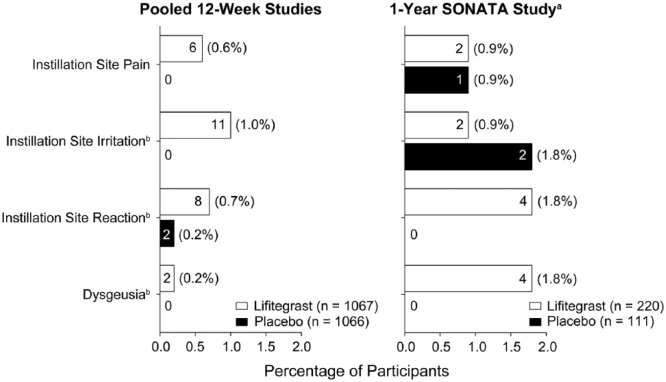
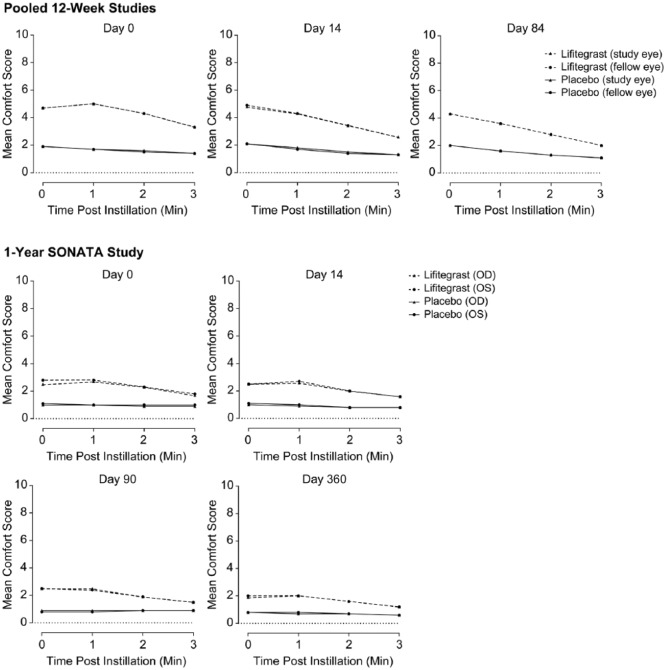
Overall, 2464 participants (lifitegrast, n = 1287; placebo, n = 1177) were included. Ocular treatment-emergent adverse events occurring in >5% in either group were instillation site irritation (lifitegrast, 15.2%; placebo, 2.8%), instillation site reaction (lifitegrast, 12.3%; placebo, 2.3%), and instillation site pain (lifitegrast, 9.8%; placebo, 2.1%); the most common (> 5%) nonocular treatment-emergent adverse event was dysgeusia (lifitegrast, 14.5%; placebo, 0.3%). The majority of treatment-emergent adverse events were mild to moderate in severity. Discontinuation due to treatment-emergent adverse events occurred in 7.0% (lifitegrast) versus 2.6% (placebo) of participants (ocular: 5.5% vs 1.5%; nonocular: 1.9% vs 1.1%). Drop comfort scores with lifitegrast improved within 3 min of instillation and the score at 3 min improved across visits (12-week trials (both eyes, day 84 vs 0): 2.0 vs 3.3; SONATA (day 360 vs 0): right eye, 1.2 vs 1.7; left eye, 1.2 vs 1.8).
Lifitegrast ophthalmic solution 5.0% appeared to be safe and well tolerated for the treatment of dry eye disease. Drop comfort with lifitegrast improved within 3 min of instillation.
评估5.0%的lifitegrast眼药水治疗干眼症的安全性和耐受性。
分析来自五项随机对照试验的汇总数据。主要纳入标准为患有干眼症的成年人(泪液分泌试验评分≥1且≤10毫米,眼干评分≥40(视觉模拟评分0-100),角膜染色评分≥2.0(0-4分))。参与者被随机分为每日两次使用5.0%的lifitegrast眼药水或安慰剂,持续84或360天。评估治疗期间出现的不良事件和滴眼液舒适度评分。
总体而言,共纳入2464名参与者(lifitegrast组,n = 1287;安慰剂组,n = 1177)。两组中发生率超过5%的眼部治疗期间出现的不良事件为滴眼部位刺激(lifitegrast组,15.2%;安慰剂组,2.8%)、滴眼部位反应(lifitegrast组,12.3%;安慰剂组,2.3%)和滴眼部位疼痛(lifitegrast组,9.8%;安慰剂组,2.1%);最常见的(>5%)非眼部治疗期间出现的不良事件是味觉障碍(lifitegrast组,14.5%;安慰剂组,0.3%)。大多数治疗期间出现的不良事件为轻至中度。因治疗期间出现的不良事件而停药的参与者比例在lifitegrast组为7.0%,在安慰剂组为2.6%(眼部:5.5%对1.5%;非眼部:1.9%对1.1%)。使用lifitegrast后,滴眼液舒适度在滴入后3分钟内有所改善,且在各次访视中3分钟时的评分均有所提高(12周试验(双眼,第84天对第0天):2.0对3.3;SONATA试验(第360天对第0天):右眼,1.2对1.7;左眼,1.2对1.8)。
5.0%的lifitegrast眼药水在治疗干眼症方面似乎安全且耐受性良好。使用lifitegrast后,滴眼液舒适度在滴入后3分钟内得到改善。