Division of Pulmonary and Critical Care, Department of Internal Medicine, Washington University School of Medicine, St. Louis 63110, Missouri.
Immunology Program, Washington University School of Medicine, St. Louis 63110, Missouri.
Bioessays. 2018 Oct;40(10):e1800086. doi: 10.1002/bies.201800086. Epub 2018 Aug 16.
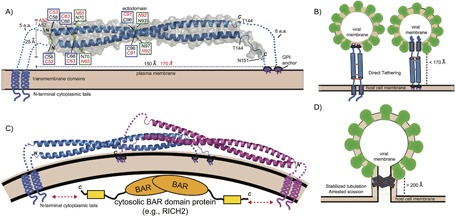
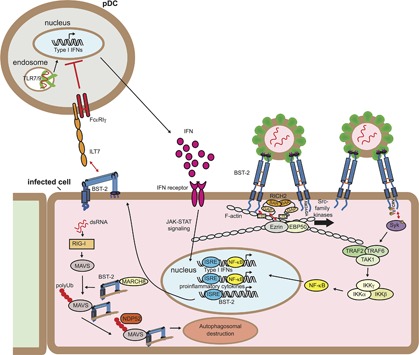
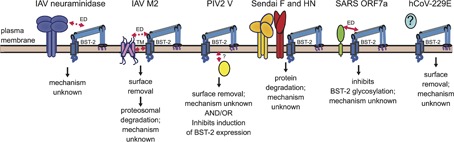
Recent findings regarding the cellular biology and immunology of BST-2 (also known as tetherin) indicate that its function could be exploited as a universal replication inhibitor of enveloped respiratory viruses (e.g., influenza, respiratory syncytial virus, etc.). BST-2 inhibits viral replication by preventing virus budding from the plasma membrane and by inducing an antiviral state in cells adjacent to infection via unique inflammatory signaling mechanisms. This review presents the first comprehensive summary of what is currently known about BST-2 anti-viral function against respiratory viruses, how these viruses construct countermeasures to antagonize BST-2, and how BST-2 function might be targeted to develop therapies to treat respiratory virus infections. The authors address the current gaps in knowledge, including the need for mechanistic understanding of BST-2 antagonism by respiratory viruses, that should be bridged to achieve that goal.
最近关于 BST-2(也称为 tetherin)的细胞生物学和免疫学的研究结果表明,其功能可以被利用作为包膜呼吸道病毒(例如流感、呼吸道合胞病毒等)的通用复制抑制剂。BST-2 通过阻止病毒从质膜出芽和通过独特的炎症信号机制诱导感染相邻细胞的抗病毒状态来抑制病毒复制。这篇综述首次全面总结了目前已知的 BST-2 对呼吸道病毒的抗病毒功能,这些病毒如何构建对抗 BST-2 的对策,以及如何靶向 BST-2 功能来开发治疗呼吸道病毒感染的疗法。作者讨论了当前知识的空白,包括需要对呼吸道病毒拮抗 BST-2 的机制进行深入了解,以实现这一目标。