Department of Health Technology and Informatics, Faculty of Health and Social Sciences, The Hong Kong Polytechnic University, Hung Hom, Kowloon, Hong Kong.
School of Public Health, Li Ka Shing Faculty of Medicine, The University of Hong Kong, Pokfulam, Hong Kong.
PLoS One. 2018 Aug 16;13(8):e0201585. doi: 10.1371/journal.pone.0201585. eCollection 2018.
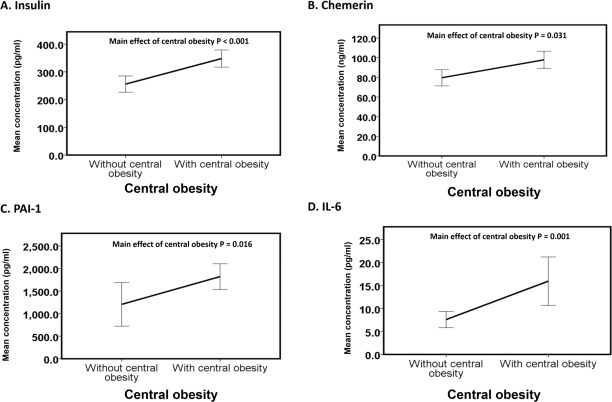
Metabolic syndrome (MetS) or prediabetes is a complex disorder that is defined by a clustering of cardiometabolic risk factors, including obesity, hypertriglyceridemia, reduced high-density lipoprotein (HDL) cholesterol, hypertension, and insulin resistance. Among cardiometabolic risk factors, central obesity plays a key role in the development of MetS through alterations in the secretion of adipokines and interacts with other MetS risk factors to unfavorably influence overall cardiometabolic risk. Obesity has grasped epidemic proportions in Asia, which has the highest number of people with diabetes in the world. But, the importance of central obesity in the clustering of all four MetS risk factors or vice versa in predicting severity of MetS has not yet been investigated in Asian population. Therefore, the present study examined the influence of central obesity on circulating levels of adipokines through its interaction with the clustering of cardiometabolic risk factors of MetS including hyperglycemia, hypertriglyceridemia, dyslipidemia and hypertension in Hong Kong Chinese adults.
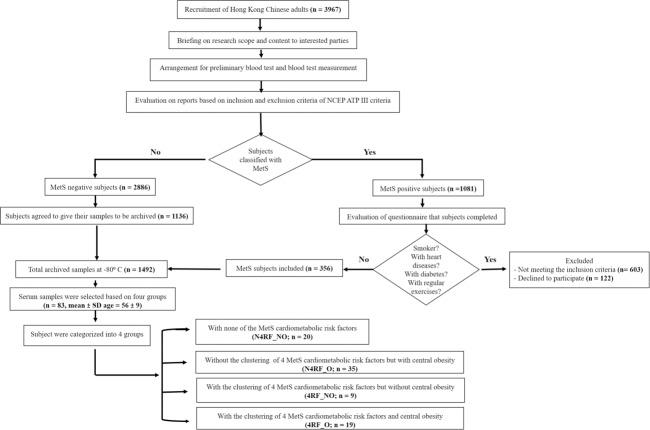
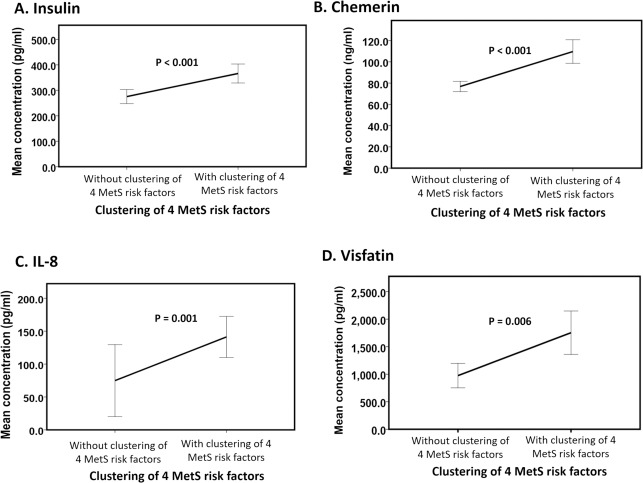
Blood samples from 83 Hong Kong Chinese adults, who were previously screened for MetS according to the guideline of the United States National Cholesterol Education Program Expert Panel Adult Treatment Panel III criteria were selected. Insulin and adipokines, including visfatin, chemerin, plasminogen activator inhibitor-1 (PAI-1), resistin, C-C motif chemokine ligand 2 (CCL-2), interleukin-6 (IL-6), interleukin-8 (IL-8), interleukin-10 (IL-10), tumour necrosis factor-α (TNF-α), leptin and adiponectin were assessed.
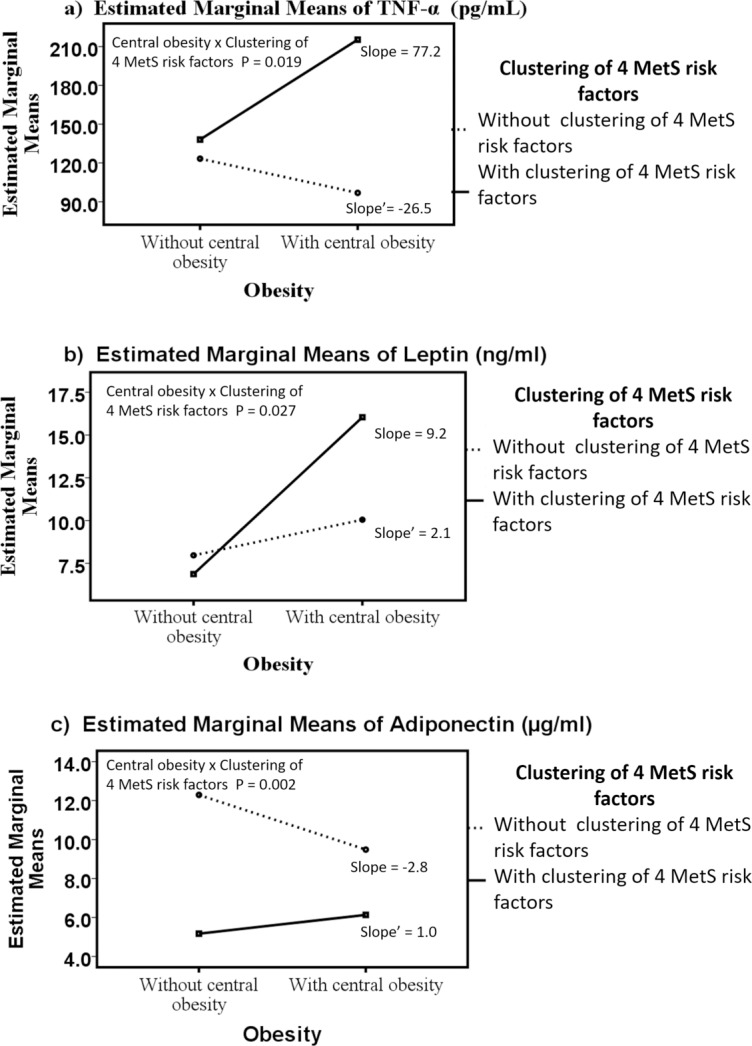
The interacting effect of central obesity with all of the other four MetS risk factors increased the proinflammatory status of adipokines (TNF-α, leptin) and decreased the anti-inflammatory status of adipokine (adiponectin).
Our results indicate that the inflammatory status of MetS may be more severe in the presence of central obesity. Adipokines, as biomarkers for pathophysiological changes, may help to improve early patient identification and to predict MetS-associated morbidity and mortality.
代谢综合征(MetS)或糖尿病前期是一种复杂的疾病,其特征是心血管代谢风险因素的聚集,包括肥胖、高甘油三酯血症、高密度脂蛋白(HDL)胆固醇降低、高血压和胰岛素抵抗。在心血管代谢风险因素中,中心性肥胖通过改变脂肪因子的分泌在 MetS 的发展中起关键作用,并与其他 MetS 风险因素相互作用,不利地影响整体心血管代谢风险。肥胖在亚洲已经达到流行程度,亚洲是世界上糖尿病患者人数最多的地区。但是,中心性肥胖在所有四个 MetS 风险因素的聚集中的重要性,或者反之,在预测 MetS 的严重程度方面,在亚洲人群中尚未得到研究。因此,本研究通过其与 MetS 的心血管代谢风险因素的聚集(包括高血糖、高甘油三酯血症、血脂异常和高血压)的相互作用,检查了中心性肥胖对循环脂肪因子水平的影响。
从先前根据美国国家胆固醇教育计划专家小组成人治疗小组 III 标准筛选出 MetS 的 83 名香港华人成年人中选取了血液样本。评估了胰岛素和脂肪因子,包括内脏脂肪素、趋化素、纤溶酶原激活物抑制剂-1(PAI-1)、抵抗素、C-C 基序趋化因子配体 2(CCL-2)、白细胞介素-6(IL-6)、白细胞介素-8(IL-8)、白细胞介素-10(IL-10)、肿瘤坏死因子-α(TNF-α)、瘦素和脂联素。
中心性肥胖与其他四个 MetS 风险因素的相互作用增加了脂肪因子的促炎状态(TNF-α、瘦素),降低了脂肪因子的抗炎状态(脂联素)。
我们的结果表明,存在中心性肥胖时,MetS 的炎症状态可能更为严重。脂肪因子作为病理生理变化的生物标志物,可能有助于改善早期患者识别,并预测 MetS 相关的发病率和死亡率。