Murdoch Childrens Research Institute, 50 Flemington Rd, Parkville, VIC, 3052, Australia.
Department of Paediatrics, The University of Melbourne, 50 Flemington Rd, Parkville, VIC, 3052, Australia.
BMC Pregnancy Childbirth. 2018 Aug 16;18(1):334. doi: 10.1186/s12884-018-1966-z.
Recruitment of pregnant women to population health research can be challenging, especially if the research topic is sensitive. While many pregnant women may be inherently interested in research about pregnancy, there is the possibility that the nature and timing of the project may give rise to anxiety in some women, especially if the topic is sensitive or it brings about new awareness of potential pregnancy complications. Research staff undertaking recruitment need to be skilled at strategies to manage the environment, and have well developed communication and interpersonal skills to explain and promote the study and facilitate each woman's informed decision-making regarding participation. However, the skills needed by recruitment staff to successfully engage pregnant women with a research topic are not well understood. This study aimed to address this evidence gap by providing insight into the dynamics between a pregnant woman and recruitment staff at the time of the offer to participate in an observational study about alcohol use in pregnancy.
Naturalistic inquiry guided a qualitative exploratory descriptive approach. Experienced recruitment staff from the Asking Questions about Alcohol in Pregnancy (AQUA) study (Muggli et al., BMC Pregnancy Childbirth 14:302, 2014) participated in individual semi-structured interviews and were asked about their experiences and approaches to engaging pregnant women. Interviews were transcribed verbatim and analysed using inductive content analysis.
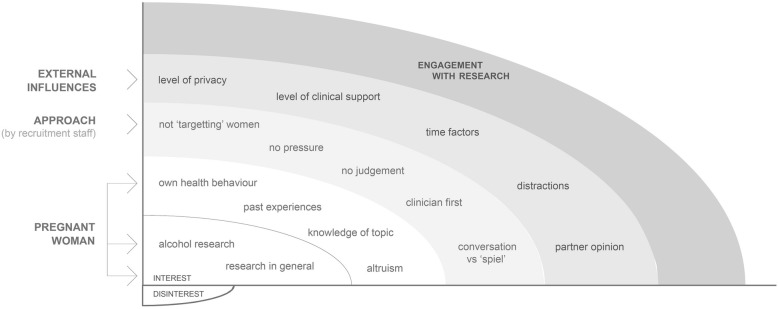
Pregnant women brought with them an inherent interest or disinterest in alcohol research, or in research in general, which formed the basis for engagement. Women responded favourably to the invitation to participate being delivered without pressure, and as part of a two-way conversation. Engagement with a sensitive topic such as alcohol use in pregnancy was facilitated by a non-judgmental and non-targeted approach. Influences such as privacy, distractions, partner's opinion, time factors and level of clinical support either facilitated or hindered a woman's engagement with the research.
These results provide an in-depth explanation of barriers and enablers to recruitment of pregnant women in antenatal clinics to studies that may inform strategies and the training of recruitment staff.
招募孕妇参与人群健康研究可能具有挑战性,特别是如果研究主题较为敏感。虽然许多孕妇可能对与妊娠相关的研究本身感兴趣,但项目的性质和时间安排有可能引起一些女性的焦虑,特别是如果话题敏感或使她们对潜在的妊娠并发症有了新的认识。从事招募工作的研究人员需要具备管理环境的技能,并且具有良好的沟通和人际交往能力,以便解释和推广研究,并促进每位女性在参与研究方面做出知情决策。然而,成功让孕妇参与研究主题的招募人员所需的技能尚不清楚。本研究旨在通过深入了解孕妇与招募人员在提供参与关于妊娠期间饮酒的观察性研究时的动态关系,来解决这一证据空白。
自然主义探究指导了一项定性探索性描述方法。来自 Asking Questions about Alcohol in Pregnancy (AQUA) 研究的有经验的招募人员(Muggli 等人,BMC Pregnancy Childbirth 14:302, 2014)参与了单独的半结构化访谈,并被问及他们在参与孕妇方面的经验和方法。访谈逐字记录并进行了归纳内容分析。
孕妇对酒精研究或一般研究本身的固有兴趣或不感兴趣,这构成了参与的基础。孕妇对没有压力的邀请表示欢迎,并作为双向对话的一部分。对像妊娠期间饮酒这样的敏感话题的参与是通过非评判性和非针对性的方法来促进的。隐私、干扰、伴侣的意见、时间因素和临床支持水平等因素促进或阻碍了女性对研究的参与。
这些结果深入解释了在产前诊所招募孕妇参与可能为策略制定和招募人员培训提供信息的研究的障碍和促进因素。