Liu Xinwei, Gu Xiaochuan, Yu Miaomiao, Zi Ying, Yu Hailong, Wang Yu, Xie Yanchun, Xiang Liangbi
Department of Orthopedics, Rescue Center of Severe Wound and Trauma of the PLA, General Hospital of Shenyang Military Area Command, Shenyang, Liaoning 110016, P.R. China.
Department of Orthopedics, Changhai Hospital Αffiliated to The Second Military Medical University, Shanghai 200433, P.R. China.
Exp Ther Med. 2018 Aug;16(2):1079-1086. doi: 10.3892/etm.2018.6286. Epub 2018 Jun 12.
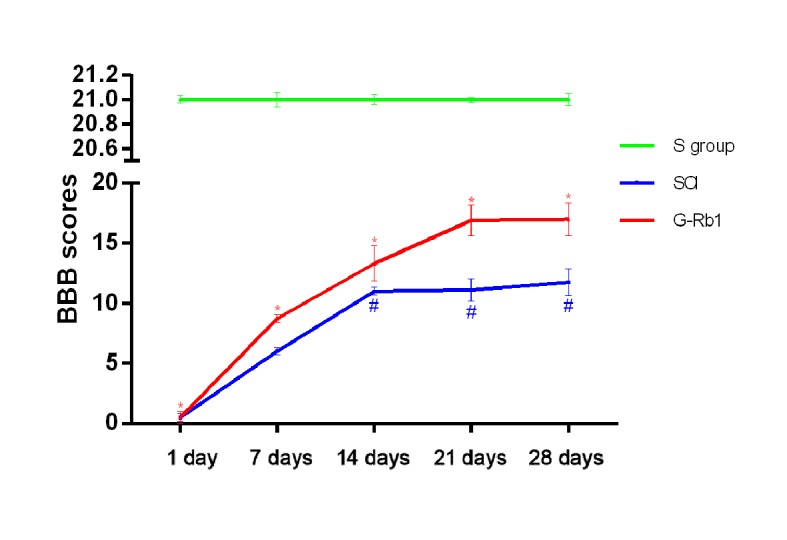
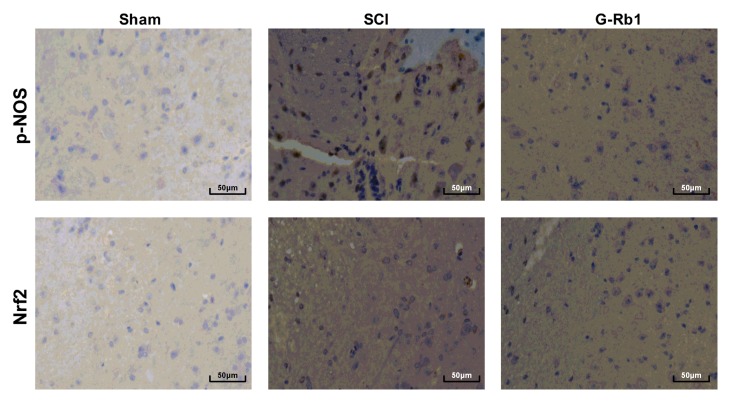
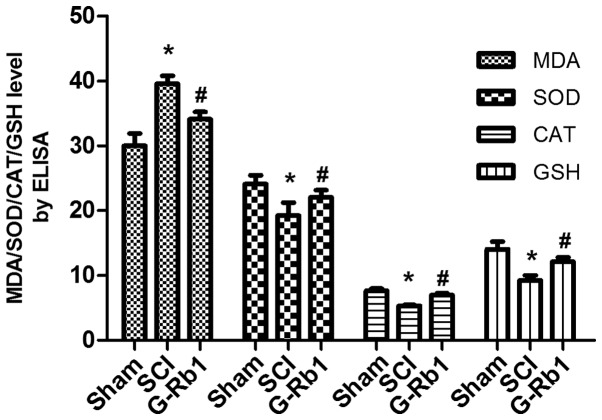
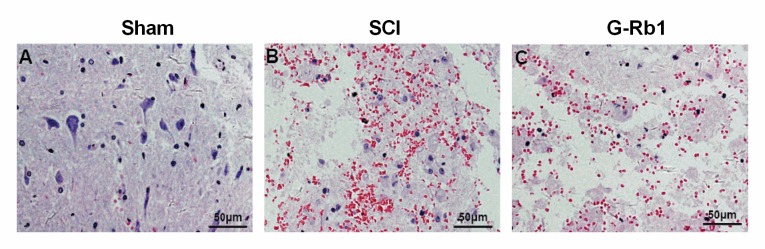
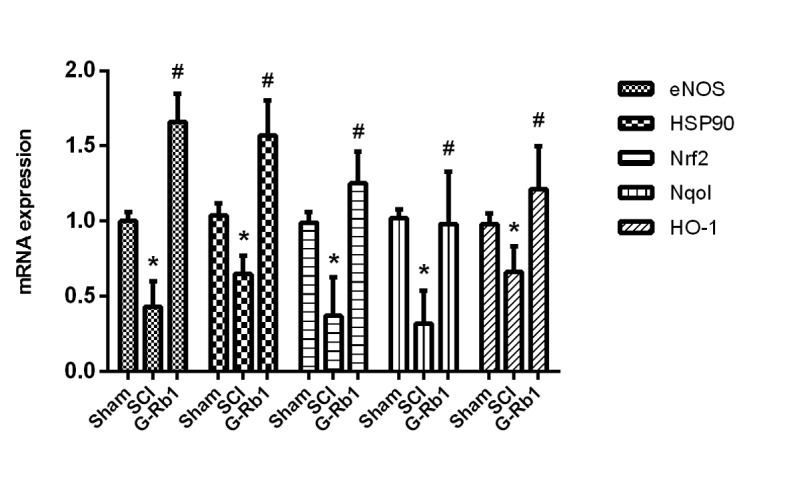
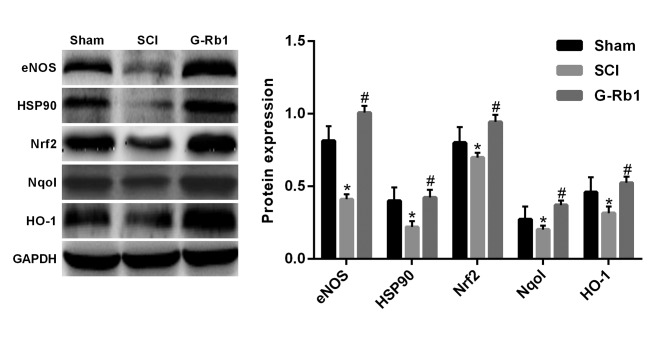
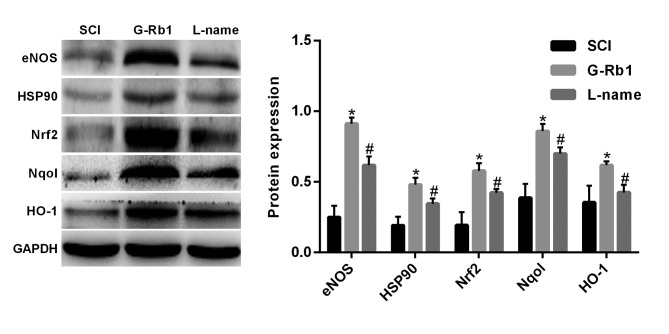
The present study aimed to investigate whether ginsenoside Rb1 (G-Rb1) attenuates spinal cord injury-associated oxidative stress in rats by regulating the endothelial nitric oxide synthase eNOS/nuclear factor erythroid 2-related factor 2 (Nrf2)/heme oxygenase (HO)-1 signaling pathway. Sprague Dawley rats were randomly divided into the sham operation group (S group), spinal cord injury group (SCI group), G-Rb1 treatment group (G-Rb1 group) and SCI+G-Rb1+Inhibitor L-name group (L-name group). The posterior limb function was evaluated via the Basso, Beattie and Bresnahan scoring method. The levels of superoxide dismutase (SOD), malondialdehyde (MDA), catalase (CAT) and glutathione (GSH) in serum were measured by ELISA. The pathological changes in the spinal cord were observed by H&E staining. Reverse transcription-quantitative polymerase chain reaction and western blot analyses were used to detect eNOS, phosphorylated (p)-eNOS, heat shock protein (HSP)90, Nrf2 and NAD(P)H quinone dehydrogenase 1 (Nqo1) at the mRNA and protein level. Immunohistochemistry was used to detect the expression of Nrf2 and p-eNOS. Compared with the S group, the scores of spinal cord function in the SCI group were significantly lower, and the levels of MDA were significantly increased, while the levels of SOD, CAT and GSH protein in spinal cord were significantly decreased (P<0.05). The spinal cord tissue exhibited hemorrhage, neuronal degeneration/necrosis, as well as mononuclear cell and lymphocyte infiltration. The eNOS, HSP90, Nrf2, Nqo1 and HO-1 mRNA levels were decreased (P<0.05). Compared with those in the SCI group, the spinal cord function score in the G-Rb1 group were significantly higher and the serum MDA content was significantly decreased, while the activity of SOD, CAT and GSH was significantly increased (P<0.05). The degeneration/necrosis of spinal cord neurons was attenuated, inflammatory cell infiltration was significantly reduced and the levels of eNOS, HSP90, Nrf2, Nqo1 and HO-1 were significantly upregulated (P<0.05). In the group that was administered the eNOS inhibitor L-name, the levels of eNOS, HSP90, Nrf2, Nqo1 and HO-1 were significantly decreased. In conclusion, G-Rb1 attenuates oxidative stress in injured spinal cords. The mechanism may at least in part involve the eNOS/Nrf2/HO-1 pathway.
本研究旨在探讨人参皂苷Rb1(G-Rb1)是否通过调节内皮型一氧化氮合酶(eNOS)/核因子红细胞2相关因子2(Nrf2)/血红素加氧酶(HO)-1信号通路减轻大鼠脊髓损伤相关的氧化应激。将Sprague Dawley大鼠随机分为假手术组(S组)、脊髓损伤组(SCI组)、G-Rb1治疗组(G-Rb1组)和SCI+G-Rb1+抑制剂L-精氨酸甲酯组(L-name组)。通过Basso、Beattie和Bresnahan评分方法评估后肢功能。采用酶联免疫吸附测定法(ELISA)检测血清中超氧化物歧化酶(SOD)、丙二醛(MDA)、过氧化氢酶(CAT)和谷胱甘肽(GSH)的水平。通过苏木精-伊红(H&E)染色观察脊髓的病理变化。采用逆转录-定量聚合酶链反应和蛋白质印迹分析检测eNOS、磷酸化(p)-eNOS、热休克蛋白(HSP)90、Nrf2和NAD(P)H醌脱氢酶1(Nqo1)的mRNA和蛋白水平。采用免疫组织化学法检测Nrf2和p-eNOS的表达。与S组相比,SCI组脊髓功能评分显著降低,MDA水平显著升高,而脊髓中SOD、CAT和GSH蛋白水平显著降低(P<0.05)。脊髓组织出现出血、神经元变性/坏死以及单核细胞和淋巴细胞浸润。eNOS、HSP90、Nrf2、Nqo1和HO-1的mRNA水平降低(P<0.05)。与SCI组相比,G-Rb1组脊髓功能评分显著升高,血清MDA含量显著降低,而SOD、CAT和GSH活性显著升高(P<0.05)。脊髓神经元的变性/坏死减轻,炎性细胞浸润显著减少,eNOS、HSP90、Nrf2、Nqo1和HO-1水平显著上调(P<0.05)。在给予eNOS抑制剂L-精氨酸甲酯的组中,eNOS、HSP90、Nrf2、Nqo1和HO-1水平显著降低。综上所述,G-Rb1减轻受损脊髓的氧化应激。其机制可能至少部分涉及eNOS/Nrf2/HO-1通路。