Nathan Steven D, Lancaster Lisa H, Albera Carlo, Glassberg Marilyn K, Swigris Jeffrey J, Gilberg Frank, Kirchgaessler Klaus-Uwe, Limb Susan L, Petzinger Ute, Noble Paul W
Inova Fairfax Hospital, Falls Church, Virginia, USA.
Vanderbilt University Medical Center, Nashville, Tennessee, USA.
BMJ Open Respir Res. 2018 Aug 2;5(1):e000323. doi: 10.1136/bmjresp-2018-000323. eCollection 2018.
Temporary dose modifications, such as reductions or interruptions, may allow patients to better manage adverse events (AEs) associated with pirfenidone use and continue treatment for idiopathic pulmonary fibrosis (IPF). However, the impact of such dosing adjustments on efficacy and safety is uncertain.
Patients randomised to receive treatment with pirfenidone 2403 mg/day or placebo in the Clinical Studies Assessing Pirfenidone in Idiopathic Pulmonary Fibrosis: Research of Efficacy and Safety Outcomes (CAPACITY (Study 004 (NCT00287716)) and Study 006 (NCT00287729))) and Assessment of Pirfenidone to Confirm Efficacy and Safety in Idiopathic Pulmonary Fibrosis (ASCEND (Study 016 (NCT01366209)) trials were included in the analysis (n=1247). Descriptive statistics and a linear mixed-effects model (slope analysis) for annual rate of decline in forced vital capacity (FVC) by dose intensity were performed. Treatment-emergent AEs (TEAEs) were summarised and grouped by dose intensity or body size.
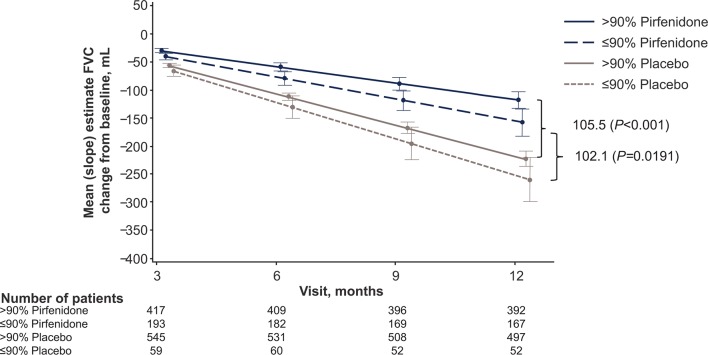
Dose reductions and interruptions occurred in 76.9% (95% CI 73.4% to 80.1%) and 46.5% (95% CI 42.6% to 50.6%) of patients receiving pirfenidone vs 72.0% (95% CI 68.3% to 75.4%) and 31.1% (95% CI 27.5% to 34.9%) of patients receiving placebo, respectively. Dose interruptions tended to occur during the first 6 months of treatment, whereas dose reductions exhibited more variability. Less FVC decline from baseline was observed in patients receiving pirfenidone versus placebo at >90% dose intensity (p<0.001) or ≤90% dose intensity (p=0.0191), showing treatment benefit in both subgroups of dose intensity. No meaningful relationship between weight and TEAEs was observed.
Dose interruptions, which may be required to manage TEAEs, mostly occurred during the first 6 months of treatment. Despite dose reductions and interruptions, most patients with IPF maintained relatively high dose intensity on pirfenidone, without compromising its treatment effect compared with placebo.
NCT00287729, NCT00287716, NCT01366209.
临时调整剂量,如减少或中断用药,可能有助于患者更好地应对与使用吡非尼酮相关的不良事件(AE),并继续接受特发性肺纤维化(IPF)的治疗。然而,这种剂量调整对疗效和安全性的影响尚不确定。
在评估吡非尼酮治疗特发性肺纤维化的疗效和安全性结果的临床研究(CAPACITY(研究004(NCT00287716))和研究006(NCT00287729))以及确认吡非尼酮在特发性肺纤维化中的疗效和安全性评估(ASCEND(研究016(NCT01366209))试验中,随机接受2403毫克/天吡非尼酮治疗或安慰剂治疗的患者被纳入分析(n = 1247)。进行了描述性统计和基于剂量强度的用力肺活量(FVC)年下降率的线性混合效应模型(斜率分析)。对治疗中出现的不良事件(TEAE)进行总结,并按剂量强度或体型分组。
接受吡非尼酮治疗的患者中,分别有76.9%(95%置信区间73.4%至80.1%)和46.5%(95%置信区间42.6%至50.6%)出现剂量减少和中断;而接受安慰剂治疗的患者中,这两个比例分别为72.0%(95%置信区间68.3%至75.4%)和31.1%(95%置信区间27.5%至34.9%)。剂量中断往往发生在治疗的前6个月,而剂量减少则表现出更大的变异性。在剂量强度>90%(p<0.001)或≤90%(p = 0.0191)时,接受吡非尼酮治疗的患者与接受安慰剂治疗的患者相比,FVC从基线的下降幅度更小,表明在两个剂量强度亚组中均有治疗益处。未观察到体重与TEAE之间存在有意义的关系。
为应对TEAE可能需要进行的剂量中断大多发生在治疗的前6个月。尽管有剂量减少和中断情况,但大多数IPF患者在吡非尼酮治疗上仍维持了相对较高的剂量强度,并与安慰剂相比未损害其治疗效果。
NCT00287729、NCT00287716、NCT01366209。