Costa-Silva Miguel, Calistru Ana, Barros Ana Margarida, Lopes Sofia, Esteves Mariana, Azevedo Filomena
Department of Dermatology and Venereology, Centro Hospitalar São João, EPE Porto, Portugal.
Dermatol Pract Concept. 2018 Jul 31;8(3):198-203. doi: 10.5826/dpc.0803a10. eCollection 2018 Jul.
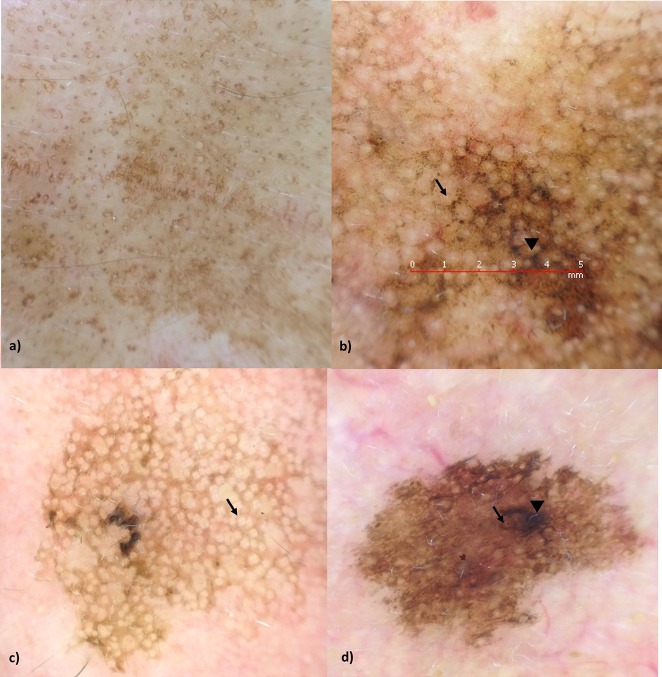
Recognition of facial lentigo maligna (LM) is often difficult, particularly at early stages. Algorithms and multivariate diagnostic models have recently been elaborated on the attempt to improve the diagnostic accuracy. We conducted a cross-sectional and retrospective study to evaluate dermatoscopic criteria aiding in diagnosis of flat pigmented facial lesions (FPFL). We examined 46 FPFL in 42 Caucasian patients and found that 4 of 20 dermatoscopic criteria reached the significance level required for features indicating malignancy namely, hyperpigmented follicular openings, obliterated follicular opening, annular-granular structures, and pigment rhomboids. Concomitant presence of at least 2 or 3 of the 4 mentioned criteria was significantly more frequent in LM than in pigmented actinic keratosis (PAK). However, despite more frequently seen in LM, these features were also displayed in some of the PAK and other FPFL, so we found them not specific for LM. Although dermatoscopy enhances the diagnostic accuracy in evaluating FPFL, histopathology remains the gold standard for correct diagnosis, making evident the need for improvements in early noninvasive diagnosis of LM.
面部恶性雀斑样痣(LM)的识别通常很困难,尤其是在早期阶段。最近已经开发了算法和多变量诊断模型,试图提高诊断准确性。我们进行了一项横断面回顾性研究,以评估有助于诊断面部扁平色素性病变(FPFL)的皮肤镜标准。我们检查了42例白种人患者的46个FPFL,发现20个皮肤镜标准中的4个达到了表明恶性特征所需的显著性水平,即色素沉着的毛囊开口、闭塞的毛囊开口、环状颗粒结构和色素菱形。在LM中,上述4个标准中至少有2个或3个同时出现的频率明显高于色素性光化性角化病(PAK)。然而,尽管这些特征在LM中更常见,但在一些PAK和其他FPFL中也有表现,因此我们发现它们对LM不具有特异性。尽管皮肤镜检查提高了评估FPFL的诊断准确性,但组织病理学仍然是正确诊断的金标准,这凸显了改进LM早期非侵入性诊断的必要性。