G0 Cell Unit, Okinawa Institute of Science and Technology Graduate University (OIST), Onna, Okinawa, Japan.
Research Support Imaging Section, OIST, Onna, Okinawa, Japan.
Sci Adv. 2018 Aug 15;4(8):eaat5685. doi: 10.1126/sciadv.aat5685. eCollection 2018 Aug.
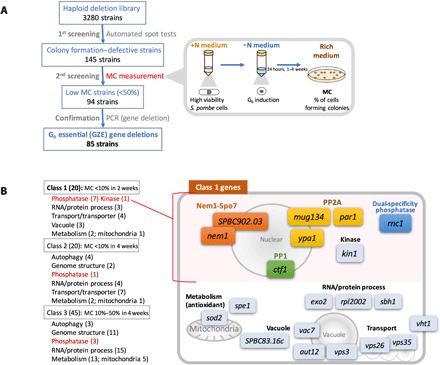
Quiescent (G phase) cells must maintain mitotic competence (MC) to restart the cell cycle. This is essential for reproduction in unicellular organisms and also for development and cell replacement in higher organisms. Recently, suppression of MC has gained attention as a possible therapeutic strategy for cancer. Using a deletion-mutant library, we identified 85 genes required to maintain MC during the G phase induced by nitrogen deprivation. G cells must recycle proteins and RNA, governed by anabolism, catabolism, transport, and availability of small molecules such as antioxidants. Protein phosphatases are also essential to maintain MC. In particular, Nem1-Spo7 protects the nucleus from autophagy by regulating Ned1, a lipin. These genes, designated GZE (G-Zero Essential) genes, reveal the landscape of genetic regulation of MC.
静止期(G 期)细胞必须维持有丝分裂能力(MC)以重新启动细胞周期。这对于单细胞生物的繁殖以及高等生物的发育和细胞替换至关重要。最近,抑制 MC 作为癌症的一种潜在治疗策略受到了关注。利用缺失突变体文库,我们鉴定了 85 个在氮饥饿诱导的 G 期维持 MC 所必需的基因。G 期细胞必须循环利用蛋白质和 RNA,受合成代谢、分解代谢、运输以及抗氧化剂等小分子的可用性调控。蛋白磷酸酶对维持 MC 也至关重要。特别是,Nem1-Spo7 通过调节 Ned1(一种脂肪酶)来保护细胞核免受自噬。这些基因被命名为 GZE(G0 必需)基因,揭示了 MC 的遗传调控全景。