Research Center for Tissue Engineering and Regenerative Medicine, Union Hospital, Tongji Medical College, Huazhong University of Science and Technology, Wuhan, 430022, China.
Department of Gastrointestinal Surgery, Union Hospital, Tongji Medical College, Huazhong University of Science and Technology, Wuhan, 430022, China.
J Exp Clin Cancer Res. 2018 Aug 17;37(1):196. doi: 10.1186/s13046-018-0839-7.
Interleukin-33 (IL-33) participates in various types of diseases including cancers. Previous studies of this cytokine in cancers mainly focused on its regulation on immune responses by which IL-33 modulated cancer progression. The IL-33 triggered signals in cancer cells remain unclear.
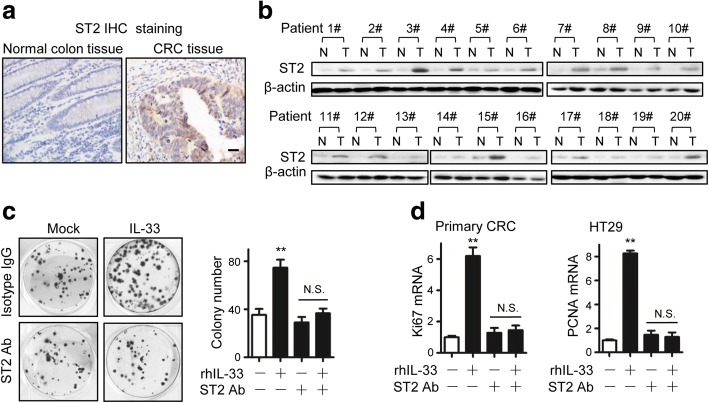
We analyzed IL-33 gene expression in human colorectal cancer (CRC) tissues and carried out gene enrichment analysis with TCGA Data Portal. We studied CRC proliferation in vivo by inoculating MC38 tumors in IL-33 transgenic mice. We investigated the cell proliferation in vitro with primary CRC cells isolated from fresh human CRC tissues, human CRC cell line HT-29 and mouse CRC cell line MC38. To evaluate the proliferation modulating effects of recombinant IL-33 incubation and other administrated factors, we measured tumor growth, colony formation, cell viability, and the expression of Ki67 and proliferating cell nuclear antigen (PCNA). We used several inhibitors, prostaglandin E2 (PGE) neutralizing antibody, ST2 blocking antibody and specific shRNA expressing plasmid to study the pathway mediating IL-33-induced CRC proliferation. The IL-33 receptor ST2 in human CRC tissues was detected by immunohistochemistry staining and western blotting. The ST2-positive or negative subsets of primary CRC cells were acquired by flow cytometry sorting.
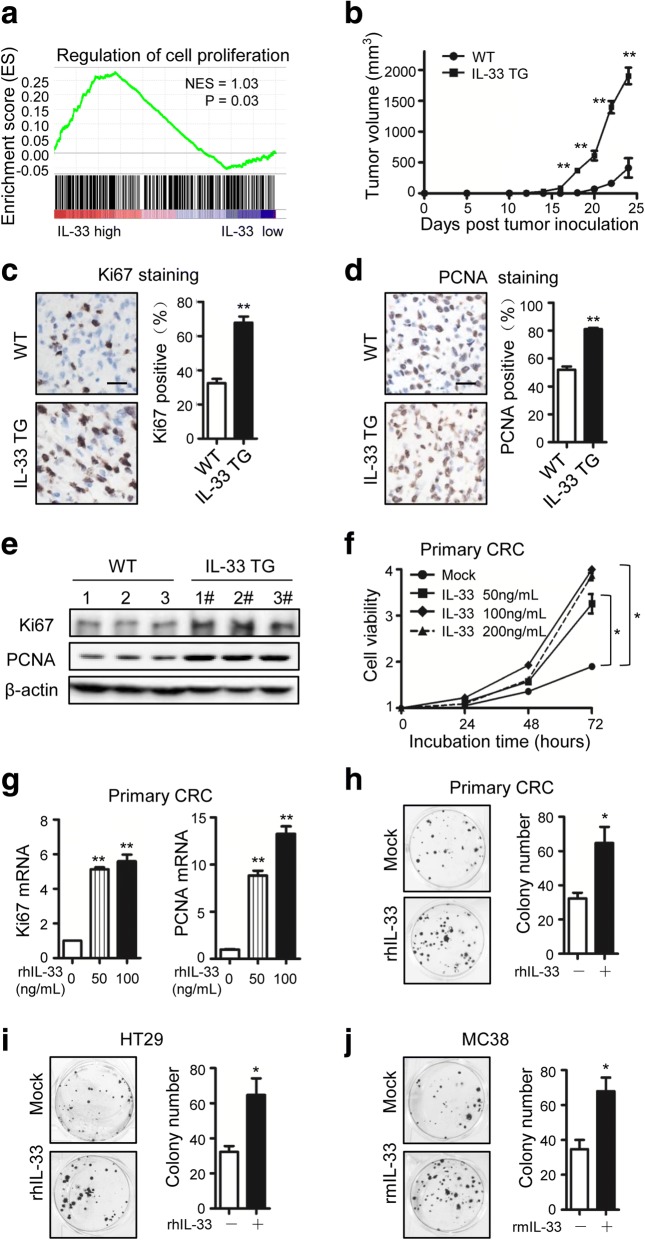
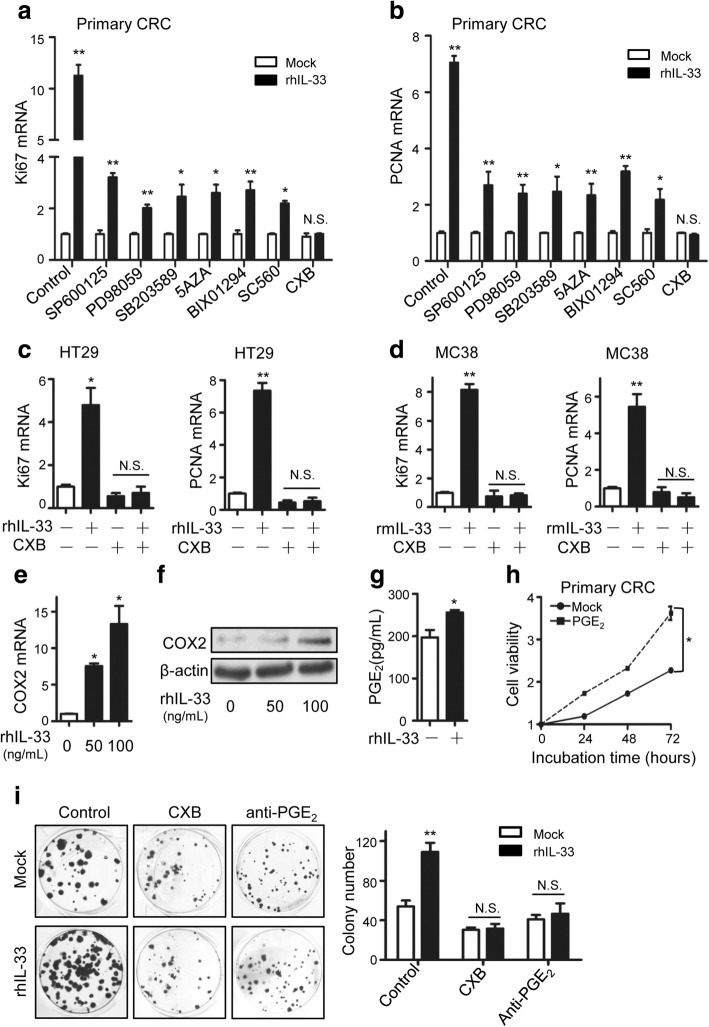
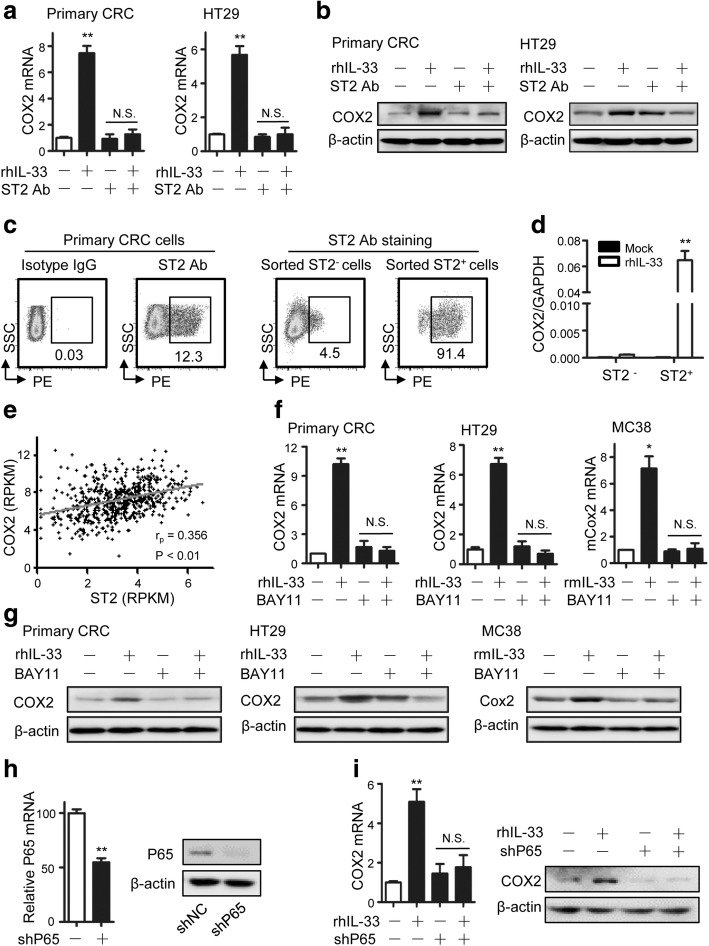
We found that IL-33 expression was correlated with the gene signature of cell proliferation in 394 human CRC samples. The MC38 tumors grew more rapidly and the tumor Ki67 and PCNA were expressed at higher levels in IL-33 transgenic mice than in wild-type mice. IL-33 promoted cell growth, colony formation and expression of Ki67 and PCNA in primary CRC cells as well as CRC cell lines. IL-33 activated cycloxygenase-2 (COX2) expression and increased PGE production, whereas the COX2 selective inhibitor and PGE neutralizing antibody abolished the proliferation promoting effect of IL-33. ST2 blockade, ST2-negative sorting, NF-κB specific inhibitor and NF-κB specific shRNA (shP65) abrogated the COX2 induction caused by IL-33.
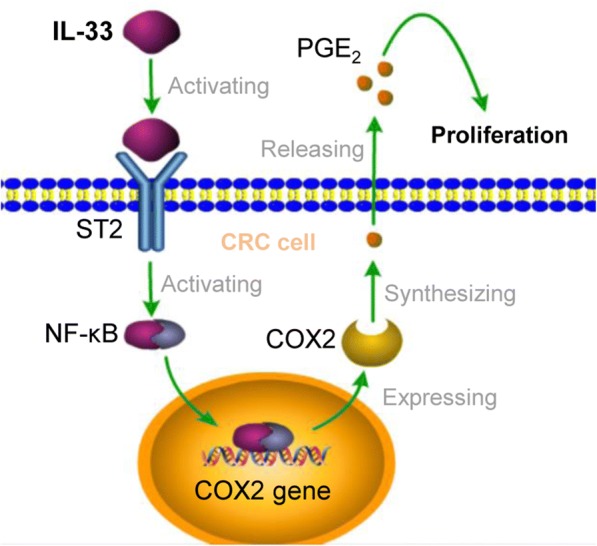
IL-33 facilitates proliferation of colorectal cancer dependent on COX2/PGE. IL-33 functions via its receptor ST2 and upregulates COX2 expression through NF-κB signaling. Understanding the IL-33 signal transduction in CRC cells provides potential therapeutic targets for clinical treatment.
白细胞介素-33(IL-33)参与多种疾病,包括癌症。以前对这种细胞因子在癌症中的研究主要集中在其对免疫反应的调节上,通过这种调节,IL-33调节癌症的进展。IL-33 在癌细胞中的触发信号尚不清楚。
我们分析了人结直肠癌(CRC)组织中 IL-33 基因的表达,并通过 TCGA 数据门户进行了基因富集分析。我们通过在 IL-33 转基因小鼠中接种 MC38 肿瘤来研究 CRC 的体内增殖。我们使用从新鲜人 CRC 组织中分离的原代 CRC 细胞、人 CRC 细胞系 HT-29 和鼠 CRC 细胞系 MC38 研究体外细胞增殖。为了评估重组 IL-33 孵育和其他给药因素的增殖调节作用,我们测量了肿瘤生长、集落形成、细胞活力以及 Ki67 和增殖细胞核抗原(PCNA)的表达。我们使用了几种抑制剂、前列腺素 E2(PGE)中和抗体、ST2 阻断抗体和表达特异性 shRNA 的质粒来研究介导 IL-33 诱导的 CRC 增殖的途径。通过免疫组织化学染色和 Western blot 检测人 CRC 组织中的 IL-33 受体 ST2。通过流式细胞术分选获得 ST2 阳性或阴性原代 CRC 细胞亚群。
我们发现,IL-33 的表达与 394 个人 CRC 样本中细胞增殖的基因特征相关。与野生型小鼠相比,IL-33 转基因小鼠的 MC38 肿瘤生长更快,肿瘤 Ki67 和 PCNA 的表达水平更高。IL-33 促进原代 CRC 细胞和 CRC 细胞系的细胞生长、集落形成以及 Ki67 和 PCNA 的表达。IL-33 激活环氧化酶-2(COX2)表达并增加 PGE 产生,而 COX2 选择性抑制剂和 PGE 中和抗体消除了 IL-33 促进增殖的作用。ST2 阻断、ST2 阴性分选、NF-κB 特异性抑制剂和 NF-κB 特异性 shRNA(shP65)消除了 IL-33 引起的 COX2 诱导。
IL-33 促进结直肠癌细胞的增殖依赖于 COX2/PGE。IL-33 通过其受体 ST2 发挥作用,并通过 NF-κB 信号通路上调 COX2 的表达。了解 CRC 细胞中的 IL-33 信号转导为临床治疗提供了潜在的治疗靶点。