Food Microbiology, Wageningen University & Research, P.O. Box 17, 6700AA, Wageningen, The Netherlands.
BMC Genomics. 2018 Aug 17;19(1):620. doi: 10.1186/s12864-018-5005-2.
Important industrial traits have been linked to plasmids in Lactococcus lactis.
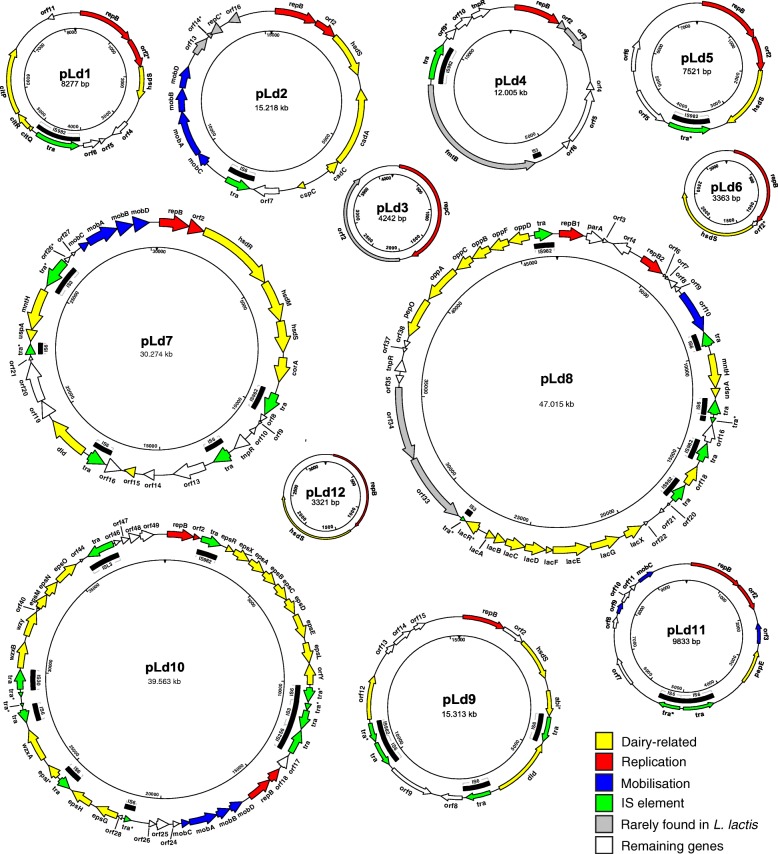
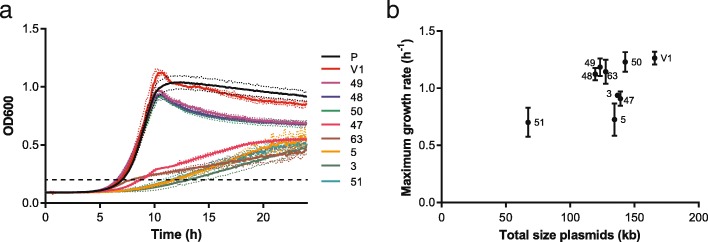
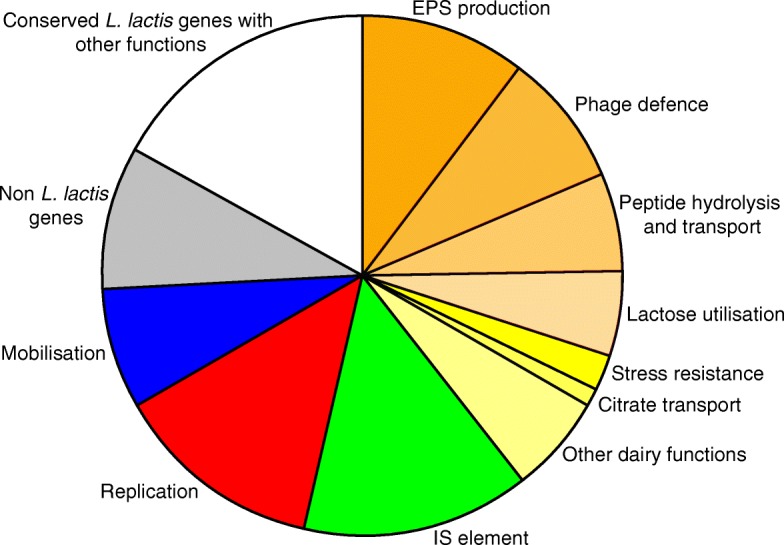
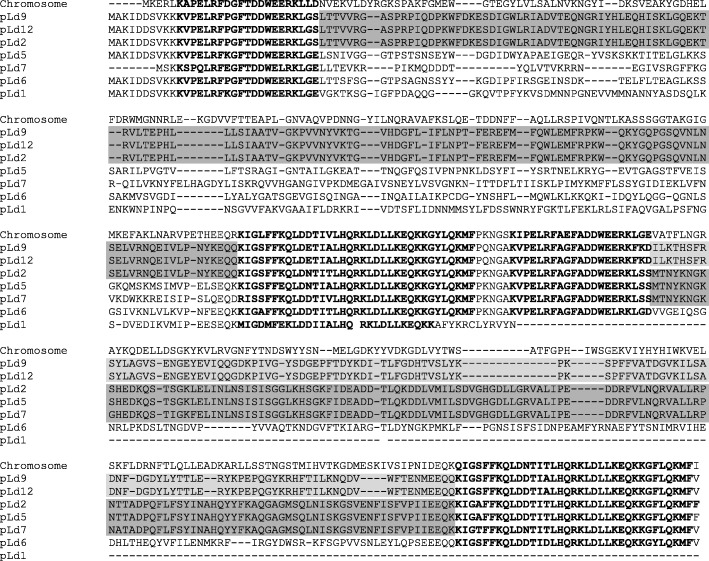
The dairy isolate L. lactis subsp. lactis biovar diacetylactis FM03P was sequenced revealing the biggest plasmidome of all completely sequenced and published L. lactis strains up till now. The 12 plasmids that were identified are: pLd1 (8277 bp), pLd2 (15,218 bp), pLd3 (4242 bp), pLd4 (12,005 bp), pLd5 (7521 bp), pLd6 (3363 bp), pLd7 (30,274 bp), pLd8 (47,015 bp), pLd9 (15,313 bp), pLd10 (39,563 bp), pLd11 (9833 bp) and pLd12 (3321 bp). Structural analysis of the repB promoters and the RepB proteins showed that eleven of the plasmids replicate via the theta-type mechanism, while only plasmid pLd3 replicates via a rolling-circle replication mechanism. Plasmids pLd2, pLd7 and pLd10 contain a highly similar operon involved in mobilisation of the plasmids. Examination of the twelve plasmids of L. lactis FM03P showed that 10 of the plasmids carry putative genes known to be important for growth and survival in the dairy environment. These genes encode technological functions such as lactose utilisation (lacR-lacABCDFEGX), citrate uptake (citQRP), peptide degradation (pepO and pepE) and oligopeptide uptake (oppDFBCA), uptake of magnesium and manganese (2 mntH, corA), exopolysaccharides production (eps operon), bacteriophage resistance (1 hsdM, 1 hsdR and 7 different hsdS genes of a type I restriction-modification system, an operon of three genes encoding a putative type II restriction-modification system and an abortive infection gene) and stress resistance (2 uspA, cspC and cadCA). Acquisition of these plasmids most likely facilitated the adaptation of the recipient strain to the dairy environment. Some plasmids were already lost during a single propagation step signifying their instability in the absence of a selective pressure.
Lactococcus lactis FM03P carries 12 plasmids important for its adaptation to the dairy environment. Some of the plasmids were easily lost demonstrating that propagation outside the dairy environment should be minimised when studying dairy isolates of L. lactis.
乳球菌中的质粒与重要的工业特性有关。
对乳品分离株乳球菌乳亚种二乙酰亚种 FM03P 进行测序,揭示了迄今为止所有完全测序和发表的乳球菌菌株中最大的质粒组。鉴定出的 12 个质粒是:pLd1(8277 bp)、pLd2(15218 bp)、pLd3(4242 bp)、pLd4(12005 bp)、pLd5(7521 bp)、pLd6(3363 bp)、pLd7(30274 bp)、pLd8(47015 bp)、pLd9(15313 bp)、pLd10(39563 bp)、pLd11(9833 bp)和 pLd12(3321 bp)。RepB 启动子和 RepB 蛋白的结构分析表明,11 个质粒通过θ型机制复制,而只有质粒 pLd3 通过滚环复制机制复制。质粒 pLd2、pLd7 和 pLd10 含有一个高度相似的操纵子,参与质粒的迁移。对乳球菌 FM03P 的 12 个质粒进行检测,发现其中 10 个质粒携带已知对乳球菌在乳制品环境中生长和存活很重要的基因。这些基因编码技术功能,如乳糖利用(lacR-lacABCDFEGX)、柠檬酸摄取(citQRP)、肽降解(pepO 和 pepE)和寡肽摄取(oppDFBCA)、镁和锰摄取(2 mntH、corA)、胞外多糖产生(eps 操纵子)、噬菌体抗性(1 hsdM、1 hsdR 和 7 种 I 型限制修饰系统的 hsdS 基因、3 个基因编码的 II 型限制修饰系统的操纵子和一个流产感染基因)和应激抗性(2 uspA、cspC 和 cadCA)。这些质粒的获得很可能促进了受体菌株对乳制品环境的适应。在单个繁殖步骤中,一些质粒已经丢失,这表明在没有选择压力的情况下,它们不稳定。
乳球菌 FM03P 携带 12 个对适应乳制品环境很重要的质粒。一些质粒很容易丢失,这表明在研究乳球菌乳品分离株时,应尽量减少在乳制品环境之外的繁殖。