Computational Neuroscience and Cognitive Robotics Centre, University of Birmingham, B15 2TT, Birmingham, UK.
Max Planck Institute for Biological Cybernetics, 72076, Tübingen, Germany.
Sci Rep. 2018 Aug 17;8(1):12376. doi: 10.1038/s41598-018-30773-3.
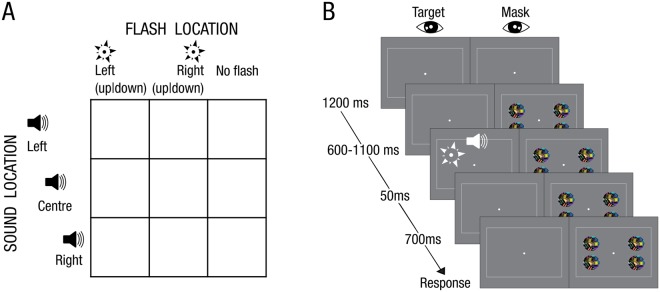
Information integration across the senses is fundamental for effective interactions with our environment. The extent to which signals from different senses can interact in the absence of awareness is controversial. Combining the spatial ventriloquist illusion and dynamic continuous flash suppression (dCFS), we investigated in a series of two experiments whether visual signals that observers do not consciously perceive can influence spatial perception of sounds. Importantly, dCFS obliterated visual awareness only on a fraction of trials allowing us to compare spatial ventriloquism for physically identical flashes that were judged as visible or invisible. Our results show a stronger ventriloquist effect for visible than invisible flashes. Critically, a robust ventriloquist effect emerged also for invisible flashes even when participants were at chance when locating the flash. Collectively, our findings demonstrate that signals that we are not aware of in one sensory modality can alter spatial perception of signals in another sensory modality.
信息在不同感觉间的整合对于与环境进行有效互动至关重要。在没有意识的情况下,来自不同感觉的信号能够在何种程度上相互作用,这一问题颇具争议。我们通过结合空间腹语幻象和动态连续闪光抑制(dCFS),在一系列两项实验中,研究了观察者无法有意识感知的视觉信号是否能够影响声音的空间感知。重要的是,dCFS 仅在一小部分试验中消除了视觉意识,这使我们能够比较物理上相同的闪光在被判断为可见或不可见时的空间腹语效果。我们的结果表明,对于可见闪光,腹语效果要强于不可见闪光。关键的是,即使参与者在定位闪光时处于随机状态,对于不可见闪光,也会出现稳健的腹语效果。总的来说,我们的研究结果表明,我们在一种感觉模式中无法意识到的信号可以改变另一种感觉模式中信号的空间感知。