Igwe Stanley C, Brigo Francesco
Department of Neuro-Psychiatry, Federal Teaching Hospital, Abakaliki, Nigeria.
Department of Neurosciences, Biomedicine and Movement Sciences, University of Verona, Verona, Italy.
Clin Psychopharmacol Neurosci. 2018 Aug 31;16(3):235-245. doi: 10.9758/cpn.2018.16.3.235.
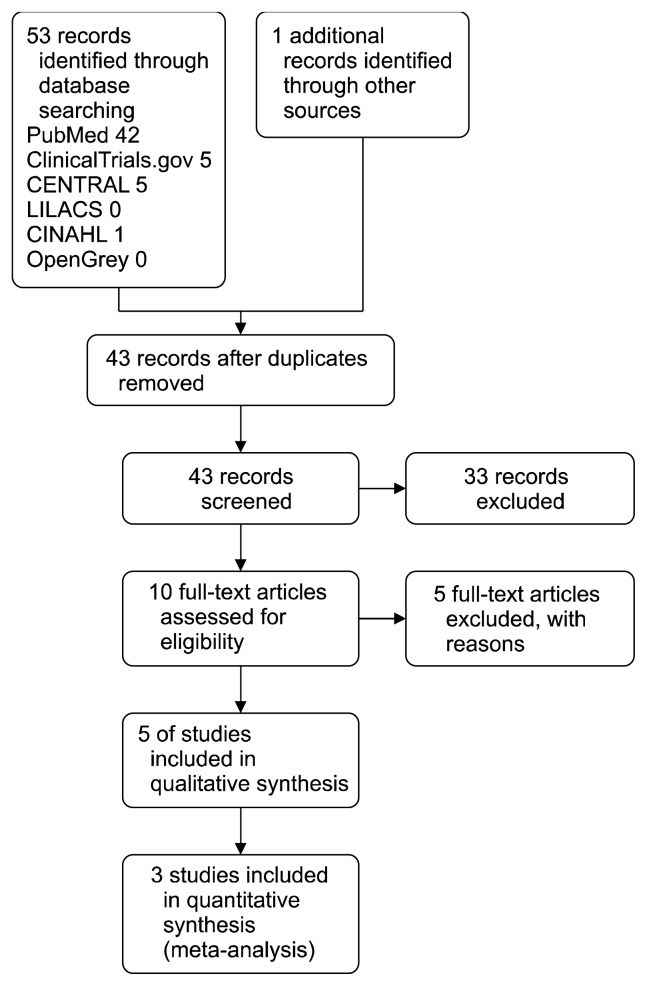
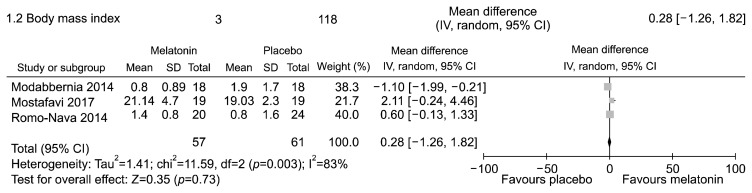
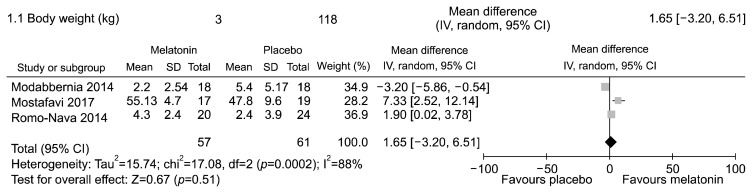
Atypical antipsychotics (AAPs) are increasingly used for the treatment of psychotic disorders but are known to be associated with metabolic abnormalities. This study is a systematic review and meta-analysis of randomized controlled trials (RCTs) studying the effectiveness of melatonin for the amelioration of AAP-induced metabolic syndrome. The MEDLINE (accessed via PubMed), Cochrane Central Register of Controlled Trials (CENTRAL), ClinicalTrials, PsycINFO, LILACS, CINAHL, and OpenGrey databases were searched for RCTs without language restrictions. Inclusion criteria were randomized, double-blind clinical trials comparing melatonin or melatonin agonists with placebo for the amelioration of AAP-induced effects at any age with selected components of metabolic syndrome as outcome measures. Two reviewers independently selected articles and assessed quality using Cochrane risk of bias and concealment tools. Of 53 records, five RCTs were eligible for the systematic review and three for the meta-analysis. The meta-analyses showed no statistically significant difference in any anthropometric or metabolic variable considered. Analysis according to psychiatric diagnosis from one RCT showed significant decreases in diastolic blood pressure (5.5 vs. -5.7 mmHg for the placebo and melatonin groups, respectively; =0.001), fat mass (2.7 vs. 0.2 kg, respectively; =0.032), and triglycerides (D) (50.1 vs. -20 mg/dl, respectively; =0.08) in the bipolar group but not the schizophrenia group. Although limited to five RCTs with small sample sizes, evidence from RCT indicates that melatonin improves AAP-induced metabolic syndrome. This beneficial effect seems more significant in patients with bipolar disorder than those with schizophrenia. Further RCTs are needed to definitively establish the potential ameliorative effect of melatonin and to justify its efficacy as an add-on therapy to curtail AAP-induced metabolic syndrome.
非典型抗精神病药物(AAPs)越来越多地用于治疗精神障碍,但已知与代谢异常有关。本研究是一项系统评价和荟萃分析,纳入了研究褪黑素改善AAP诱导的代谢综合征有效性的随机对照试验(RCT)。检索了MEDLINE(通过PubMed访问)、Cochrane对照试验中央注册库(CENTRAL)、ClinicalTrials、PsycINFO、LILACS、CINAHL和OpenGrey数据库,纳入无语言限制的RCT。纳入标准为随机、双盲临床试验,比较褪黑素或褪黑素激动剂与安慰剂,以改善任何年龄的AAP诱导效应,并将代谢综合征的选定成分作为结局指标。两名评价者独立选择文章,并使用Cochrane偏倚风险和隐藏工具评估质量。在53条记录中,5项RCT符合系统评价的标准,3项符合荟萃分析的标准。荟萃分析显示,在所考虑的任何人体测量或代谢变量上均无统计学显著差异。根据一项RCT的精神疾病诊断进行的分析显示,双相情感障碍组的舒张压(安慰剂组和褪黑素组分别为5.5 vs. -5.7 mmHg;P =0.001)、脂肪量(分别为2.7 vs. 0.2 kg;P =0.032)和甘油三酯(D)(分别为50.1 vs. -20 mg/dl;P =0.08)显著降低,而精神分裂症组则无此现象。尽管该研究仅限于5项样本量较小的RCT,但来自RCT的证据表明,褪黑素可改善AAP诱导的代谢综合征。这种有益作用在双相情感障碍患者中似乎比精神分裂症患者更显著。需要进一步的RCT来明确确定褪黑素的潜在改善作用,并证明其作为辅助治疗以减少AAP诱导的代谢综合征的疗效。