Dobs Katharina, Bülthoff Isabelle, Schultz Johannes
Department of Brain and Cognitive Sciences, Massachusetts Institute of Technology, Cambridge, MA, United States.
Department Human Perception, Cognition and Action, Max Planck Institute for Biological Cybernetics, Tübingen, Germany.
Front Psychol. 2018 Aug 3;9:1355. doi: 10.3389/fpsyg.2018.01355. eCollection 2018.
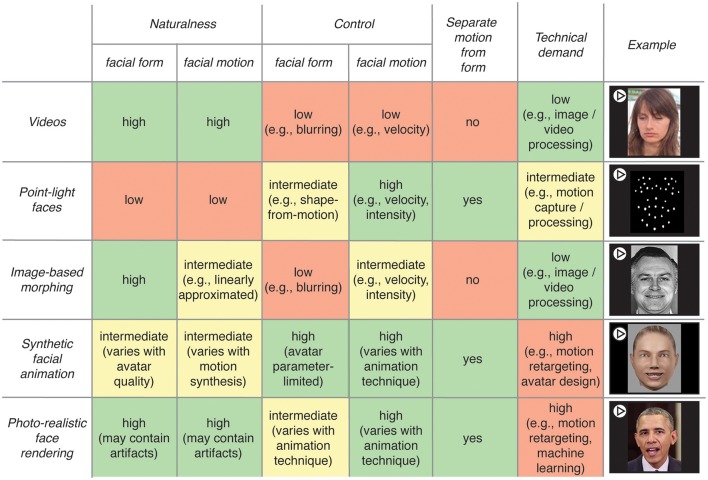
Faces that move contain rich information about facial form, such as facial features and their configuration, alongside the motion of those features. During social interactions, humans constantly decode and integrate these cues. To fully understand human face perception, it is important to investigate what information dynamic faces convey and how the human visual system extracts and processes information from this visual input. However, partly due to the difficulty of designing well-controlled dynamic face stimuli, many face perception studies still rely on static faces as stimuli. Here, we focus on evidence demonstrating the usefulness of dynamic faces as stimuli, and evaluate different types of dynamic face stimuli to study face perception. Studies based on dynamic face stimuli revealed a high sensitivity of the human visual system to natural facial motion and consistently reported dynamic advantages when static face information is insufficient for the task. These findings support the hypothesis that the human perceptual system integrates sensory cues for robust perception. In the present paper, we review the different types of dynamic face stimuli used in these studies, and assess their usefulness for several research questions. Natural videos of faces are ecological stimuli but provide limited control of facial form and motion. Point-light faces allow for good control of facial motion but are highly unnatural. Image-based morphing is a way to achieve control over facial motion while preserving the natural facial form. Synthetic facial animations allow separation of facial form and motion to study aspects such as identity-from-motion. While synthetic faces are less natural than videos of faces, recent advances in photo-realistic rendering may close this gap and provide naturalistic stimuli with full control over facial motion. We believe that many open questions, such as what dynamic advantages exist beyond emotion and identity recognition and which dynamic aspects drive these advantages, can be addressed adequately with different types of stimuli and will improve our understanding of face perception in more ecological settings.
动态面部包含有关面部形态的丰富信息,例如面部特征及其配置,以及这些特征的运动。在社交互动过程中,人类不断解码并整合这些线索。为了全面理解人类面部感知,研究动态面部传达了哪些信息以及人类视觉系统如何从这种视觉输入中提取和处理信息非常重要。然而,部分由于设计严格控制的动态面部刺激存在困难,许多面部感知研究仍然依赖静态面部作为刺激。在此,我们关注证明动态面部作为刺激有用性的证据,并评估不同类型的动态面部刺激以研究面部感知。基于动态面部刺激的研究揭示了人类视觉系统对自然面部运动的高敏感性,并一致报告当静态面部信息不足以完成任务时存在动态优势。这些发现支持了人类感知系统整合感官线索以实现稳健感知的假设。在本文中,我们回顾了这些研究中使用的不同类型的动态面部刺激,并评估它们对几个研究问题的有用性。面部的自然视频是生态刺激,但对面部形态和运动的控制有限。点光面部可以很好地控制面部运动,但非常不自然。基于图像的变形是一种在保留自然面部形态的同时实现对面部运动控制的方法。合成面部动画允许分离面部形态和运动,以研究诸如从运动中识别身份等方面。虽然合成面部不如面部视频自然,但逼真渲染方面的最新进展可能会缩小这一差距,并提供对面部运动具有完全控制权的自然主义刺激。我们相信,许多开放性问题,例如除了情感和身份识别之外还存在哪些动态优势以及哪些动态方面驱动了这些优势,可以通过不同类型的刺激得到充分解决,并将在更生态的环境中提高我们对面部感知的理解。