Tantikanlayaporn Duangrat, Tourkova Irina L, Larrouture Quitterie, Luo Jianhua, Piyachaturawat Pawinee, Witt Michelle R, Blair Harry C, Robinson Lisa J
Division of Cell Biology, Faculty of Medicine, Thammasat University, Pathumthani, Thailand.
Veterans Affairs Medical Center, Pittsburgh, PA, USA.
JBMR Plus. 2018 Jul;2(4):217-226. doi: 10.1002/jbm4.10037. Epub 2018 Jan 29.
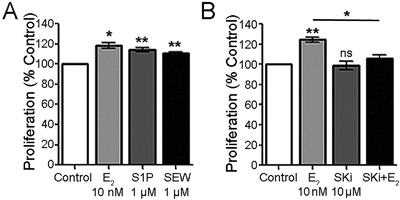
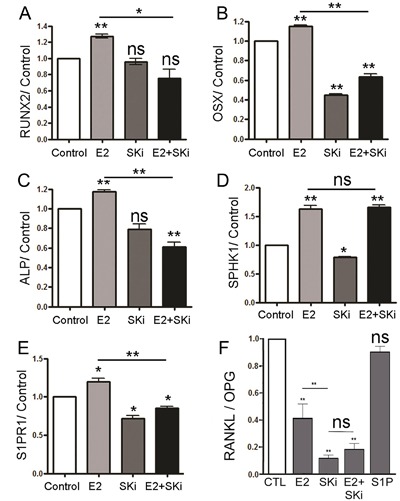
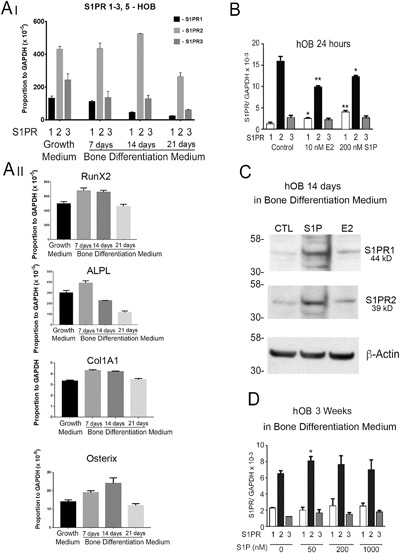
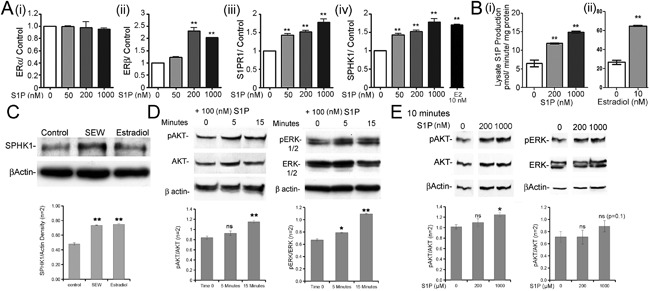
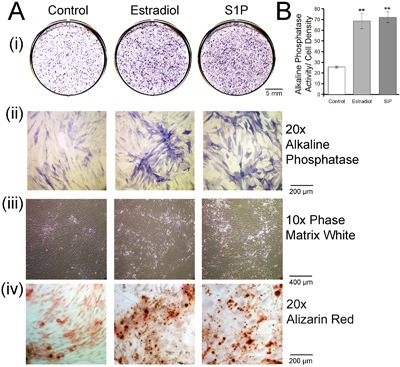
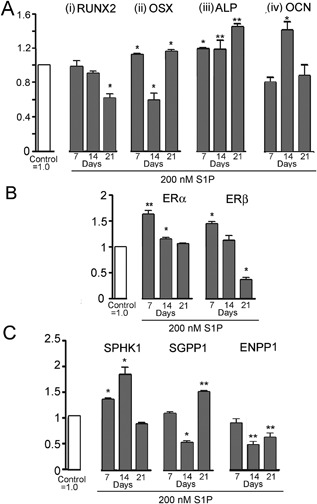
Production of sphingosine-1-phosphate (S1P) is linked to 17β-estradiol (E2) activity in many estrogen-responsive cells; in bone development, the role of S1P is unclear. We studied effects of S1P on proliferation and differentiation of human osteoblasts (hOB). Ten nM E2, 1 μM S1P, or 1 μM of the S1P receptor 1 (S1PR1) agonist SEW2871 increased hOB proliferation at 24 hours. S1PR 1, 2, and 3 mRNAs are expressed by hOB but not S1PR4 or S1PR5. Expression of S1PR2 was increased at 7 and 14 days of differentiation, in correspondence with osteoblast-related mRNAs. Expression of S1PR1 was increased by E2 or S1P in proliferating hOB, whereas S1PR2 mRNA was unaffected in proliferating cells; S1PR3 was not affected by E2 or S1P. Inhibiting sphingosine kinase (SPHK) activity with sphingosine kinase inhibitor (Ski) greatly reduced the E2 proliferative effect. Both E2 and S1P increased SPHK mRNA at 24 hours in hOB. S1P promoted osteoblast proliferation via activating MAP kinase activity. Either E2 or S1P increased S1P synthesis in a fluorescent S1P assay. Interaction of E2 and S1P signaling was indicated by upregulation of E2 receptor mRNA after S1P treatment. E2 and S1P also promoted alkaline phosphatase expression. During osteoblast differentiation, S1P increased bone-specific mRNAs, similarly to the effects of E2. However, E2 and S1P showed differences in the activation of some osteoblast pathways. Pathway analysis by gene expression arrays was consistent with regulation of pathways of osteoblast differentiation; collagen and cell adhesion proteins centered on Rho/Rac small GTPase signaling and Map kinase or signal transducer and activator of transcription (Stat) intermediates. Transcriptional activation also included significant increases in superoxide dismutase 1 and 2 transcription by either S1P or E2. We demonstrate that the SPHK system is a co-mediator for osteoblast proliferation and differentiation, which is mainly, but not entirely, complementary to E2, whose effects are mediated by S1PR1 and S1PR2.
在许多雌激素反应性细胞中,鞘氨醇-1-磷酸(S1P)的产生与17β-雌二醇(E2)活性相关;在骨骼发育过程中,S1P的作用尚不清楚。我们研究了S1P对人成骨细胞(hOB)增殖和分化的影响。10 nM E2、1 μM S1P或1 μM的S1P受体1(S1PR1)激动剂SEW2871在24小时时可增加hOB增殖。hOB表达S1PR 1、2和3的mRNA,但不表达S1PR4或S1PR5。在分化的第7天和第14天,S1PR2的表达增加,与成骨细胞相关的mRNA相对应。在增殖的hOB中,E2或S1P可增加S1PR1的表达,而在增殖细胞中S1PR2 mRNA不受影响;S1PR3不受E2或S1P的影响。用鞘氨醇激酶抑制剂(Ski)抑制鞘氨醇激酶(SPHK)活性可大大降低E2的增殖作用。E2和S1P在24小时时均可增加hOB中SPHK mRNA的表达。S1P通过激活丝裂原活化蛋白激酶(MAP)激酶活性促进成骨细胞增殖。在荧光S1P测定中,E2或S1P均可增加S1P合成。S1P处理后E2受体mRNA上调表明E2和S1P信号之间存在相互作用。E2和S1P还可促进碱性磷酸酶表达。在成骨细胞分化过程中,S1P可增加骨特异性mRNA,与E2的作用相似。然而,E2和S1P在某些成骨细胞途径的激活方面存在差异。通过基因表达阵列进行的通路分析与成骨细胞分化途径的调节一致;胶原蛋白和细胞粘附蛋白集中在Rho/Rac小GTP酶信号传导以及MAP激酶或信号转导和转录激活因子(Stat)中间体上。转录激活还包括S1P或E2使超氧化物歧化酶1和2的转录显著增加。我们证明,SPHK系统是成骨细胞增殖和分化的共同介质,它主要但并非完全与E2互补,E2的作用由S1PR1和S1PR2介导。