Dr von Hauner Children's Hospital, Ludwig Maximilians University, Munich, Germany.
Department of Paediatric Respiratory Medicine, Inselspital, University Children's Hospital of Bern, University of Bern, Bern, Switzerland.
BMC Pulm Med. 2018 Aug 20;18(1):140. doi: 10.1186/s12890-018-0705-6.
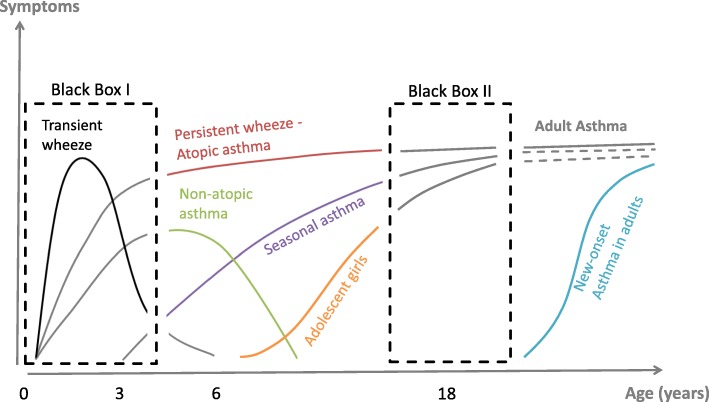
Asthma and wheezing disorders in childhood and adulthood are clinically heterogeneous regarding disease presentation, natural course, and response to treatment. Deciphering common disease mechanisms in distinct subgroups requires harmonized molecular (endo-) phenotyping of both children and adult patients with asthma in a prospective, longitudinal setting.
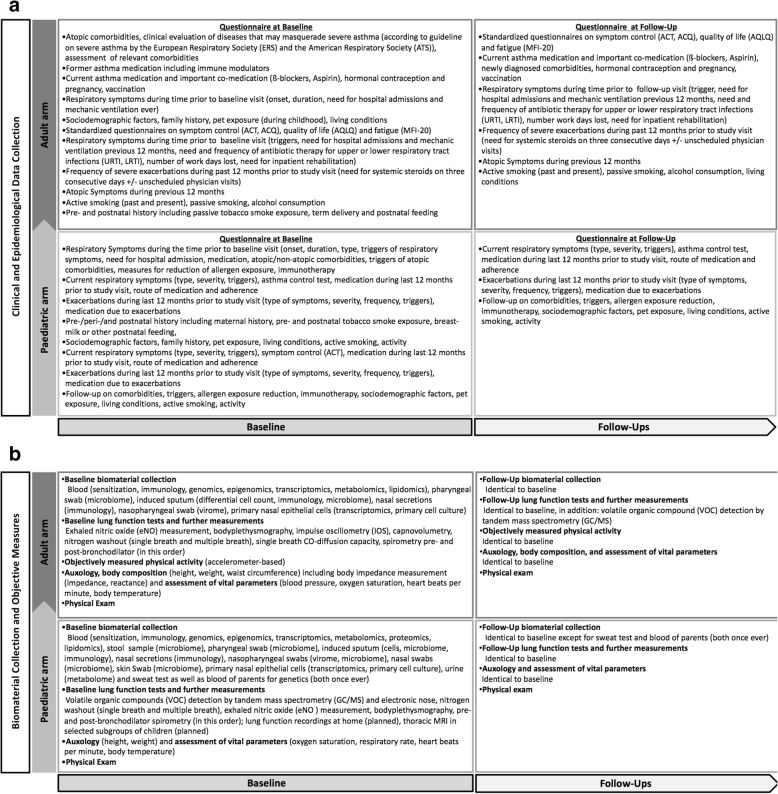
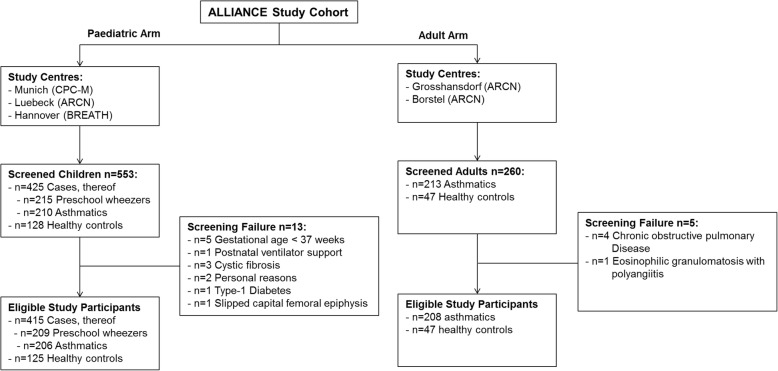
The ALL Age Asthma Cohort (ALLIANCE) of the German Center for Lung Research (DZL) is a prospective, multi-center, observational cohort study with seven recruiting sites across Germany. Data are derived from four sources: (a) patient history from medical records, (b) standardized questionnaires and structured interviews, (c) telephone interviews, and (d) objective measurements. Objective measurements include amongst others lung function and quantitative assessment of airway inflammation and exhaled breath, peripheral blood, skin, nasal, pharyngeal, and nasopharyngeal swabs, nasal secretions, primary nasal epithelial cells, and induced sputum. In cases, objective measurements and biomaterial collection are performed regularly, while control subjects are only examined once at baseline.
The standardized and detailed collection of epidemiological and physiological data, and the molecular deep phenotyping of a comprehensive range of biomaterials in a considerable number of study participants across all ages are the outstanding characteristics of this multi-center cohort. Despite extensive biomaterial sampling, and a recruitment strategy that also includes pre-school children as young as 6 months, attrition is low. In children 83.9%, and in adults 90.5% attended the 12-month follow-up. The earliest time-point to include cases, however, is disease manifestation. Therefore, unraveling mechanisms that drive disease onset is limited, as this question can only be answered in a population-based birth cohort. Nonetheless, ALLIANCE offers a unique, integrative and inter-disciplinary framework with a comprehensive molecular approach in a prospective and identical fashion across ages in order to identify biomarkers and predictors for distinct childhood wheeze and asthma trajectories as well as their further course during adulthood. Ultimately, this approach aims to translate its most significant findings into clinical practice, and to improve asthma transition from adolescence to adulthood.
NCT02496468 for pediatric arm, NCT02419274 for adult arm.
儿童和成年期的哮喘和喘息障碍在疾病表现、自然病程和治疗反应方面存在临床异质性。要在前瞻性、纵向研究中解析不同亚组中的常见疾病机制,需要对哮喘的儿童和成年患者进行协调一致的分子(内)表型分析。
德国肺研究中心(DZL)的 ALL Age Asthma Cohort(ALLIANCE)是一项前瞻性、多中心、观察性队列研究,在德国有 7 个招募点。数据来源于 4 个来源:(a)病历中的患者病史,(b)标准化问卷和结构化访谈,(c)电话访谈,以及(d)客观测量。客观测量包括肺功能和气道炎症及呼气的定量评估,以及外周血、皮肤、鼻、咽、鼻咽拭子、鼻分泌物、原代鼻上皮细胞和诱导痰。在病例中,客观测量和生物材料采集是定期进行的,而对照组仅在基线时检查一次。
该多中心队列的突出特点是,对流行病学和生理学数据进行了标准化和详细的收集,并对大量研究参与者的广泛生物材料进行了分子深度表型分析。尽管进行了广泛的生物材料采样,且招募策略还包括了年仅 6 个月大的学龄前儿童,但患者的脱落率很低。在儿童中,83.9%,在成年人中,90.5%参加了 12 个月的随访。然而,纳入病例的最早时间点是疾病表现。因此,驱动疾病发生的机制尚不清楚,因为这个问题只能在基于人群的出生队列中回答。尽管如此,ALLIANCE 提供了一个独特的、综合的和跨学科的框架,以前瞻性的方式在不同年龄段以相同的方式进行综合分子分析,以确定儿童喘息和哮喘轨迹以及成年后进一步发展的生物标志物和预测因子。最终,该方法旨在将其最重要的发现转化为临床实践,并改善哮喘从青少年到成年的过渡。
儿科组 NCT02496468,成人组 NCT02419274。