de Almeida Célio Fabiano, Friche Amélia Augusta de Lima, Jennings M Zane, Andrade Amanda Cristina de Souza, Xavier Cesar Coelho, Proietti Fernando, Coulton Claudia J, Caiaffa Waleska Teixeira
Observatory for Urban Health in Belo Horizonte, School of Medicine, Federal University of Minas Gerais, Belo Horizonte, Brazil.
School of Applied Social Sciences, Case Western Reserve University Jack Joseph and Morton Mandel School of Applied Social Sciences, Cleveland, Ohio, USA.
BMJ Open. 2018 Aug 20;8(8):e021445. doi: 10.1136/bmjopen-2017-021445.
Health outcomes have been associated with physical and social characteristics of neighbourhoods, but little is known about the relationship between contextual factors and perceived neighbourhood scale.
To identify the contextual factors associated with self-perceived neighbourhood scale.
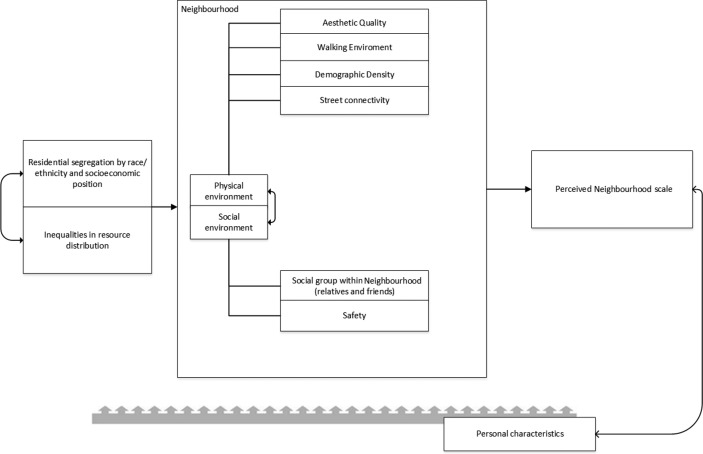
We analysed data from a cross-sectional population-based study in Belo Horizonte, Brazil, that took place in 2008-2009. The dependent variable was perceived neighbourhood, encoded as an ordinal scale based on a brief description of the concept of the neighbourhood, and two independent scales relating distance, expressed in terms of geography and time. Street connectivity, demographic density and residents' perceptions of the neighbourhoods' physical and social environment were used as contextual predictors. Individual characteristics were used as covariates. Multilevel ordinal logistic regression models estimated the association between perceived neighbourhood scale and contextual characteristics.
Residents that perceive better walkability (OR 2.96; 95% CI 1.29 to 3.82) and high amounts of violence (OR 1.35; 95% CI 1.12 to 1.62) perceived their neighbourhoods to be larger, even after adjusting for individual characteristics.
There are contextual factors that are associated with self-perceived neighbourhood scale. Careful definition of neighbourhood scale is a key factor in improving the results of eco-epidemiological studies. Although these findings must be further explored in other studies, these results can contribute to a better understanding of an appropriate choice of neighbourhood scale, especially for cities in Latin America.
健康结果与社区的物理和社会特征相关,但关于背景因素与感知到的社区规模之间的关系却知之甚少。
确定与自我感知的社区规模相关的背景因素。
我们分析了2008 - 2009年在巴西贝洛奥里藏特进行的一项基于人群的横断面研究的数据。因变量是感知到的社区,根据对社区概念的简要描述编码为一个有序量表,以及两个与距离相关的独立量表,分别以地理和时间来表示。街道连通性、人口密度以及居民对社区物理和社会环境的感知被用作背景预测因素。个体特征被用作协变量。多水平有序逻辑回归模型估计了感知到的社区规模与背景特征之间的关联。
即使在调整个体特征之后,那些认为步行便利性更好(比值比2.96;95%置信区间1.29至3.82)以及暴力事件较多(比值比1.35;95%置信区间1.12至1.62) 的居民感觉他们的社区更大。
存在与自我感知的社区规模相关的背景因素。社区规模的精确定义是改善生态流行病学研究结果的关键因素。尽管这些发现必须在其他研究中进一步探索,但这些结果有助于更好地理解社区规模的合适选择,特别是对于拉丁美洲的城市。