Britton Chance Center for Biomedical Photonics, Wuhan National Laboratory for Optoelectronics-Huazhong University of Science and Technology, Wuhan, Hubei 430074, China.
MoE Key Laboratory for Biomedical Photonics, Collaborative Innovation Center for Biomedical Engineering, School of Engineering Sciences, Huazhong University of Science and Technology, Wuhan, Hubei 430074, China.
Theranostics. 2018 Jul 30;8(15):4181-4198. doi: 10.7150/thno.25707. eCollection 2018.
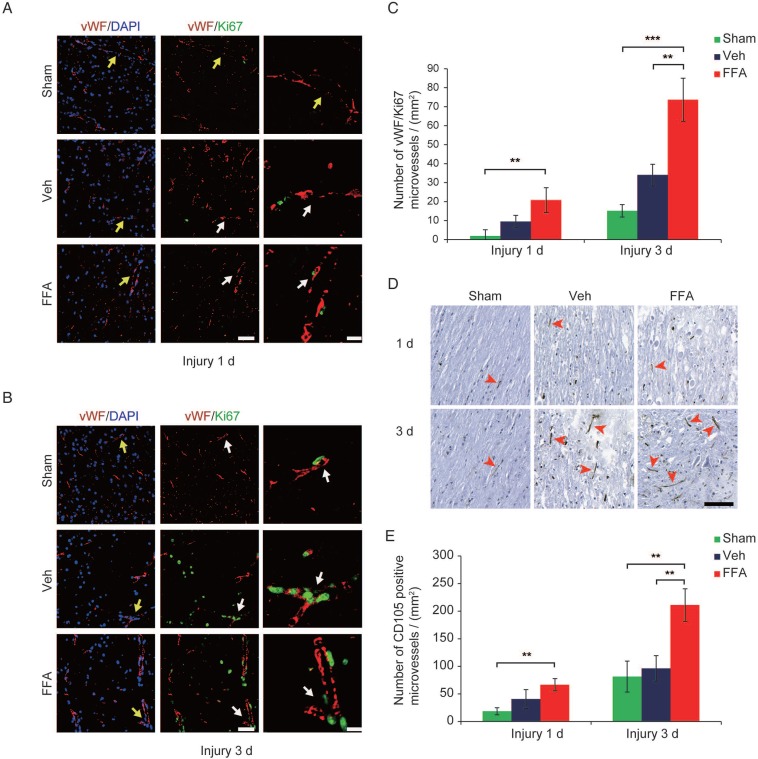
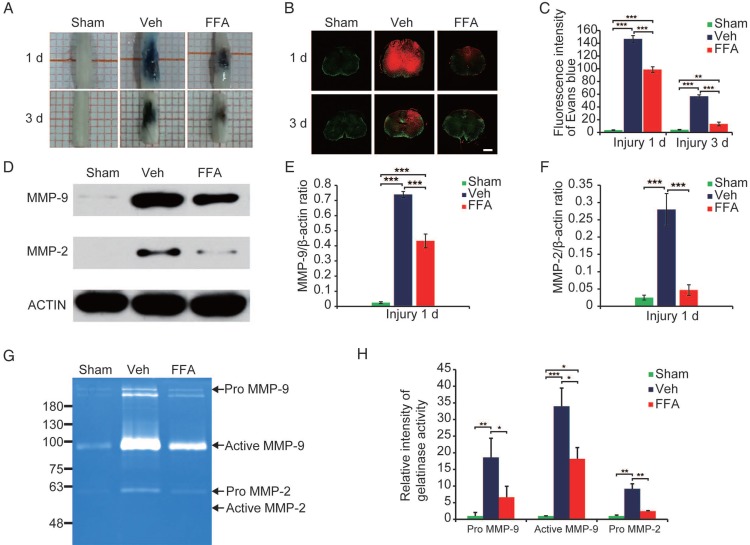
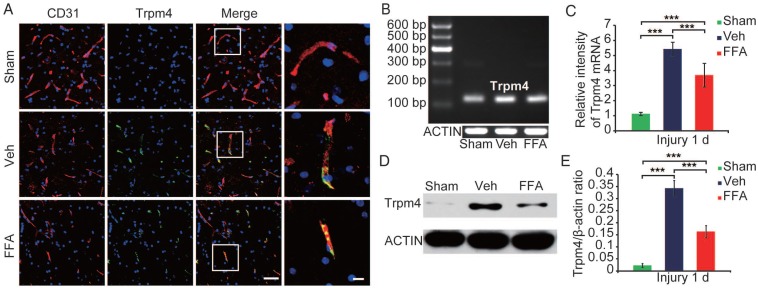
Acute spinal cord injury (SCI) induces secondary hemorrhage and initial blood-spinal cord barrier (BSCB) disruption. The transient receptor potential melastatin 4 (Trpm4) together with sulfonylurea receptor 1 (Sur1) forms the Sur1-Trpm4 channel complex. The up-regulation of Sur1-Trpm4 after injury plays a crucial role in secondary hemorrhage, which is the most destructive mechanism in secondary injuries of the central nervous system (CNS). The matrix metalloprotease (MMP)-mediated disruption of the BSCB leads to an inflammatory response, neurotoxin production and neuronal cell apoptosis. Thus, preventing secondary hemorrhage and BSCB disruption should be an important goal of therapeutic interventions in SCI. Using a moderate contusion injury model at T10 of the spinal cord, flufenamic acid (FFA) was injected intraperitoneally 1 h after SCI and then continuously once per day for one week. Trpm4 expression is highly up-regulated in capillaries 1 d after SCI. Treatment with flufenamic acid (FFA) inhibited Trpm4 expression, secondary hemorrhage, and capillary fragmentation and promoted angiogenesis. In addition, FFA significantly inhibited the expression of MMP-2 and MMP-9 at 1 d after SCI and significantly attenuated BSCB disruption at 1 d and 3 d after injury. Furthermore, we found that FFA decreased the hemorrhage- and BSCB disruption-induced activation of microglia/macrophages and was associated with smaller lesions, decreased cavity formation, better myelin preservation and less reactive gliosis. Finally, FFA protected motor neurons and improved locomotor functions after SCI. This study indicates that FFA improves functional recovery, in part, due to the following reasons: (1) it inhibits the expression of Trpm4 to reduce the secondary hemorrhage; and (2) it inhibits the expression of MMP-2 and MMP-9 to block BSCB disruption. Thus, the results of our study suggest that FFA may represent a potential therapeutic agent for promoting functional recovery.
急性脊髓损伤 (SCI) 可引起继发性出血和初始血脊髓屏障 (BSCB) 破坏。瞬时受体电位 melastatin 4 (Trpm4) 与磺酰脲受体 1 (Sur1) 形成 Sur1-Trpm4 通道复合物。损伤后 Sur1-Trpm4 的上调在继发性出血中起着至关重要的作用,继发性出血是中枢神经系统 (CNS) 继发性损伤中最具破坏性的机制。基质金属蛋白酶 (MMP) 介导的 BSCB 破坏导致炎症反应、神经毒素产生和神经元细胞凋亡。因此,防止继发性出血和 BSCB 破坏应该是 SCI 治疗干预的重要目标。 在脊髓 T10 处使用中度挫伤损伤模型,SCI 后 1 小时经腹腔注射氟芬那酸 (FFA),然后连续每天一次持续一周。 SCI 后 1 天,毛细血管中 Trpm4 表达高度上调。用氟芬那酸 (FFA) 治疗可抑制 Trpm4 表达、继发性出血、毛细血管碎裂和促进血管生成。此外,FFA 可显著抑制 SCI 后 1 天 MMP-2 和 MMP-9 的表达,并显著减轻损伤后 1 天和 3 天的 BSCB 破坏。此外,我们发现 FFA 可减少出血和 BSCB 破坏诱导的小胶质细胞/巨噬细胞激活,并与较小的病变、减少腔形成、更好的髓鞘保存和较少的反应性神经胶质增生有关。最后,FFA 可保护 SCI 后的运动神经元并改善运动功能。 本研究表明,FFA 改善功能恢复,部分原因是:(1)抑制 Trpm4 的表达以减少继发性出血;(2)抑制 MMP-2 和 MMP-9 的表达以阻断 BSCB 破坏。因此,我们的研究结果表明,FFA 可能代表一种促进功能恢复的潜在治疗药物。