Maighal Mahmood, Salem Mohamed, Kohler Josef, Rillig Matthias C
Institut für Biologie Plant Ecology Freie Universität Berlin Berlin Germany.
Berlin-Brandenburg Institute of Advanced Biodiversity Research (BBIB) Berlin Germany.
Ecol Evol. 2016 Oct 5;6(21):7683-7689. doi: 10.1002/ece3.2491. eCollection 2016 Nov.
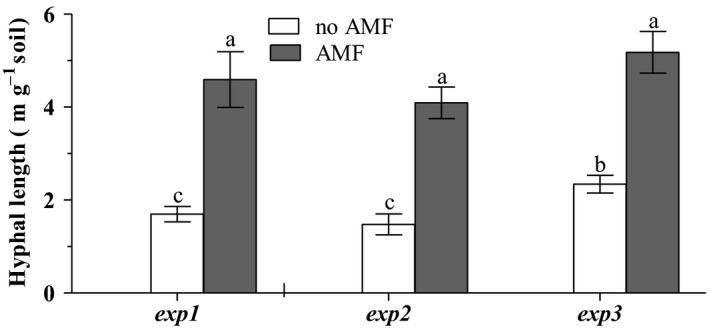
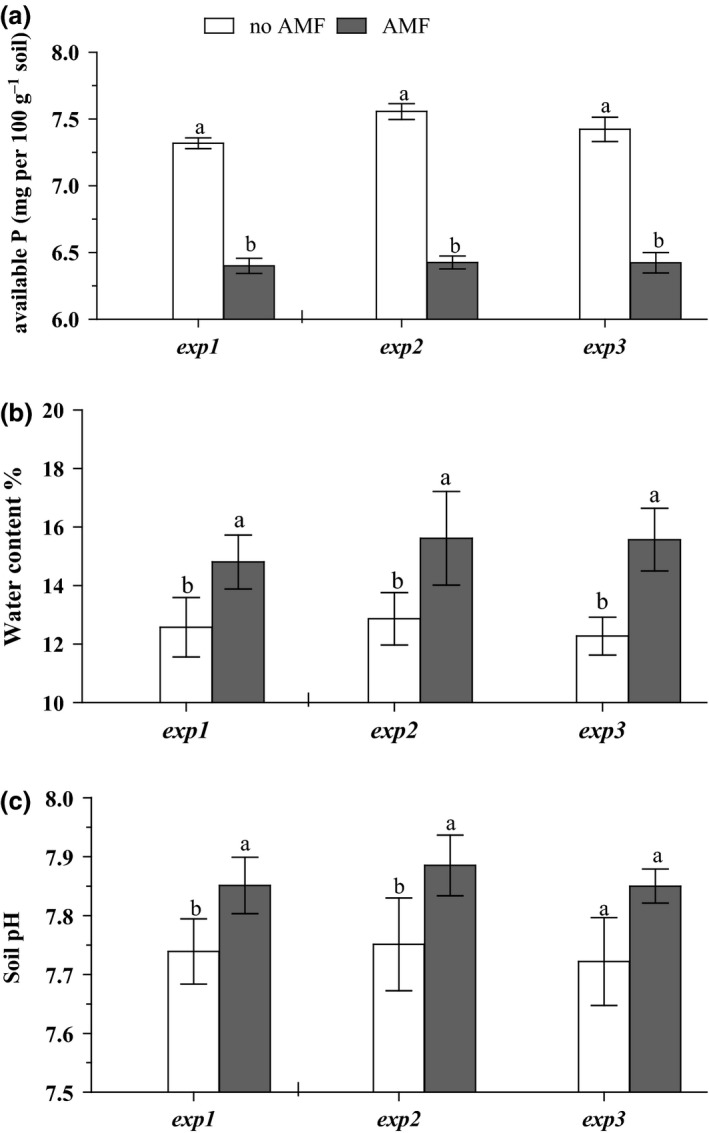
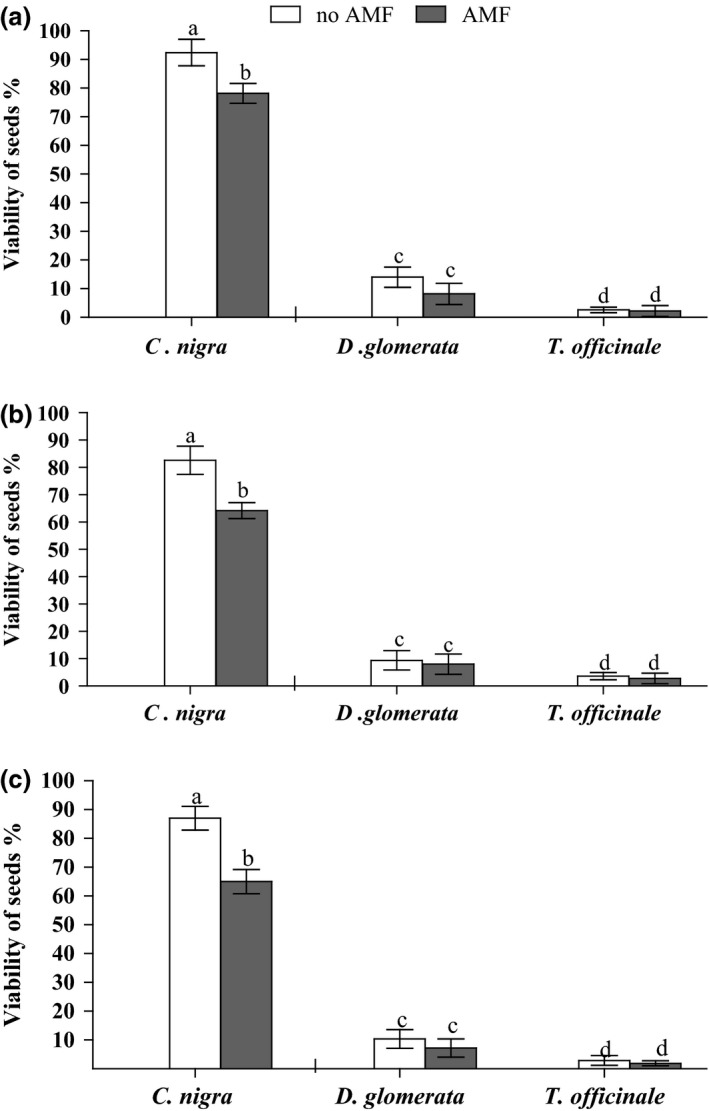
Seed banks represent a reservoir of propagules important for understanding plant population dynamics. Seed viability in soil depends on soil abiotic conditions, seed species, and soil biota. Compared to the vast amount of data on plant growth effects, next to nothing is known about how arbuscular mycorrhizal fungi (AMF) could influence viability of seeds in the soil seed bank. To test whether AMF could influence seed bank viability, we conducted three two-factorial experiments using seeds of three herbaceous plant species (, and ) under mesocosm (experiments 1 and 2) and field conditions (experiment 3) and modifying the factor AMF presence (yes and no). To allow only hyphae to grow in and to prevent root penetration, paired root exclusion compartments (RECs) were used in experiments 2 and 3, which were either rotated (interrupted mycelium connection) or kept static (allows mycorrhizal connection). After harvesting, seed viability, soil water content, soil phosphorus availability, soil pH, and hyphal length in RECs were measured. In experiment 1, we used inoculation or not with the AMF to establish the mycorrhizal treatment levels. A significant negative effect of mycorrhizal hyphae on viability of seeds was observed in experiments 1 and 3, and a similar trend in experiment 2. All three experiments showed that water content, soil pH, and AMF extraradical hyphal lengths were increased in the presence of AMF, but available P was decreased significantly. Viability of seeds in the soil seed bank correlated negatively with water content, soil pH, and AMF extraradical hyphal lengths and positively with soil P availability. Our results suggest that AMF can have a negative impact on soil seed viability, which is in contrast to the often-documented positive effects on plant growth. Such effects must now be included in our conceptual models of the AM symbiosis.
种子库是理解植物种群动态的重要繁殖体库。土壤中的种子活力取决于土壤非生物条件、种子种类和土壤生物群。与大量关于植物生长效应的数据相比,关于丛枝菌根真菌(AMF)如何影响土壤种子库中种子的活力几乎一无所知。为了测试AMF是否会影响种子库活力,我们进行了三项双因素实验,使用三种草本植物物种(、和)的种子,分别在中型生态系统(实验1和2)和田间条件(实验3)下进行,并设置了AMF存在与否(是和否)这一因素。为了仅允许菌丝生长并防止根系穿透,在实验2和3中使用了成对的根系排斥隔室(REC),隔室要么旋转(中断菌丝连接),要么保持静止(允许菌根连接)。收获后,测量了种子活力、土壤含水量、土壤磷有效性、土壤pH值以及REC中的菌丝长度。在实验1中,我们通过接种或不接种AMF来确定菌根处理水平。在实验1和3中观察到菌根菌丝对种子活力有显著负面影响,实验2也有类似趋势。所有三项实验均表明,在有AMF的情况下,土壤含水量、土壤pH值和AMF根外菌丝长度增加,但有效磷显著降低。土壤种子库中种子的活力与土壤含水量、土壤pH值和AMF根外菌丝长度呈负相关,与土壤磷有效性呈正相关。我们的结果表明,AMF可能对土壤种子活力产生负面影响,这与通常记录的对植物生长的积极影响形成对比。现在必须将这些影响纳入我们的AM共生概念模型中。