Miller Elizabeth C, Perron Gabriel G, Collins Cathy D
Biology Program Bard College Annandale-on-Hudson NY USA.
Ecol Evol. 2019 Jul 25;9(16):9298-9311. doi: 10.1002/ece3.5476. eCollection 2019 Aug.
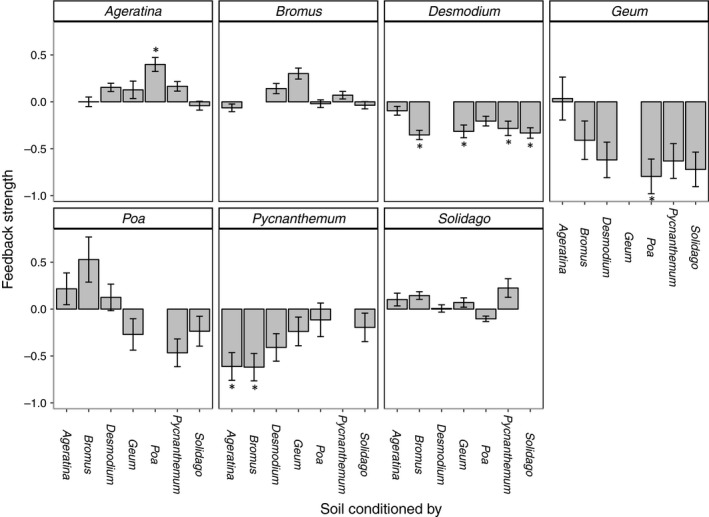
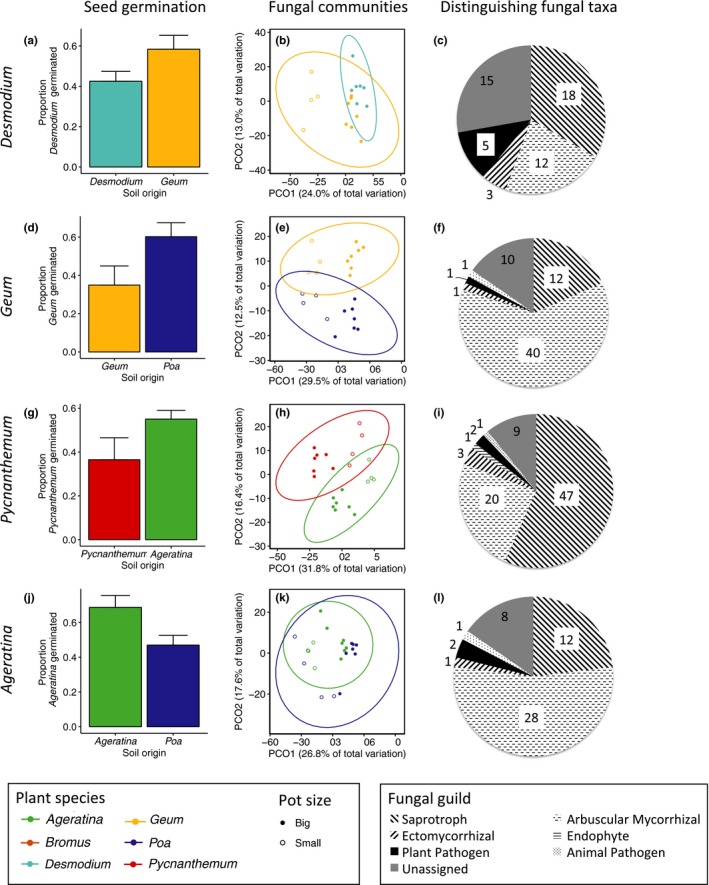
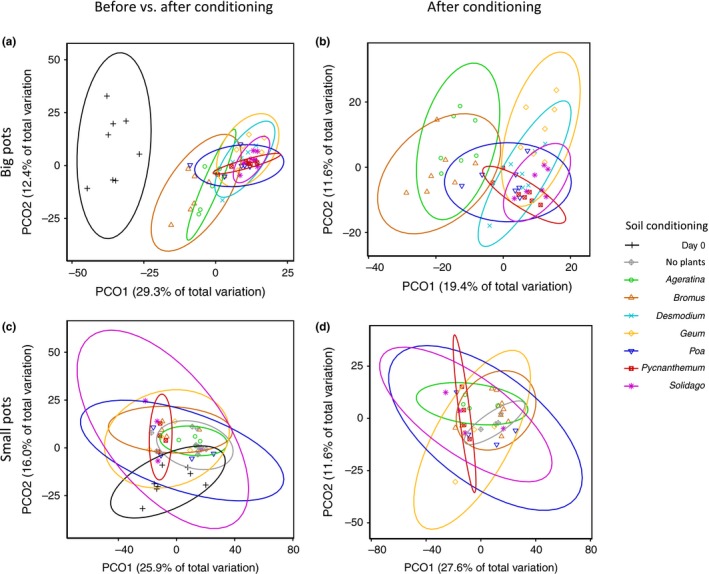
Plant-soil feedbacks (PSFs) drive plant community diversity via interactions between plants and soil microbes. However, we know little about how frequently PSFs affect plants at the seed stage, and the compositional shifts in fungi that accompany PSFs on germination.We conducted a pairwise PSF experiment to test whether seed germination was differentially impacted by conspecific versus heterospecific soils for seven grassland species. We used metagenomics to characterize shifts in fungal community composition in soils conditioned by each plant species. To investigate whether changes in the abundance of certain fungal taxa were associated with multiple PSFs, we assigned taxonomy to soil fungi and identified putative pathogens that were significantly more abundant in soils conditioned by plant species that experienced negative or positive PSFs.We observed negative, positive, and neutral PSFs on seed germination. Although conspecific and heterospecific soils for pairs with significant PSFs contained host-specialized soil fungal communities, soils with specialized microbial communities did not always lead to PSFs. The identity of host-specialized pathogens, that is, taxa uniquely present or significantly more abundant in soils conditioned by plant species experiencing negative PSFs, overlapped among plant species, while putative pathogens within a single host plant species differed depending on the identity of the heterospecific plant partner. Finally, the magnitude of feedback on germination was not related to the degree of fungal community differentiation between species pairs involved in negative PSFs. . Our findings reveal the potential importance of PSFs at the seed stage. Although plant species developed specialized fungal communities in rhizosphere soil, pathogens were not strictly host-specific and varied not just between plant species, but according to the identity of plant partner. These results illustrate the complexity of microbe-mediated interactions between plants at different life stages that next-generation sequencing can begin to unravel.
植物-土壤反馈(PSFs)通过植物与土壤微生物之间的相互作用驱动植物群落多样性。然而,我们对PSFs在种子阶段影响植物的频率,以及PSFs伴随种子萌发时真菌组成的变化了解甚少。我们进行了一项成对PSF实验,以测试七种草原物种的种子萌发是否受到同种土壤与异种土壤的不同影响。我们使用宏基因组学来表征每种植物物种处理过的土壤中真菌群落组成的变化。为了研究某些真菌类群丰度的变化是否与多种PSFs相关,我们对土壤真菌进行分类,并鉴定出在经历负向或正向PSFs的植物物种处理过的土壤中显著更丰富的假定病原体。我们观察到种子萌发存在负向、正向和中性的PSFs。虽然具有显著PSFs的成对组合中的同种和异种土壤含有宿主特异性土壤真菌群落,但具有特殊微生物群落的土壤并不总是导致PSFs。宿主特异性病原体的身份,即在经历负向PSFs的植物物种处理过的土壤中独特存在或显著更丰富的类群,在植物物种之间存在重叠,而单个宿主植物物种内的假定病原体则因异种植物伙伴的身份而异。最后,对萌发的反馈强度与参与负向PSFs的物种对之间真菌群落分化程度无关。我们的研究结果揭示了PSFs在种子阶段的潜在重要性。尽管植物物种在根际土壤中形成了特殊的真菌群落,但病原体并非严格宿主特异性,不仅在植物物种之间存在差异,还会根据植物伙伴的身份而变化。这些结果说明了不同生命阶段植物之间微生物介导的相互作用的复杂性,而新一代测序技术可以开始揭示这些相互作用。