Immunology Division, The Walter & Eliza Hall Institute of Medical Research, Parkville, Vic., Australia.
Department of Medical Biology, The University of Melbourne, Parkville, Vic., Australia.
Immunol Rev. 2018 Sep;285(1):249-262. doi: 10.1111/imr.12695.
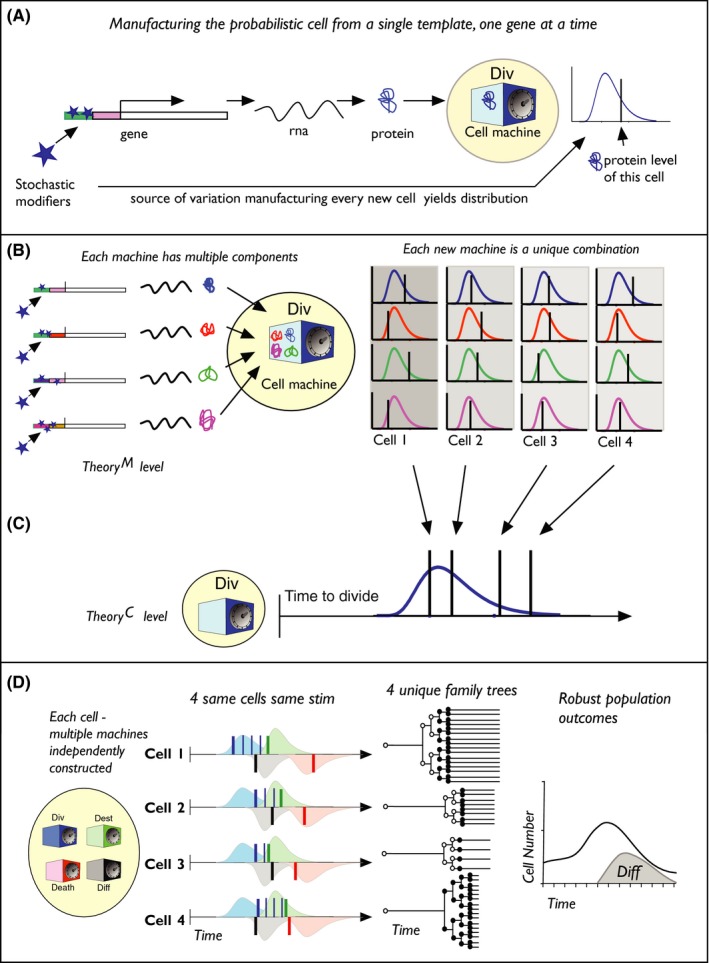
Problem-solving strategies in immunology currently utilize a series of ad hoc, qualitative variations on a foundation of Burnet's formulation of clonal selection theory. These modifications, including versions of two-signal theory, describe how signals regulate lymphocytes to make important decisions governing self-tolerance and changes to their effector and memory states. These theories are useful but are proving inadequate to explain the observable genesis and control of heterogeneity in cell types, the nonlinear passage of cell fate trajectories and how the input from multiple environmental signals can be integrated at different times and strengths. Here, I argue for a paradigm change to place immune theory on a firmer philosophical and quantitative foundation to resolve these difficulties. This change rejects the notion of identical cell subsets and substitutes the concept of a cell as comprised of autonomous functional mechanical components subject to stochastic variations in construction and operation. The theory aims to explain immunity in terms of cell population dynamics, dictated by the operation of cell machinery, such as randomizing elements, division counters, and fate timers. The effect of communicating signals alone and in combination within this system is determined with a cellular calculus. A series of models developed with these principles can resolve logical cell fate and signaling paradoxes and offer a reinterpretation for how self-non-self discrimination and immune response class are controlled.
目前,免疫学中的问题解决策略利用了一系列特定的、定性的变异,这些变异是基于 Burnet 的克隆选择理论公式。这些修改包括双信号理论的版本,描述了信号如何调节淋巴细胞做出重要决策,这些决策决定了自身耐受性以及它们的效应器和记忆状态的变化。这些理论很有用,但事实证明,它们不足以解释细胞类型异质性的可观察起源和控制、细胞命运轨迹的非线性传递,以及如何在不同时间和强度整合来自多个环境信号的输入。在这里,我主张进行范式转变,将免疫理论置于更坚实的哲学和定量基础上,以解决这些困难。这种转变拒绝了相同细胞亚群的概念,代之以细胞作为由自主功能机械组件组成的概念,这些组件的构建和操作受到随机变化的影响。该理论旨在根据细胞机制的运作,从细胞群体动力学的角度来解释免疫,例如随机元素、分裂计数器和命运定时器。在这个系统中,单独和组合的通信信号的影响是通过细胞微积分来确定的。利用这些原则开发的一系列模型可以解决逻辑细胞命运和信号悖论,并提供对自我-非自我识别和免疫反应类如何被控制的重新解释。