Department of Microbiology and Immunology and the Emory Vaccine Center, Emory University School of Medicine, Atlanta, GA, 30322, USA.
Nat Commun. 2020 Aug 10;11(1):3989. doi: 10.1038/s41467-020-17798-x.
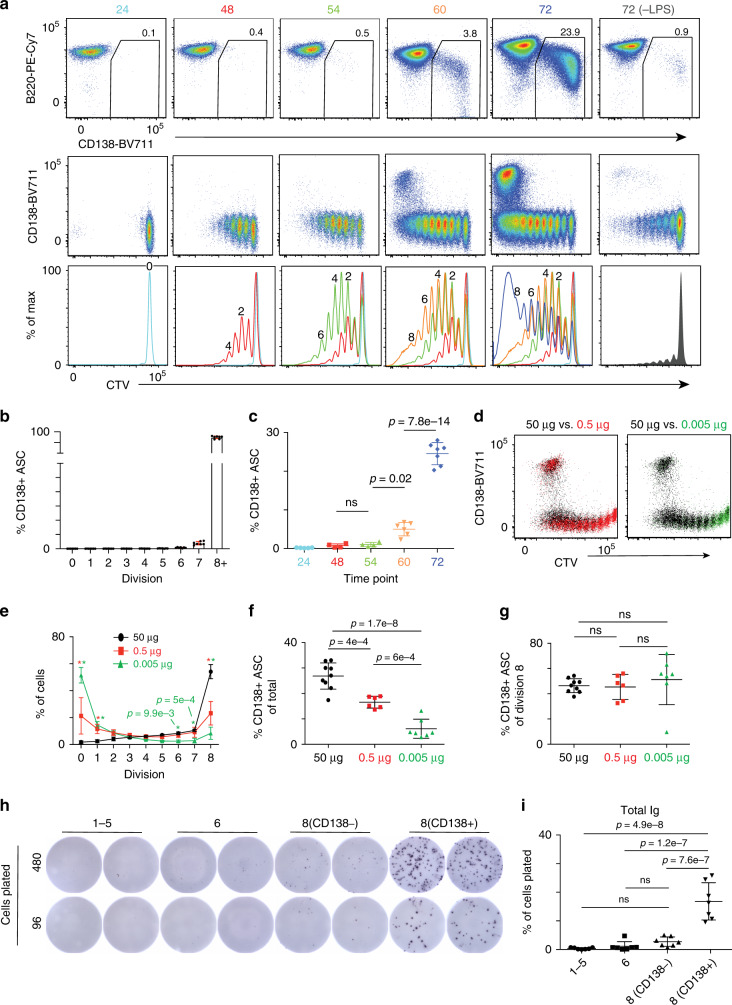
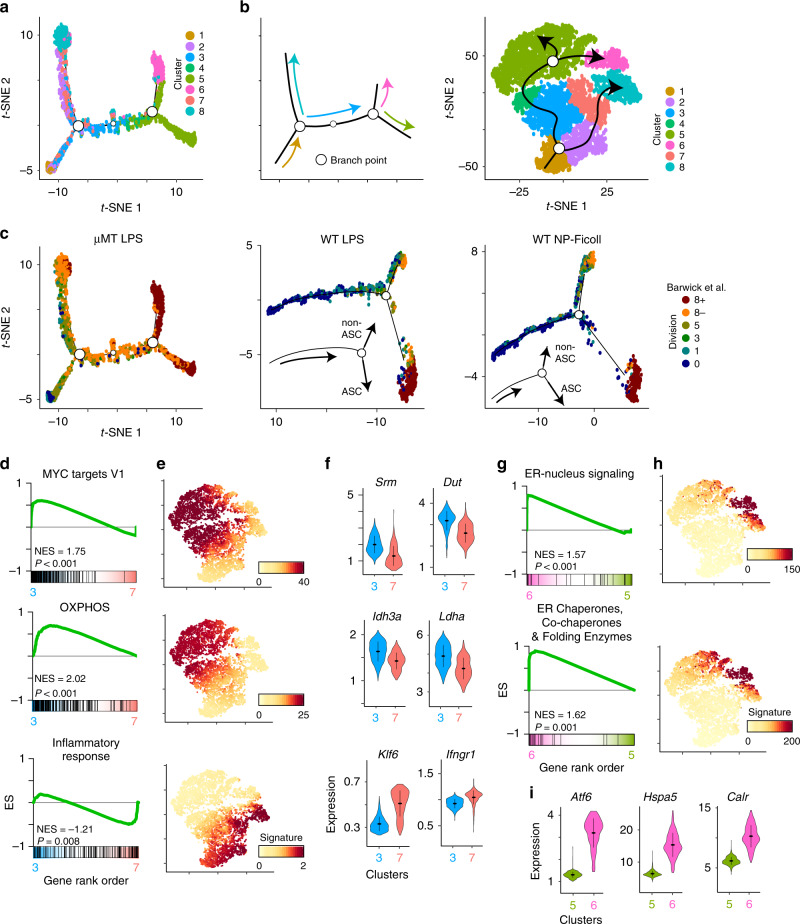
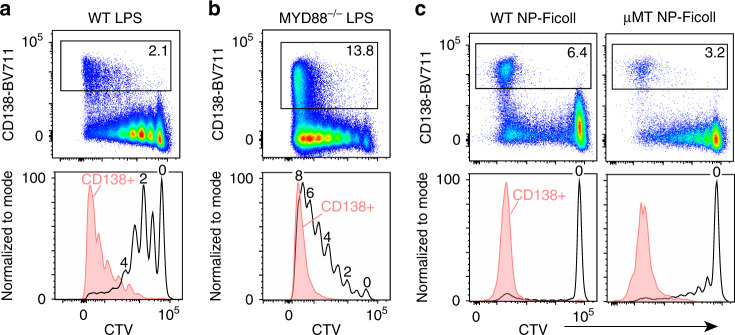
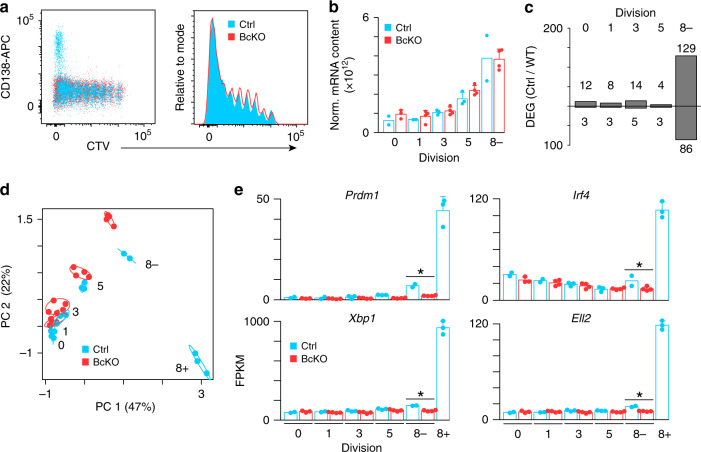
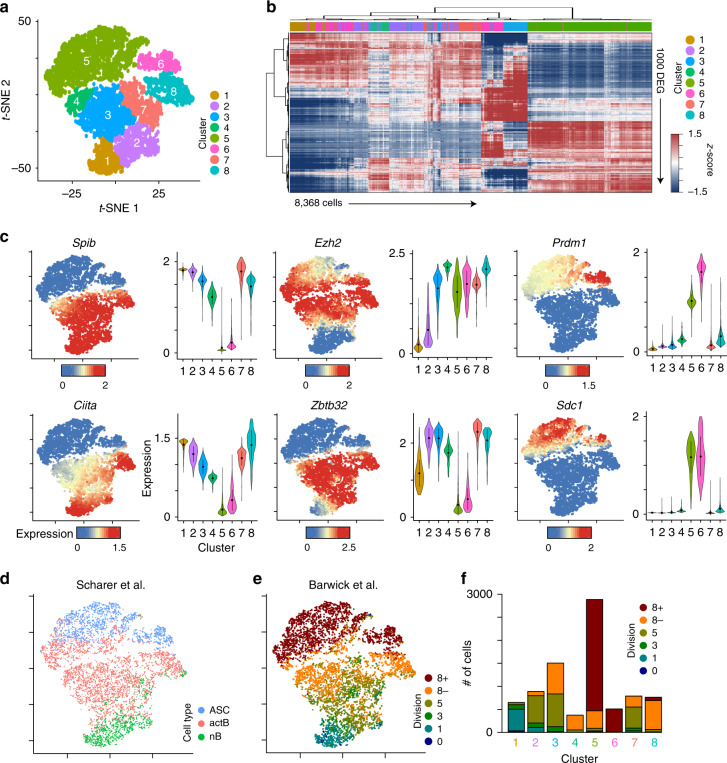
Upon stimulation, B cells assume heterogeneous cell fates, with only a fraction differentiating into antibody-secreting cells (ASC). Here we investigate B cell fate programming and heterogeneity during ASC differentiation using T cell-independent models. We find that maximal ASC induction requires at least eight cell divisions in vivo, with BLIMP-1 being required for differentiation at division eight. Single cell RNA-sequencing of activated B cells and construction of differentiation trajectories reveal an early cell fate bifurcation. The ASC-destined branch requires induction of IRF4, MYC-target genes, and oxidative phosphorylation, with the loss of CD62L expression serving as a potential early marker of ASC fate commitment. Meanwhile, the non-ASC branch expresses an inflammatory signature, and maintains B cell fate programming. Finally, ASC can be further subseted based on their differential responses to ER-stress, indicating multiple development branch points. Our data thus define the cell division kinetics of B cell differentiation in vivo, and identify the molecular trajectories of B cell fate and ASC formation.
受到刺激后,B 细胞会呈现出异质的细胞命运,只有一部分分化为抗体分泌细胞 (ASC)。在这里,我们使用 T 细胞非依赖性模型研究 ASC 分化过程中的 B 细胞命运编程和异质性。我们发现,最大程度地诱导 ASC 需要体内至少进行八次细胞分裂,并且在第八次分裂时需要 BLIMP-1 分化。激活 B 细胞的单细胞 RNA 测序和分化轨迹的构建揭示了早期细胞命运分支。ASC 命运分支需要诱导 IRF4、MYC 靶基因和氧化磷酸化,而 CD62L 表达的丧失可作为 ASC 命运决定的潜在早期标志物。同时,非 ASC 分支表达炎症特征,并维持 B 细胞命运编程。最后,根据 ASC 对 ER 应激的不同反应,可将其进一步分为亚群,表明存在多个发育分支点。因此,我们的数据定义了体内 B 细胞分化的细胞分裂动力学,并确定了 B 细胞命运和 ASC 形成的分子轨迹。