Department of Radiation Oncology, The University of Alabama at Birmingham, Birmingham, Alabama, United States of America.
Informatics Institute, Department of Medicine, The University of Alabama at Birmingham, Birmingham, Alabama, United States of America.
PLoS One. 2018 Aug 21;13(8):e0202139. doi: 10.1371/journal.pone.0202139. eCollection 2018.
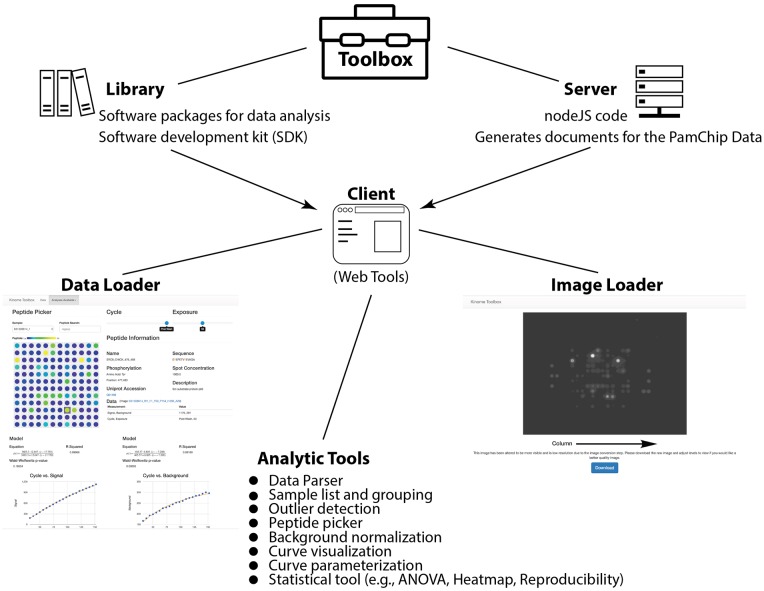
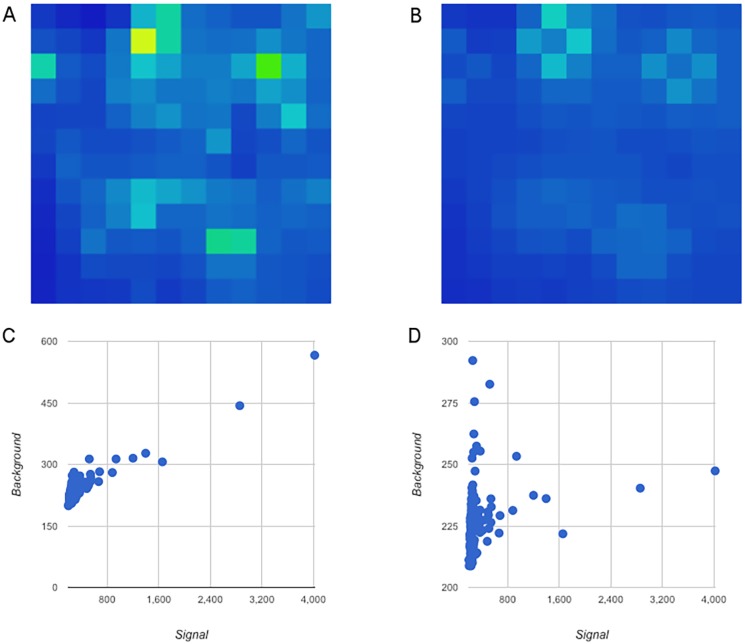
Kinomics is an emerging field of science that involves the study of global kinase activity. As kinases are essential players in virtually all cellular activities, kinomic testing can directly examine protein function, distinguishing kinomics from more remote, upstream components of the central dogma, such as genomics and transcriptomics. While there exist several different approaches for kinomic research, peptide microarrays are the most widely used and involve kinase activity assessment through measurement of phosphorylation of peptide substrates on the array. Unfortunately, bioinformatic tools for analyzing kinomic data are quite limited necessitating the development of accessible open access software in order to facilitate standardization and dissemination of kinomic data for scientific use. Here, we examine and present tools for data analysis for the popular PamChip® (PamGene International) kinomic peptide microarray. As a result, we propose (1) a procedural optimization of kinetic curve data capture, (2) new methods for background normalization, (3) guidelines for the detection of outliers during parameterization, and (4) a standardized data model to store array data at various analytical points. In order to utilize the new data model, we developed a series of tools to implement the new methods and to visualize the various data models. In the interest of accessibility, we developed this new toolbox as a series of JavaScript procedures that can be utilized as either server side resources (easily packaged as web services) or as client side scripts (web applications running in the browser). The aggregation of these tools within a Kinomics Toolbox provides an extensible web based analytic platform that researchers can engage directly and web programmers can extend. As a proof of concept, we developed three analytical tools, a technical reproducibility visualizer, an ANOVA based detector of differentially phosphorylated peptides, and a heatmap display with hierarchical clustering.
kinomics 是一门新兴的科学领域,涉及对全球激酶活性的研究。由于激酶是几乎所有细胞活动的重要参与者,因此 kinomic 测试可以直接检查蛋白质功能,将 kinomics 与中心法则中更遥远的上游成分(如基因组学和转录组学)区分开来。虽然 kinomic 研究有几种不同的方法,但肽微阵列是最广泛使用的方法,涉及通过测量阵列上肽底物的磷酸化来评估激酶活性。不幸的是,用于分析 kinomic 数据的生物信息学工具非常有限,因此需要开发可访问的开放获取软件,以促进 kinomic 数据的标准化和传播,以供科学使用。在这里,我们检查并介绍了流行的 PamChip®(PamGene International)kinomic 肽微阵列的数据分析工具。因此,我们提出了(1)动力学曲线数据捕获的过程优化,(2)用于背景归一化的新方法,(3)在参数化过程中检测异常值的准则,以及(4)用于以各种分析点存储阵列数据的标准化数据模型。为了利用新的数据模型,我们开发了一系列工具来实现新方法并可视化各种数据模型。为了便于访问,我们将这个新的工具箱开发为一系列 JavaScript 过程,可以用作服务器端资源(轻松打包为 Web 服务)或客户端脚本(在浏览器中运行的 Web 应用程序)。这些工具的集合在一个 Kinomics Toolbox 中提供了一个可扩展的基于 Web 的分析平台,研究人员可以直接使用,网络程序员可以扩展。作为概念验证,我们开发了三个分析工具,一个技术再现性可视化器,一个基于 ANOVA 的差异磷酸化肽检测工具,以及一个具有层次聚类的热图显示。