Bremer Vincent, Becker Dennis, Kolovos Spyros, Funk Burkhardt, van Breda Ward, Hoogendoorn Mark, Riper Heleen
Institute of Information Systems, Leuphana University, Lüneburg, Germany.
Department of Clinical, Neuro- & Developmental Psychology, Vrije University, Amsterdam, Netherlands.
J Med Internet Res. 2018 Aug 21;20(8):e10275. doi: 10.2196/10275.
Different treatment alternatives exist for psychological disorders. Both clinical and cost effectiveness of treatment are crucial aspects for policy makers, therapists, and patients and thus play major roles for healthcare decision-making. At the start of an intervention, it is often not clear which specific individuals benefit most from a particular intervention alternative or how costs will be distributed on an individual patient level.
This study aimed at predicting the individual outcome and costs for patients before the start of an internet-based intervention. Based on these predictions, individualized treatment recommendations can be provided. Thus, we expand the discussion of personalized treatment recommendation.
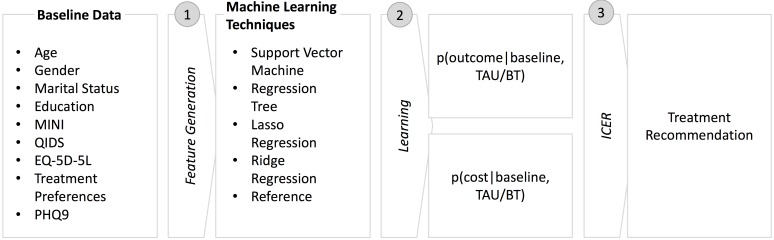
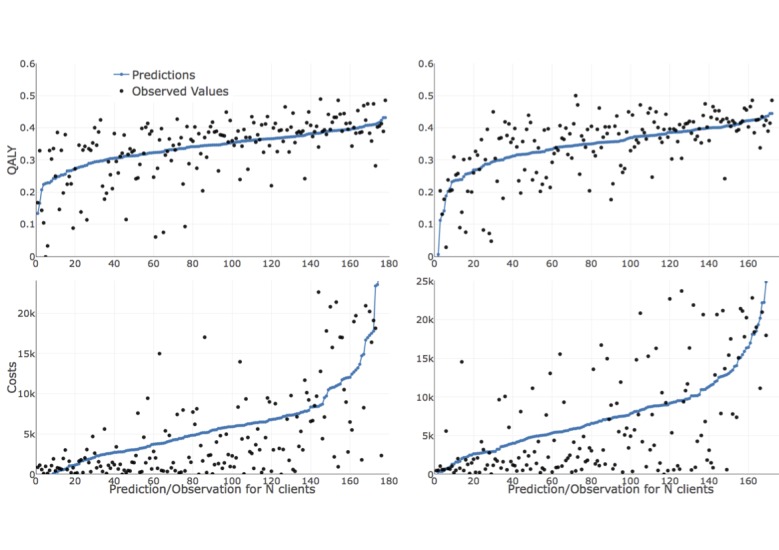
Outcomes and costs were predicted based on baseline data of 350 patients from a two-arm randomized controlled trial that compared treatment as usual and blended therapy for depressive disorders. For this purpose, we evaluated various machine learning techniques, compared the predictive accuracy of these techniques, and revealed features that contributed most to the prediction performance. We then combined these predictions and utilized an incremental cost-effectiveness ratio in order to derive individual treatment recommendations before the start of treatment.
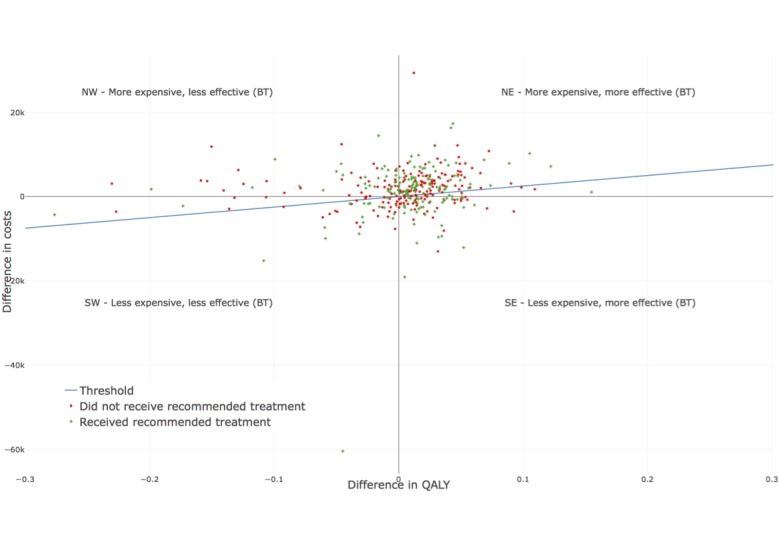
Predicting clinical outcomes and costs is a challenging task that comes with high uncertainty when only utilizing baseline information. However, we were able to generate predictions that were more accurate than a predefined reference measure in the shape of mean outcome and cost values. Questionnaires that include anxiety or depression items and questions regarding the mobility of individuals and their energy levels contributed to the prediction performance. We then described how patients can be individually allocated to the most appropriate treatment type. For an incremental cost-effectiveness threshold of 25,000 €/quality-adjusted life year, we demonstrated that our recommendations would have led to slightly worse outcomes (1.98%), but with decreased cost (5.42%).
Our results indicate that it was feasible to provide personalized treatment recommendations at baseline and thus allocate patients to the most beneficial treatment type. This could potentially lead to improved decision-making, better outcomes for individuals, and reduced health care costs.
心理障碍存在不同的治疗选择。治疗的临床效果和成本效益对政策制定者、治疗师和患者而言都是至关重要的方面,因此在医疗保健决策中发挥着重要作用。在干预开始时,通常并不清楚哪些特定个体能从特定的治疗选择中获益最多,或者成本将如何在个体患者层面上进行分配。
本研究旨在预测基于互联网的干预开始前患者的个体治疗结果和成本。基于这些预测,可以提供个性化的治疗建议。因此,我们扩展了关于个性化治疗建议的讨论。
基于一项双臂随机对照试验中350名患者的基线数据预测结果和成本,该试验比较了抑郁症的常规治疗和混合疗法。为此,我们评估了各种机器学习技术,比较了这些技术的预测准确性,并揭示了对预测性能贡献最大的特征。然后,我们结合这些预测结果,并利用增量成本效益比,以便在治疗开始前得出个体治疗建议。
仅利用基线信息来预测临床结果和成本是一项具有挑战性的任务,存在高度不确定性。然而,我们能够生成比以平均结果和成本值形式预先定义的参考指标更准确的预测。包含焦虑或抑郁项目以及关于个体活动能力和能量水平问题的问卷对预测性能有贡献。然后,我们描述了如何将患者个体分配到最合适的治疗类型。对于每质量调整生命年25,000欧元的增量成本效益阈值,我们证明我们的建议可能会导致结果略差(1.98%),但成本降低(5.42%)。
我们的结果表明,在基线时提供个性化治疗建议并将患者分配到最有益的治疗类型是可行的。这可能会改善决策,为个体带来更好的结果,并降低医疗保健成本。