Martínez-Alcalá Claudia I, Rosales-Lagarde Alejandra, Hernández-Alonso Esmeralda, Melchor-Agustin Roberto, Rodriguez-Torres Erika E, Itzá-Ortiz Benjamín A
Consejo Nacional de Ciencia y Tecnología, Ciudad de México, Mexico.
Department of Gerontology, School of Health Sciences, Universidad Autónoma del Estado de Hidalgo, Pachuca, Mexico.
JMIR Res Protoc. 2018 Aug 21;7(8):e172. doi: 10.2196/resprot.9603.
Cognitive impairment is considered one of the most feared chronic conditions among the older adult population since its incidence is approximately twice more frequent than that of dementia. In Mexico, no studies or reports of older adults using technology for cognitive interventions have been published, given that institutions usually frame cognitive stimulation tasks in paper and pencil (ie, in the traditional manner).
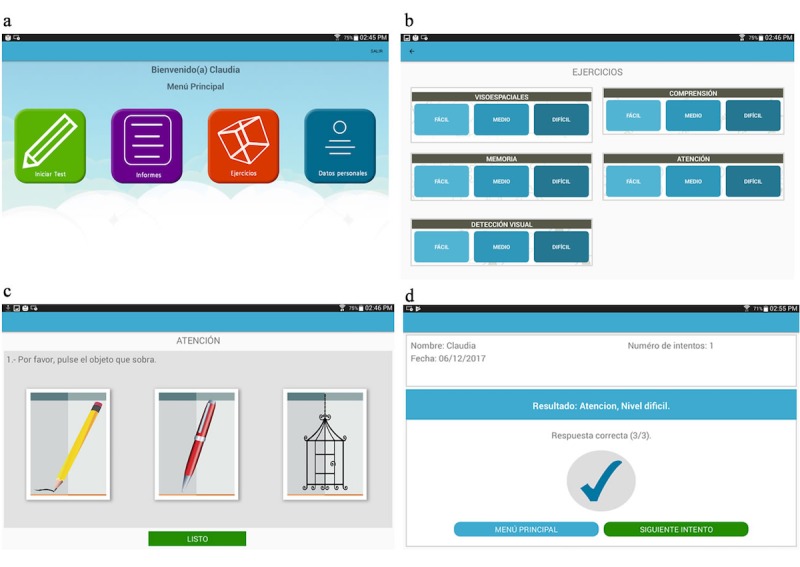
The objective of this study was to create and analyze the effect, viability, and impact of a mobile app for cognitive stimulation implemented among a group of elderly adults (over 60 years of age) from the state of Hidalgo in Mexico.
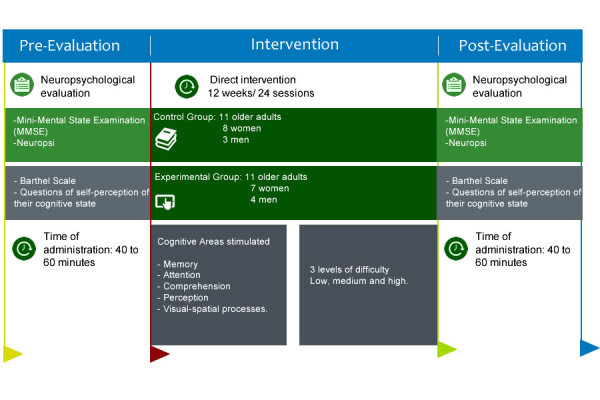
This study was a nonprobabilistic pilot trial using convenience sampling. An intervention was implemented among a group of 22 older adults between 60 and 80 years of age over 12 weeks. Half of the older adults were stimulated with the mobile app (experimental group) and the other half followed the traditional paper and pencil training (control group). Assessments with the Mini-Mental State Examination (MMSE) and the Neuropsi, a neuropsychological test validated in Mexico, were done before and after both cognitive stimulations.
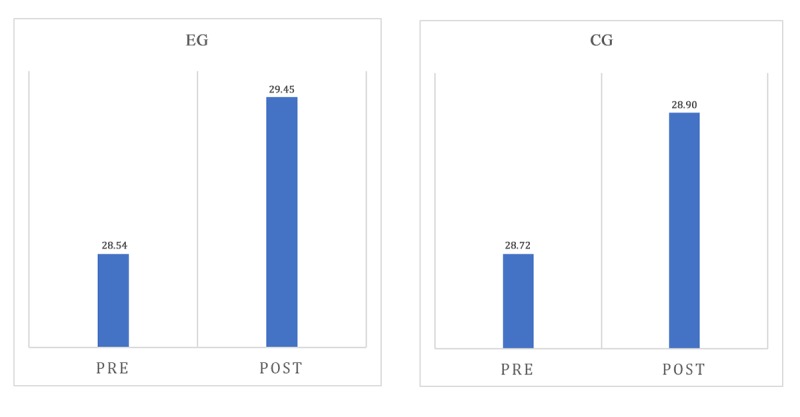
According to the analyzed data, 6/11 (55%) participants from the experimental group obtained better results in their cognitive skills, and 5 (45%) of the adults maintained their score, given that the participants were able to execute the exercises repetitively. Meanwhile, for the control group, only 3/11 (27%) participants obtained better results in the postevaluation. Significant values for results of the MMSE were obtained in the postevaluation for the experimental group compared to the control group, while results did not show significant differences in the Neuropsi. Regarding the validation of the app, all the participants evaluated its pertinence positively.
The intervention data show that the experimental group obtained better results in the postevaluation given that the participants were able to execute the exercises repetitively. The control group could not accomplish this since they had to respond on the manual and no further attempts were provided. However, both groups increased their score in the neuropsychological evaluations. This suggests that a longer and more frequent intervention is required.
RR1-10.2196/9603.
认知障碍被认为是老年人群中最令人担忧的慢性病之一,因为其发病率大约是痴呆症的两倍。在墨西哥,尚未发表关于老年人使用技术进行认知干预的研究或报告,因为机构通常采用纸笔形式(即传统方式)来设计认知刺激任务。
本研究的目的是创建并分析一款用于认知刺激的移动应用程序在墨西哥伊达尔戈州一组60岁以上老年人中的效果、可行性和影响。
本研究是一项采用便利抽样的非概率性试点试验。在一组22名60至80岁的老年人中进行了为期12周的干预。一半老年人使用移动应用程序进行刺激(实验组),另一半采用传统的纸笔训练(对照组)。在两种认知刺激前后,使用简易精神状态检查表(MMSE)和在墨西哥验证过的神经心理测试Neuropsi进行评估。
根据分析数据,实验组的6/11(55%)参与者在认知技能方面取得了更好的成绩,5名(45%)成年人保持了他们的分数,因为参与者能够重复执行练习。同时,对于对照组,只有3/11(27%)的参与者在评估后取得了更好的成绩。与对照组相比,实验组在评估后的MMSE结果中获得了显著值,而在Neuropsi测试中结果没有显示出显著差异。关于应用程序的验证,所有参与者都对其相关性给予了积极评价。
干预数据表明,实验组在评估后取得了更好的成绩,因为参与者能够重复执行练习。对照组无法做到这一点,因为他们必须在手册上作答,且没有提供进一步的尝试。然而,两组在神经心理评估中的分数都有所提高。这表明需要进行更长时间和更频繁的干预。
RR1-10.2196/9603