Campinas State University, Department of Tocoginecology, Campinas, São Paulo, Brazil.
Campinas State University, Institute of Chemistry, Campinas, São Paulo, Brazil.
PLoS One. 2018 Aug 22;13(8):e0202401. doi: 10.1371/journal.pone.0202401. eCollection 2018.
To characterize the lipid profile in vaginal discharge of women with vulvovaginal candidiasis, cytolytic vaginosis, or no vaginal infection or dysbiosis.
Cross-sectional study.
Genital Infections Ambulatory, Department of Tocogynecology, University of Campinas, Campinas, São Paulo-Brazil.
Twenty-four women were included in this study: eight with vulvovaginal candidiasis, eight with cytolytic vaginosis and eight with no vaginal infections or dysbiosis (control group).
The lipid profile in vaginal discharge of the different study groups was determined by liquid chromatography-mass spectrometry and further analyzed with MetaboAnalyst 3.0 platform.
Vaginal lipids concentration and its correlation with vulvovaginal candidiasis and cytolytic vaginosis.
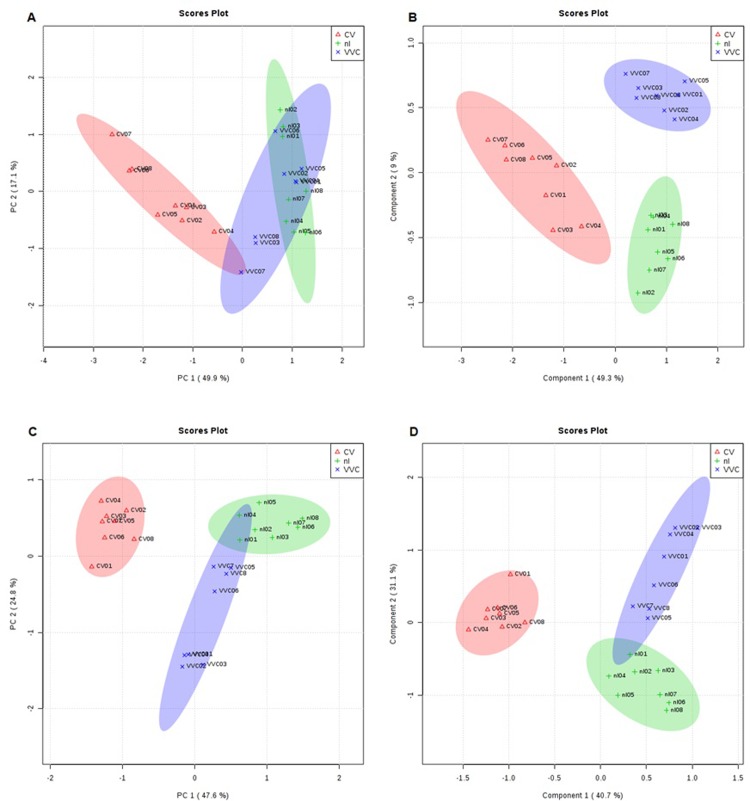
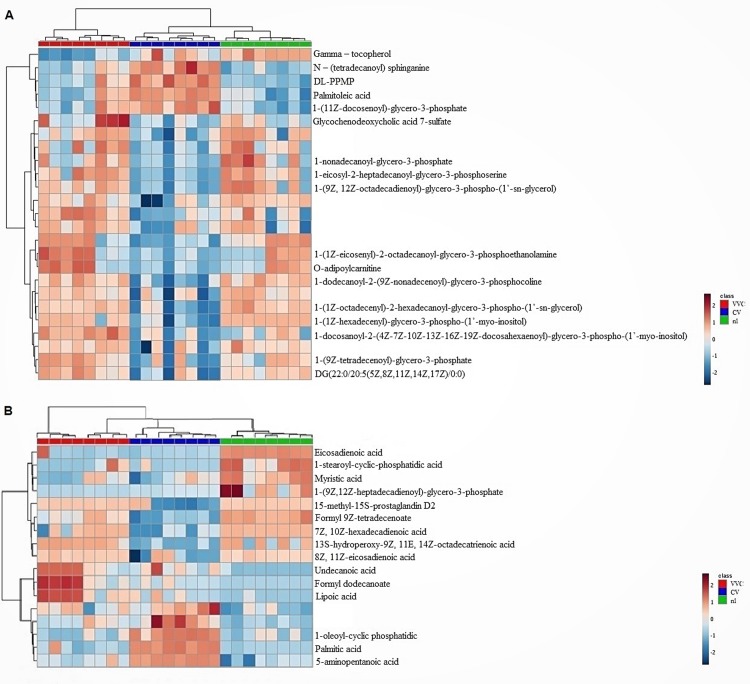
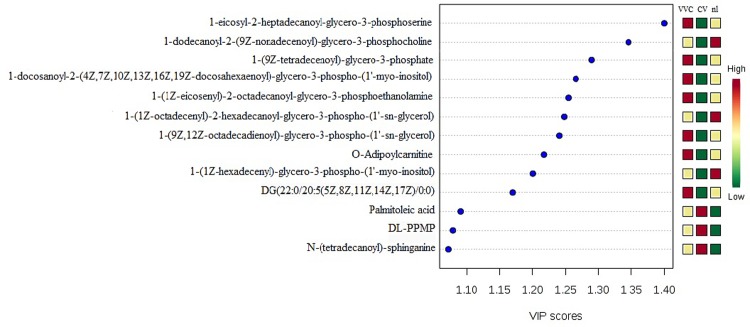
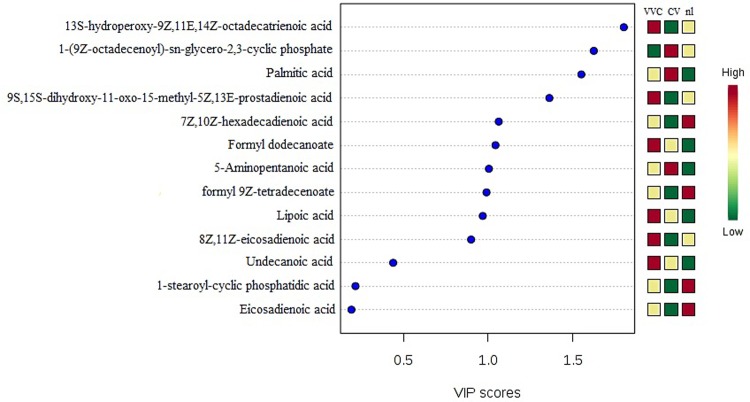
PCA, PLS-DA and hierarchical clustering analyses indicated 38 potential lipid biomarkers for the different groups, correlating with oxidative stress, inflammation, apoptosis and integrity of the vaginal epithelial tissue. Among these, greater concentrations were found for Glycochenodeoxycholic acid-7-sulfate, O-adipoylcarnitine, 1-eicosyl-2-heptadecanoyl-glycero-3-phosphoserine, undecanoic acid, formyl dodecanoate and lipoic acid in the vulvovaginal candidiasis group; N-(tetradecanoyl)-sphinganine, DL-PPMP, 1-oleoyl-cyclic phosphatidic, palmitic acid and 5-aminopentanoic acid in the cytolytic vaginosis group; and 1-nonadecanoyl-glycero-3-phosphate, eicosadienoic acid, 1-stearoyl-cyclic-phosphatidic acid, 1-(9Z,12Z-heptadecadienoyl)-glycero-3-phosphate, formyl 9Z-tetradecenoate and 7Z,10Z-hexadecadienoic acid in the control group.
Lipids related to oxidative stress and apoptosis were found in higher concentrations in women with vulvovaginal candidiasis and cytolytic vaginosis, while lipids related to epithelial tissue integrity were more pronounced in the control group. Furthermore, in women with cytolytic vaginosis, we observed higher concentrations of lipids related to bacterial overgrowth.
描述患有外阴阴道念珠菌病、细胞溶解性阴道病或无阴道感染或菌群失调的女性阴道分泌物中的脂质谱。
横断面研究。
巴西坎皮纳斯大学妇科感染门诊。
本研究纳入 24 名女性:8 名患有外阴阴道念珠菌病,8 名患有细胞溶解性阴道病,8 名无阴道感染或菌群失调(对照组)。
通过液相色谱-质谱法测定不同研究组阴道分泌物中的脂质谱,并使用 MetaboAnalyst 3.0 平台进一步分析。
阴道脂质浓度及其与外阴阴道念珠菌病和细胞溶解性阴道病的相关性。
PCA、PLS-DA 和层次聚类分析表明,38 种潜在的脂质生物标志物可用于不同组别,与氧化应激、炎症、细胞凋亡和阴道上皮组织完整性相关。其中,在外阴阴道念珠菌病组中,甘氨胆酸-7-硫酸、O-脂酰肉碱、1-二十烷酰-2-十七烷酰基甘油-3-磷酸丝氨酸、十一酸、甲酰基十二烷酸和硫辛酸的浓度较高;在细胞溶解性阴道病组中,N-(十四烷酰基)-鞘氨醇、DL-PPMP、1-油酰基环磷酰磷脂、棕榈酸和 5-氨基戊酸的浓度较高;在对照组中,1-十九烷酰基甘油-3-磷酸、二十碳二烯酸、1-硬脂酰环磷酰磷脂、1-(9Z,12Z-十七碳二烯酰基)-甘油-3-磷酸、甲酰基 9Z-十四烯酸和 7Z,10Z-十六碳二烯酸的浓度较高。
在外阴阴道念珠菌病和细胞溶解性阴道病患者中,与氧化应激和细胞凋亡相关的脂质浓度较高,而与上皮组织完整性相关的脂质在对照组中更为明显。此外,在患有细胞溶解性阴道病的女性中,我们观察到与细菌过度生长相关的脂质浓度较高。