Tang Fanlong, Xu Guangji, Ma Tao, Kong Lingyun
School of Transportation, Southeast University, Nanjing, Jiangsu 210096, China.
School of Civil Engineering & Architecture, Chongqing Jiaotong University, Chongqing 400074, China.
Materials (Basel). 2018 Aug 21;11(9):1488. doi: 10.3390/ma11091488.
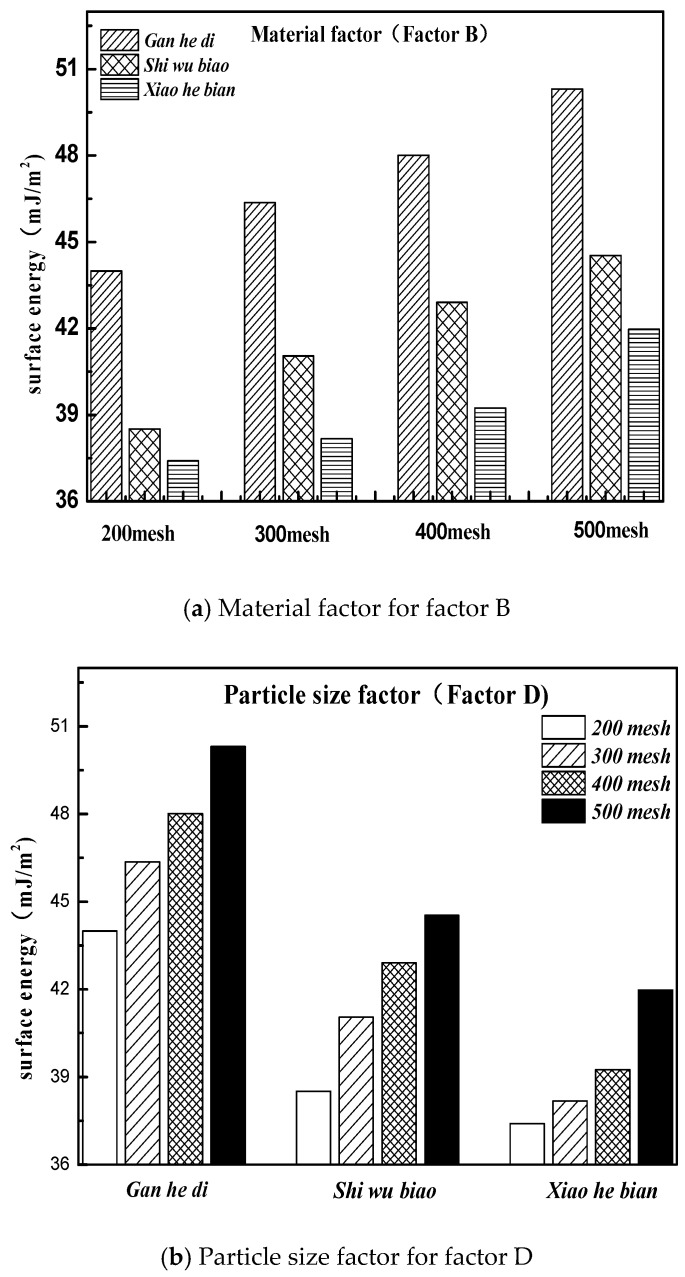
Aggregate is an indispensable raw material for emulsified asphalt construction. For the purpose of explaining the influence of aggregate characteristics on the demulsification speed of emulsified asphalt, the surface energy and specific surface area (SSA) characteristics of aggregates were calculated based on the capillary rise method and the BET (Brunauer-Emmett-Teller) adsorption test. Afterwards, the effect of the surface energy and specific surface area of the aggregate on the emulsified asphalt demulsification speed was systematically studied by using ultraviolet spectroscopy as well as the orthogonal test. Experimental results indicate that the specific surface energy parameter of the aggregate is certainly related to the particle size of the aggregate. That is, the surface free energy of the unit system is proportional to the surface area A and the density of the interface unit. The specific surface area parameter of aggregates increases with the decrease of particle size, when the particle size is reduced to 600 mesh, the specific surface area parameters of the three aggregates selected in this paper tend to be consistent. Orthogonal experimental analysis demonstrates that the surface energy and specific surface area have an impact on the emulsion breaking speed and they are proven to be positively correlated. Meanwhile, in the case of small particle sizes, there is no statistically significant correlation between the physical properties of aggregates and the demulsification speed of emulsified asphalt, and the physical property of aggregates is not the main factor that affects the demulsification speed of the emulsified asphalt. On the contrary, the material properties of the aggregate, such as acid-base property and chargeability, are the dominant factors.
集料是乳化沥青施工中不可或缺的原材料。为解释集料特性对乳化沥青破乳速度的影响,基于毛细上升法和BET(布鲁瑙尔-埃米特-特勒)吸附试验计算了集料的表面能和比表面积(SSA)特性。之后,采用紫外光谱法以及正交试验系统研究了集料的表面能和比表面积对乳化沥青破乳速度的影响。实验结果表明,集料的比表面能参数与集料粒径肯定相关。也就是说,单位体系的表面自由能与表面积A以及界面单元的密度成正比。集料的比表面积参数随粒径减小而增大,当粒径减小到600目时,本文选取的三种集料的比表面积参数趋于一致。正交试验分析表明,表面能和比表面积对破乳速度有影响,且二者呈正相关。同时,在粒径较小的情况下,集料的物理性质与乳化沥青破乳速度之间不存在统计学上的显著相关性,集料的物理性质不是影响乳化沥青破乳速度的主要因素。相反,集料的材料性质,如酸碱性质和带电性,才是主导因素。