Department of Obstetrics and Gynecology, School of Medicine, CHA University, Gyeonggi-do, Seongnam, 13488, South Korea.
Department of Epidemiology, Brown University School of Public Health, Providence, 02903, RI, USA.
BMC Pregnancy Childbirth. 2018 Aug 22;18(1):340. doi: 10.1186/s12884-018-1982-z.
Previous studies suggested associations between prenatal exposure to air pollution and hypertensive disorders of pregnancy. We explored the associations between ambient concentrations of five major air pollutants during preconceptional and prenatal periods and three hypertensive disorders of pregnancy in Seoul, Korea, using a population-representative cohort.
We obtained heath and demographic data of pregnant women residing in Seoul for 2002-2013 from the Korean National Health Insurance Service-National Sample Cohort. For mother's individual exposures to air pollution, we computed concentrations of particulate matter ≤10 μm in diameter (PM), nitrogen dioxide (NO), carbon monoxide (CO), sulfur dioxide (SO), and ozone (O) during 1, 3, 6, and 12 months to birth using regulatory monitoring data in Seoul. The associations between air pollution and hypertensive disorders were explored by using logistic regression models after adjusting for individual confounders.
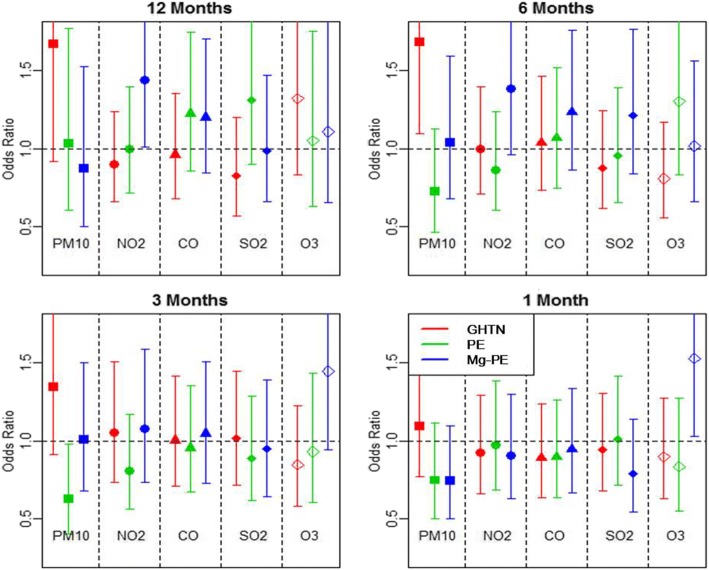
Among 18,835 pregnant women in Seoul, 0.6, 0.5, and 0.4% of women developed gestational hypertension, preeclampsia, and preeclampsia requiring magnesium sulfate (Mg-preeclampsia), respectively. Although most odds ratios (ORs) were not statistically significant, we found increasing risk gradients with disease severity depending on the pollutant. There was the association between PM during 6 months to birth and gestational hypertension (OR for an interquartile range increase = 1.68 [95% confidence interval = 1.09-2.58]). NO and ozone during 12 and 1 month, respectively, before birth were associated with Mg-preeclampsia (1.43 [1.01-2.03], 1.53 [1.03-2.27]).
We observed positive associations of exposure to some air pollutants before and during pregnancy with hypertensive disorders of pregnancy among the Korean general population. Future studies with refined exposure metrics should confirm our findings.
先前的研究表明,产前暴露于空气污染与妊娠高血压疾病之间存在关联。我们在韩国首尔,利用一个具有代表性的人群队列,探索了受孕前和孕期期间五种主要空气污染物的环境浓度与三种妊娠高血压疾病之间的关系。
我们从韩国国民健康保险服务-国家样本队列中获取了 2002 年至 2013 年期间居住在首尔的孕妇的健康和人口统计学数据。对于母亲个体的空气污染暴露,我们使用首尔的监管监测数据计算了直径≤10μm 的颗粒物(PM)、二氧化氮(NO)、一氧化碳(CO)、二氧化硫(SO)和臭氧(O)在 1、3、6 和 12 个月到出生时的浓度。在调整了个体混杂因素后,我们使用逻辑回归模型探讨了空气污染与高血压疾病之间的关系。
在首尔的 18835 名孕妇中,分别有 0.6%、0.5%和 0.4%的孕妇患有妊娠期高血压、子痫前期和需要硫酸镁治疗的子痫前期(Mg-子痫前期)。尽管大多数比值比(OR)没有统计学意义,但我们发现随着疾病严重程度的增加,污染物的风险梯度也在增加。在受孕前 6 个月的 PM 与妊娠期高血压之间存在关联(OR 为 1.68 [95%置信区间为 1.09-2.58])。在出生前分别为 12 个月和 1 个月的 NO 和臭氧与 Mg-子痫前期相关(1.43 [1.01-2.03],1.53 [1.03-2.27])。
我们观察到在韩国普通人群中,受孕前和孕期期间暴露于某些空气污染物与妊娠高血压疾病之间存在正相关关系。未来应采用更精细的暴露指标进行研究,以证实我们的发现。