Department of Biostatistics, School of Public Health, Nanjing Medical University, Nanjing, 211166, Jiangsu, China.
Department of Environmental Health, Harvard T.H. Chan School of Public Health, Boston, MA, 02115, USA.
Environ Health. 2018 Aug 22;17(1):68. doi: 10.1186/s12940-018-0412-z.
Increasing evidence suggests that welding fume exposure is associated with systemic inflammation. Although celluar metabolites may be associated with inflammation, there is limited information on metabolomic changes during welding fume exposure. Such changes may play an important role in the occurrence, development, and prevention of metal-associated diseases. We aim to investigate human metabolomics changes pre- and post-welding fume exposure.
This study included 52 boilermakers totally. We collected plasma samples pre- and post-shift welding fume exposure and prepared samples using the automated MicroLab STAR® system. Metabolite concentrations were measured using ultra performance liquid chromatography - tandem mass spectrometer (UPLC-MS/MS) methods. Two-way analysis of variance was used to test the significance of metabolite changes with false discovery rate correction.
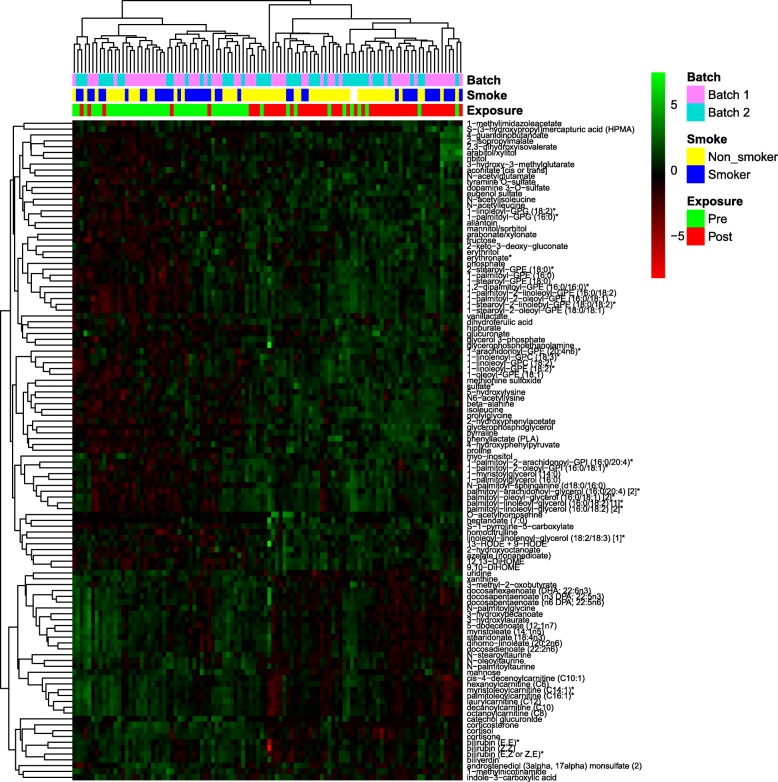
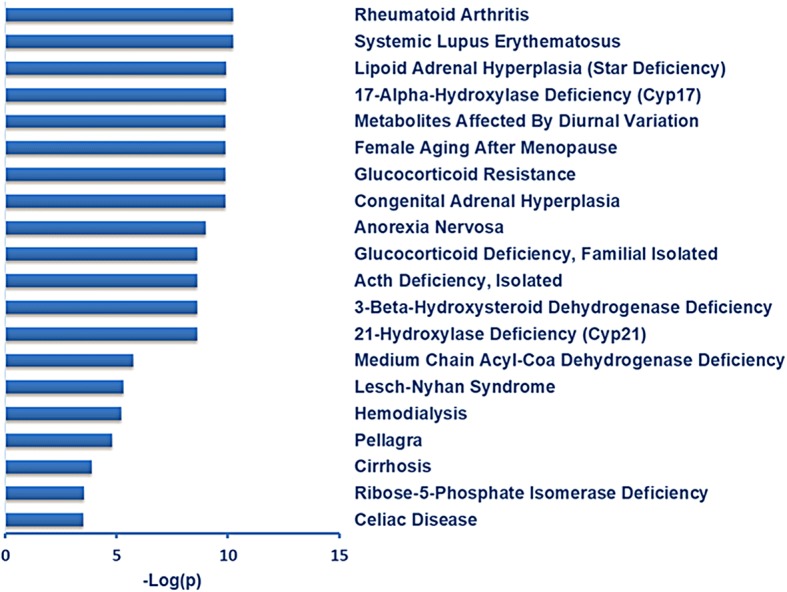
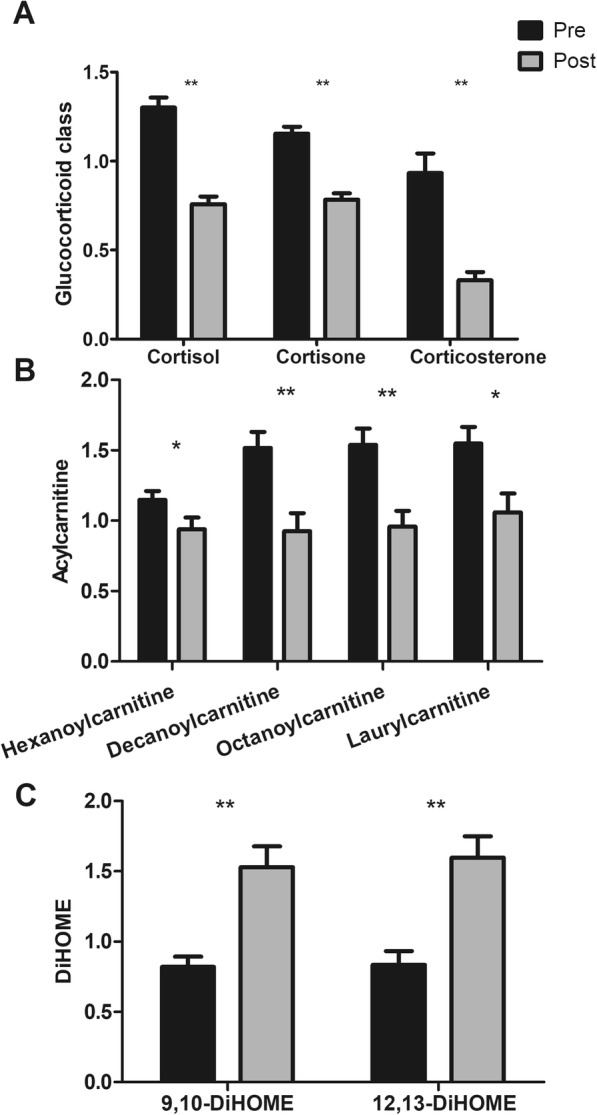
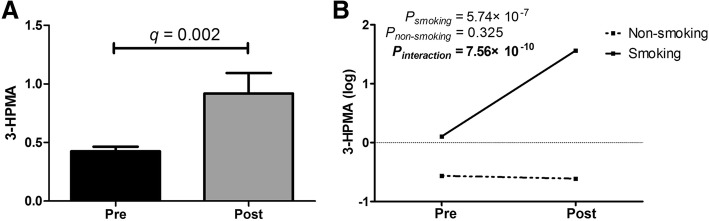
Analysis detected several metabolic changes after welding fume exposure, mainly involved in the lipid pathway [glucocorticoid class (cortisol, corticosterone, and cortisone), acylcarnitine class, and DiHOME species (9,10-DiHOME and 12,13-DiHOME)], amino acid utilization (isoleucine, proline and phenylalanine), and S-(3-hydroxypropyl) mercapturic acid (3-HPMA). These compounds are all associated with inflammation according to previous studies. Further, additive interaction effects linked smoking and 3-HPMA levels. In the metabolite set enrichment analysis for diseases, the top two disease-associated metabolite pathways were systemic inflammation-related diseases including rheumatoid arthritis and systemic lupus erythematosus.
This global metabolomics study shows evidence that metabolite changes during welding fume exposure are closely associated with systemic inflammation. The altered metabolites detected may be potential health monitoring biomarkers for boilermakers, especially for inflammation-related disease prevention.
越来越多的证据表明,焊接烟尘暴露与全身炎症有关。虽然细胞代谢物可能与炎症有关,但关于焊接烟尘暴露期间代谢组学变化的信息有限。这些变化可能在金属相关疾病的发生、发展和预防中发挥重要作用。我们旨在研究焊接烟尘暴露前后的人体代谢组学变化。
本研究共纳入 52 名锅炉制造工人。我们在轮班前后采集了血浆样本,并使用自动化 MicroLab STAR®系统制备了样本。使用超高效液相色谱-串联质谱(UPLC-MS/MS)方法测量代谢物浓度。采用双向方差分析和错误发现率校正来测试代谢物变化的显著性。
分析检测到焊接烟尘暴露后发生了几种代谢变化,主要涉及脂质途径[糖皮质激素类(皮质醇、皮质酮和可的松)、酰基肉碱类和 DiHOME 类(9,10-DiHOME 和 12,13-DiHOME)]、氨基酸利用(异亮氨酸、脯氨酸和苯丙氨酸)和 S-(3-羟丙基)硫代尿酸(3-HPMA)。根据先前的研究,这些化合物都与炎症有关。此外,吸烟和 3-HPMA 水平之间存在附加的交互作用效应。在疾病相关代谢物集富集分析中,前两个与疾病相关的代谢物途径是全身性炎症相关疾病,包括类风湿关节炎和系统性红斑狼疮。
这项全局代谢组学研究表明,焊接烟尘暴露期间代谢物的变化与全身炎症密切相关。检测到的改变的代谢物可能是锅炉工人,特别是炎症相关疾病预防的潜在健康监测生物标志物。