Centre for Blood Research.
Department of Pathology and Laboratory Medicine, and.
Blood Adv. 2018 Aug 28;2(16):2104-2114. doi: 10.1182/bloodadvances.2016003616.
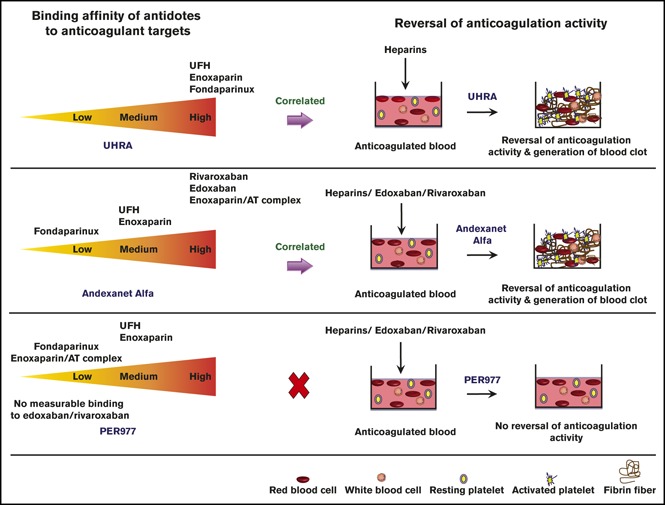
Anticoagulants such as unfractionated heparin (UFH), low-molecular-weight heparins (LMWHs), fondaparinux, and direct oral anticoagulants (DOACs) targeting thrombin (IIa) or factor Xa (FXa) are widely used in prevention and treatment of thromboembolic disorders. However, anticoagulant-associated bleeding is a concern that demands monitoring and neutralization. Protamine, the UFH antidote, has limitations, while there is no antidote available for certain direct FXa inhibitors. Improved antidotes in development include UHRA (Universal Heparin Reversal Agent) for all heparin anticoagulants; andexanet alfa (andexanet), a recombinant antidote for both direct FXa inhibitors and LMWHs; and ciraparantag (PER977), a small-molecule antidote for UFH, LMWHs, and certain DOACs. The binding affinities of these antidotes for their presumed anticoagulant targets have not been compared. Here, isothermal titration calorimetry (ITC) was used to determine the affinity of each antidote for its putative targets. Clotting and chromogenic FXa assays were used to characterize neutralization activity, and electron microscopy was used to visualize the effect of each antidote on clot morphology in the absence or presence of anticoagulant. ITC confirmed binding of UHRA to all heparins, and binding of andexanet to edoxaban and rivaroxaban, and to the antithrombin-enoxaparin complex. PER977 was found to bind heparins weakly, but not the direct FXa inhibitors studied. For UHRA and andexanet, an affinity at or below the micromolar level was found to correlate with neutralization activity, while no reversal activity was observed for the PER977/anticoagulant systems. Standard metrics of clot structure were found to correlate weakly with PER977's activity. This is the first study comparing 3 antidotes in development, with each exerting activity through a distinct mechanism.
肝素(UFH)、低分子肝素(LMWH)、磺达肝癸钠和直接口服抗凝剂(DOAC)等抗凝剂广泛用于预防和治疗血栓栓塞性疾病。然而,抗凝相关出血是一个令人关注的问题,需要进行监测和中和。肝素的解毒剂鱼精蛋白存在局限性,而某些直接 FXa 抑制剂则没有解毒剂。正在开发中的改进解毒剂包括用于所有肝素抗凝剂的 UHRA(通用肝素逆转剂);以及用于直接 FXa 抑制剂和 LMWH 的重组解毒剂andexanet alfa(andexanet);以及用于 UFH、LMWH 和某些 DOAC 的小分子解毒剂 ciraparantag(PER977)。这些解毒剂与其假定抗凝靶标的结合亲和力尚未进行比较。在这里,等温滴定量热法(ITC)用于确定每种解毒剂与其假定靶标的亲和力。凝血和显色 FXa 测定用于表征中和活性,电子显微镜用于在不存在或存在抗凝剂的情况下观察每种解毒剂对凝块形态的影响。ITC 证实 UHRA 与所有肝素结合,andexanet 与依度沙班和利伐沙班以及抗凝血酶-依诺肝素复合物结合。发现 PER977 与肝素结合较弱,但与研究的直接 FXa 抑制剂不结合。对于 UHRA 和 andexanet,发现与中和活性相关的亲和力在微摩尔水平或更低,而对于 PER977/抗凝剂系统则没有观察到逆转活性。发现凝块结构的标准指标与 PER977 的活性弱相关。这是第一项比较 3 种正在开发中的解毒剂的研究,每种解毒剂都通过不同的机制发挥作用。