McGovern Institute for Brain Research, Massachusetts Institute of Technology, Cambridge, MA, USA.
Department of Brain and Cognitive Sciences, Massachusetts Institute of Technology, Cambridge, MA, USA.
Sci Rep. 2018 Aug 22;8(1):12597. doi: 10.1038/s41598-018-30722-0.
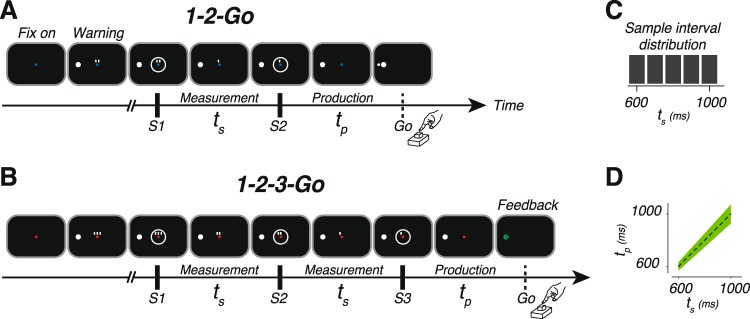
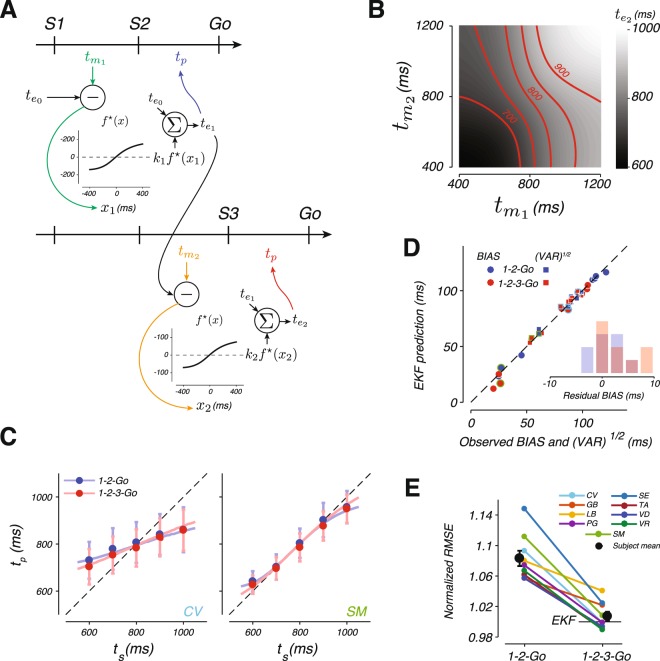
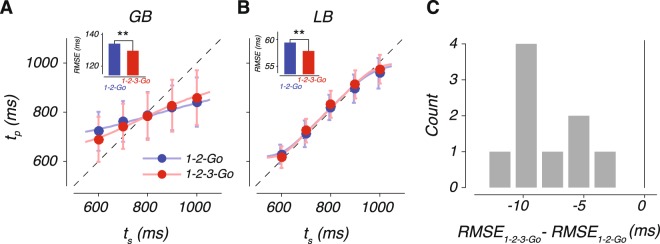
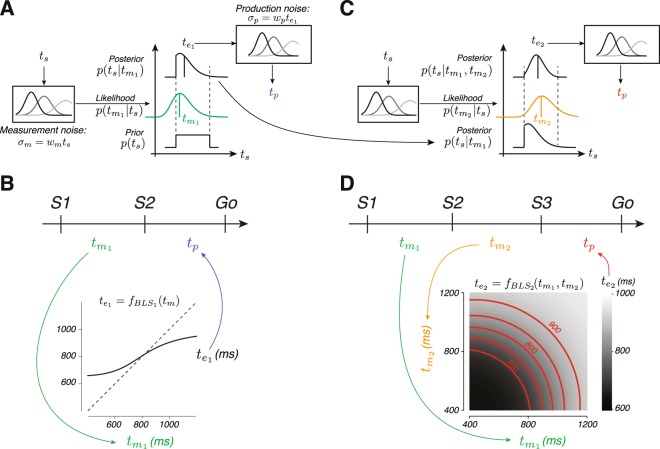
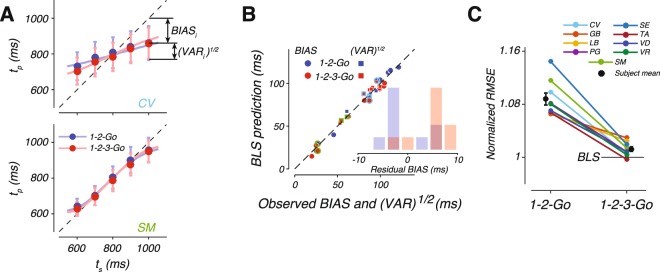
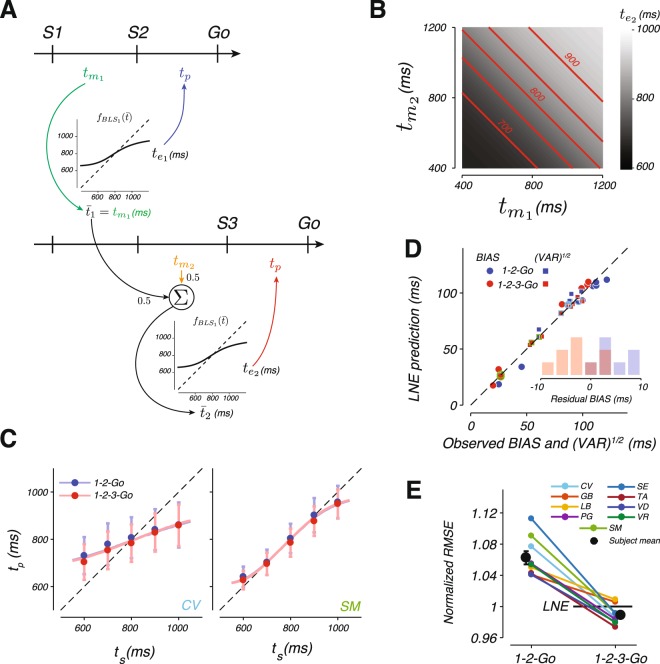
Bayesian models have advanced the idea that humans combine prior beliefs and sensory observations to optimize behavior. How the brain implements Bayes-optimal inference, however, remains poorly understood. Simple behavioral tasks suggest that the brain can flexibly represent probability distributions. An alternative view is that the brain relies on simple algorithms that can implement Bayes-optimal behavior only when the computational demands are low. To distinguish between these alternatives, we devised a task in which Bayes-optimal performance could not be matched by simple algorithms. We asked subjects to estimate and reproduce a time interval by combining prior information with one or two sequential measurements. In the domain of time, measurement noise increases with duration. This property takes the integration of multiple measurements beyond the reach of simple algorithms. We found that subjects were able to update their estimates using the second measurement but their performance was suboptimal, suggesting that they were unable to update full probability distributions. Instead, subjects' behavior was consistent with an algorithm that predicts upcoming sensory signals, and applies a nonlinear function to errors in prediction to update estimates. These results indicate that the inference strategies employed by humans may deviate from Bayes-optimal integration when the computational demands are high.
贝叶斯模型提出,人类将先验信念和感官观察结合起来,以优化行为。然而,大脑如何实现贝叶斯最优推断仍知之甚少。简单的行为任务表明,大脑可以灵活地表示概率分布。另一种观点认为,大脑依赖于简单的算法,只有在计算需求较低时,这些算法才能实现贝叶斯最优行为。为了区分这些替代方案,我们设计了一项任务,在该任务中,简单算法无法匹配贝叶斯最优性能。我们要求受试者通过将先验信息与一到两个连续的测量值相结合来估计和再现时间间隔。在时间领域中,测量噪声会随时间的延长而增加。这种特性使得多个测量值的集成超出了简单算法的能力范围。我们发现,受试者能够使用第二个测量值来更新他们的估计值,但他们的表现并不理想,这表明他们无法更新完整的概率分布。相反,受试者的行为与一种算法一致,该算法预测即将到来的感觉信号,并对预测中的误差应用非线性函数来更新估计值。这些结果表明,当计算需求较高时,人类采用的推断策略可能偏离贝叶斯最优集成。