Department of Psychological & Brain Sciences, University of Massachusetts, Amherst, Massachusetts, USA.
Neuroscience & Behavior Program, University of Massachusetts, Amherst, Massachusetts, USA.
Sci Rep. 2018 Aug 22;8(1):12609. doi: 10.1038/s41598-018-30980-y.
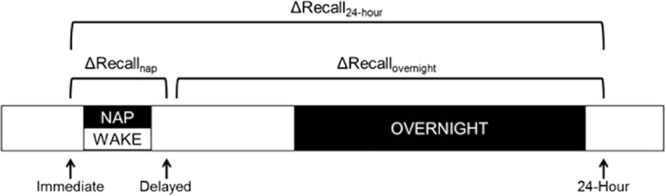
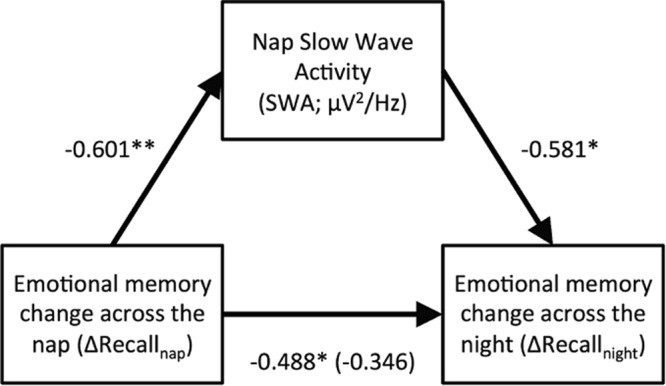
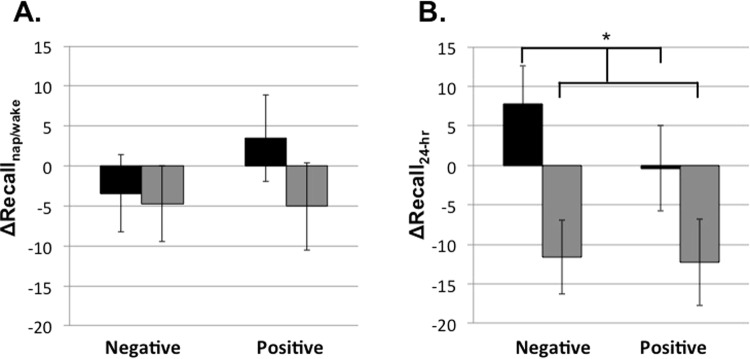
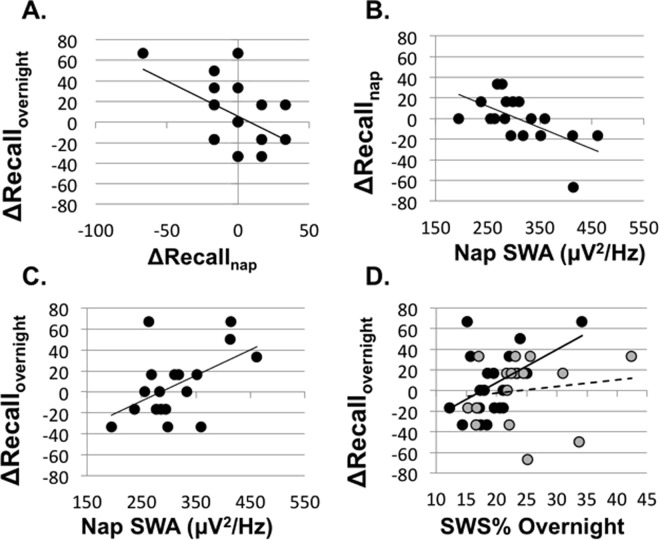
Naps in early childhood support declarative memory consolidation. However, emotional memories are unique in the neural basis of encoding as well as the sleep physiology underlying consolidation. Specifically, while consolidation of declarative memories has been associated with slow wave sleep, a prevailing theory suggests that REM sleep is necessary for consolidation of memories with emotional valence. Thus, we presented children (34-64 months) with faces paired with mean or nice descriptions. There were no significant main effects of emotional valence on recognition memory. Change in memory accuracy also did not differ when probed after a nap compared to the change in memory accuracy after an interval awake. However, when memory was probed again following overnight sleep, the change in memory accuracy was greater if the child napped the previous day. Greater nap slow wave activity was associated with greater memory decay during the nap. Yet nap slow wave activity also predicted greater overnight improvement in memory. These results suggest that sleep bouts can interact to benefit memory in early childhood.
幼儿期的小睡有助于陈述性记忆的巩固。然而,情绪记忆在编码的神经基础以及巩固所涉及的睡眠生理方面是独特的。具体来说,虽然陈述性记忆的巩固与慢波睡眠有关,但一个流行的理论认为, REM 睡眠对于具有情绪效价的记忆的巩固是必要的。因此,我们向儿童(34-64 个月)展示了与中性或正面描述配对的面孔。情绪效价对识别记忆没有显著的主效应。与清醒间隔后的记忆准确性变化相比,午睡后探测到的记忆准确性变化也没有差异。然而,如果前一天孩子午睡,那么在一夜睡眠后再次探测记忆时,记忆准确性的变化会更大。更大的午睡慢波活动与午睡期间更大的记忆衰退有关。然而,午睡慢波活动也预示着夜间记忆的改善更大。这些结果表明,睡眠发作可以相互作用,有利于幼儿期的记忆。