Wu San-Gang, Zhang Wen-Wen, Sun Jia-Yuan, Li Feng-Yan, Lin Qin, He Zhen-Yu
Department of Radiation Oncology, Xiamen Cancer Hospital, First Affiliated Hospital of Xiamen University, Xiamen, China.
State Key Laboratory of Oncology in South China, Department of Radiation Oncology, Sun Yat-sen University Cancer Center, Collaborative Innovation Center of Cancer Medicine, Guangzhou, China.
Front Oncol. 2018 Aug 8;8:302. doi: 10.3389/fonc.2018.00302. eCollection 2018.
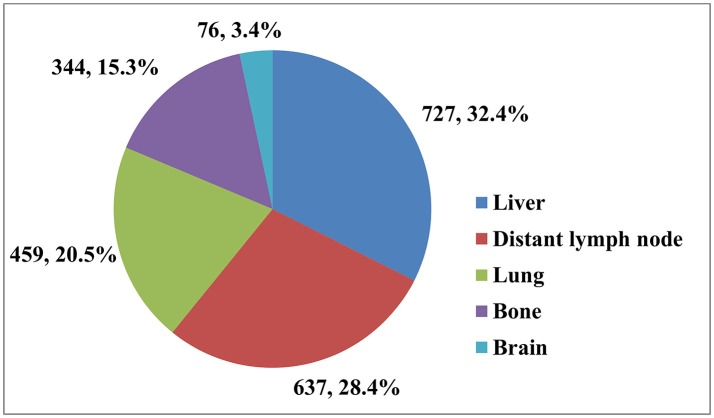
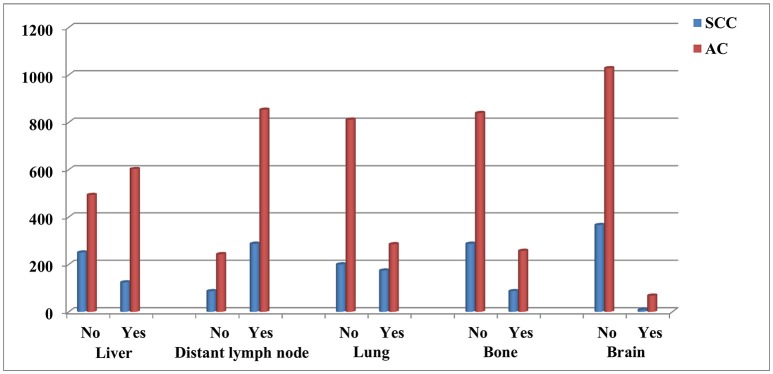
Distant metastasis remains the major cause of treatment failure in esophageal cancer, though there have been few large-scale studies of the patterns of distant metastasis in different histological types. We investigated the patterns of distant metastasis in esophageal adenocarcinoma (AC) and squamous cell carcinoma (SCC) using a population-based approach. Patients with stage IV esophageal cancer at diagnosis were identified using the Surveillance, Epidemiology, and End Results database. Multivariable logistic regression was performed to identify potential risk factors for site-specific distant metastasis to the distant lymph nodes, bone, liver, brain, and lung at diagnosis. We identified 1,470 patients with complete data for analysis including 1,096 (74.6%) patients with AC and 374 (25.4%) patients with SCC. A total of 2,243 sites of distant metastasis were observed, the liver was the most common site of distant metastasis (727, 32.4%), followed by the distant lymph nodes (637, 28.4%), lung (459, 20.5%), bone (344, 15.3%), and brain (76, 3.4%). Multivariable logistic regression showed that compared to patients with SCC, patients with AC were more likely to have metastasis to the brain (odds ratio [OR] 3.026, 95% confidence interval [CI] 1.441-6.357, = 0.003) and liver (OR 1.848, 95% CI 1.394-2.451, < 0.001), and less likely to have metastasis to the lung (OR 0.404, 95% CI 0.316-0.516, < 0.001). Histological type had no effect on metastasis to the distant lymph nodes or bone. Patients with esophageal AC are more likely to present with liver and brain metastases, and less likely to present with lung metastasis than patients with esophageal SCC.
远处转移仍然是食管癌治疗失败的主要原因,尽管针对不同组织学类型的远处转移模式的大规模研究较少。我们采用基于人群的方法调查了食管腺癌(AC)和鳞状细胞癌(SCC)的远处转移模式。使用监测、流行病学和最终结果数据库确定诊断时为IV期食管癌的患者。进行多变量逻辑回归以确定诊断时远处淋巴结、骨、肝、脑和肺特定部位远处转移的潜在危险因素。我们确定了1470例有完整数据可供分析的患者,其中包括1096例(74.6%)AC患者和374例(25.4%)SCC患者。共观察到2243个远处转移部位,肝脏是最常见的远处转移部位(727个,32.4%),其次是远处淋巴结(637个,28.4%)、肺(459个,20.5%)、骨(344个,15.3%)和脑(76个,3.4%)。多变量逻辑回归显示,与SCC患者相比,AC患者更易发生脑转移(比值比[OR]3.026,95%置信区间[CI]1.441 - 6.357,P = 0.003)和肝转移(OR 1.848,95%CI 1.394 - 2.451,P < 0.001),而发生肺转移的可能性较小(OR 0.404,95%CI 0.316 - 0.516,P < 0.001)。组织学类型对远处淋巴结或骨转移无影响。与食管SCC患者相比,食管AC患者更易出现肝和脑转移,而出现肺转移的可能性较小。