Gretschel Dietlind, Visagie Surona, Inglis Gakeemah
Centre of Rehabilitation Studies, Stellenbosch University, South Africa.
Physiotherapy Division, Faculty of Health Sciences, Stellenbosch University, South Africa.
S Afr J Physiother. 2017 Oct 20;73(1):361. doi: 10.4102/sajp.v73i1.361. eCollection 2017.
Community integration is an important outcome of rehabilitation, because the ultimate focus of rehabilitation is to enable people to participate in their life roles.
To determine community integration scores achieved by adults with disabilities post discharge from an in-patient rehabilitation centre in the Western Cape Province.
Fifty-nine individuals participated in this cross-sectional study. Community integration was determined using the Reintegration to Normal Living Index (RNLI). Descriptive analysis of age, gender, medical diagnosis and RNLI scores was performed. Kruskal-Wallis test and -tests were used to determine whether there exists any relationship between age, gender, medical diagnosis and RNLI scores ( < 0.05).
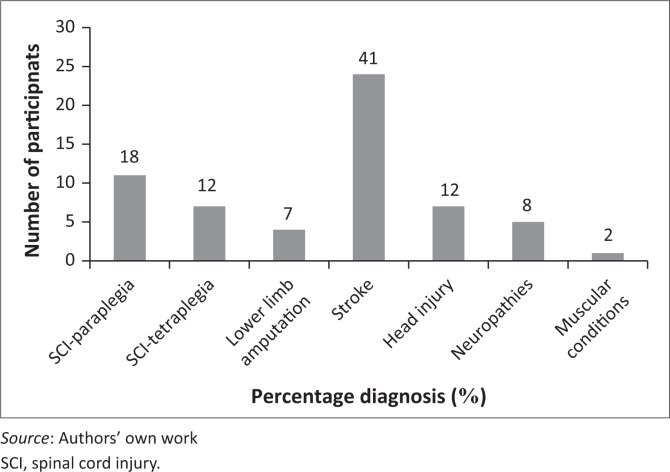
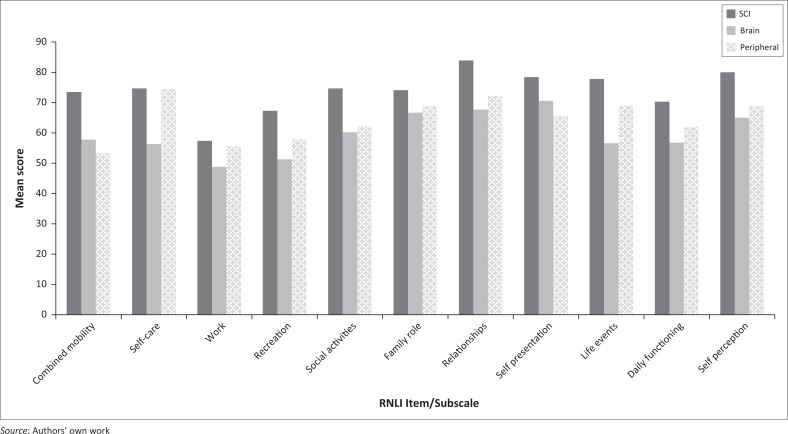
Participants' mean age was 45 (± 15.9) years. Of the study participants, 54% were women. The most common diagnosis was stroke (41%), followed by spinal cord injury (30%). The mean overall RNLI score was 66.3 (± 25.5). Persons with brain trauma (stroke or head injury) had a mean of 60.9 (±20.3); those with spinal cord injury had a mean of 75.2 (± 25.8) and those with peripheral impairments had a mean of 65.5 (± 30.5). The RNLI domains 'personal relationships' 73.45 (± 31.6) and 'presentation of self' 72.13 (± 35.4) recorded the highest mean scores. The domain 'work or meaningful activities' had the lowest mean score 52.54 (± 35.3). 'Community mobility' (59.9; ± 34.6) and 'recreation' (57.3; ± 37.2) also had mean scores below 60. No statistically significant relationships were found between age, gender and medical diagnosis and RNLI scores.
The relatively low mean scores indicate that participants achieved poor community reintegration.
社区融入是康复的一项重要成果,因为康复的最终重点是使人们能够参与其生活角色。
确定西开普省一家住院康复中心出院后的成年残疾人的社区融入得分。
59人参与了这项横断面研究。使用重新融入正常生活指数(RNLI)来确定社区融入情况。对年龄、性别、医学诊断和RNLI得分进行了描述性分析。采用Kruskal-Wallis检验和t检验来确定年龄、性别、医学诊断与RNLI得分之间是否存在任何关系(P<0.05)。
参与者的平均年龄为45(±15.9)岁。在研究参与者中,54%为女性。最常见的诊断是中风(41%),其次是脊髓损伤(30%)。RNLI的总体平均得分为66.3(±25.5)。脑外伤(中风或头部受伤)患者的平均分为60.9(±20.3);脊髓损伤患者的平均分为75.2(±25.8),周围损伤患者的平均分为65.5(±30.5)。RNLI领域中,“人际关系”(73.45±31.6)和“自我呈现”(72.13±35.4)的平均得分最高。“工作或有意义的活动”领域的平均得分最低,为52.54(±35.3)。“社区出行”(59.9;±34.6)和“娱乐”(57.3;±37.2)的平均得分也低于60。在年龄、性别、医学诊断与RNLI得分之间未发现统计学上的显著关系。
相对较低的平均得分表明参与者的社区重新融入情况较差。