Department of Surgery, Division of Cardiac Surgery, Medical University of Vienna, Vienna, Austria.
Department of Internal Medicine II, Division of Cardiology, Medical University of Vienna, Vienna, Austria.
Eur J Cardiothorac Surg. 2019 Mar 1;55(3):527-533. doi: 10.1093/ejcts/ezy273.
The Edwards INTUITY Valve System is a balloon-expandable bioprosthesis, inspired from the Edwards Magna valve and transcatheter technology, with a subvalvular stent frame to enable rapid deployment. We report a single-centre experience of aortic valve replacement with this novel bioprosthesis.
Five hundred consecutive patients, of whom 45.6% were female with a mean age of 73.5 [standard deviation (SD) 7.9 years], with severe aortic stenosis who received a rapid deployment aortic valve between May 2010 and July 2017 were included in a prospective and ongoing database. The median follow-up time was 12 months, and the total accumulated follow-up time was 818 patient years. Preoperative characteristics, operative parameters, survival, valve-related adverse events and valve haemodynamics were assessed.
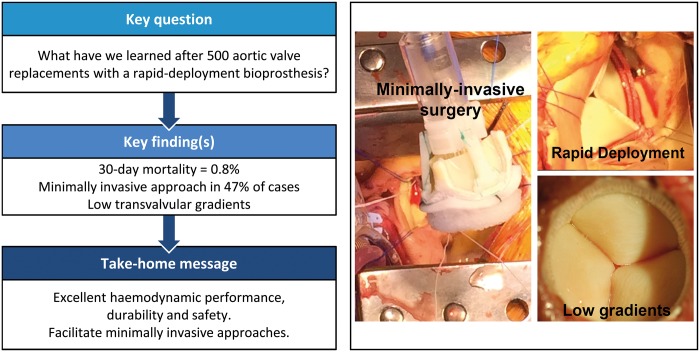
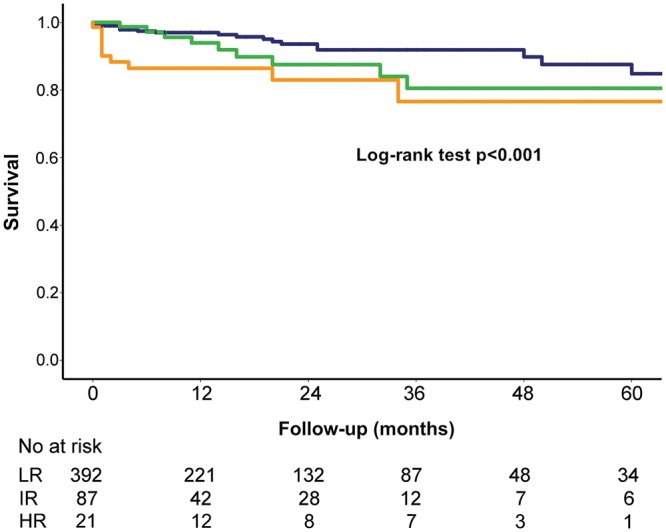
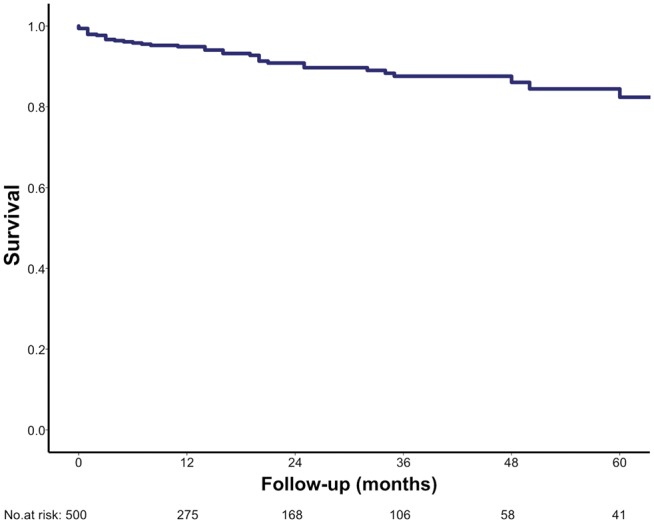
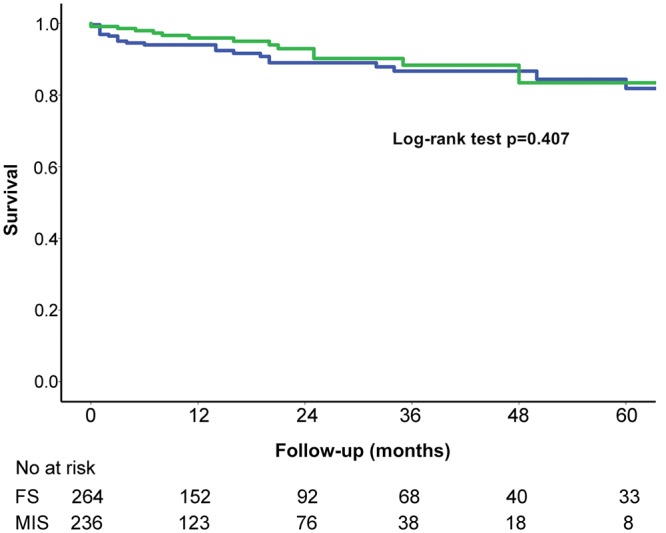
Thirty-day mortality was 0.8% (4/500), and overall survival at 1, 3 and 5 years was 94%, 89% and 81%, respectively. A minimally invasive surgical approach was chosen in 236 patients (47%), of which 122 (24%) were operated on through an anterior right thoracotomy. Cross-clamp and cardiopulmonary bypass times for isolated aortic valve replacement were 53 (SD 17) and 89 (SD 29) min for full sternotomy as well as 75 (SD 23) and 110 (SD 31) min for minimally invasive surgery approaches (P < 0.001). Mean gradients at discharge, 1, 3 and 5 years were 13 (SD 5), 11 (SD 4), 12 (SD 5) and 11 (SD 3) mmHg, respectively. New pacemaker implantation was necessary in 8.6% of patients. A single case (0.2%) of structural degeneration was registered after 6 years. Valve explantation for non-structural dysfunction or endocarditis occurred in 9 patients (1.8%).
This rapid deployment aortic valve has shown excellent results concerning haemodynamic performance, durability and safety. Implantation requires specific training, and the rate of pacemaker implantation remains a matter of concern. This novel valve also facilitates minimally invasive approaches and may be beneficial in complex combined procedures.
Edwards INTUITY 瓣膜系统是一种球囊扩张型生物瓣,灵感来自于 Edwards Magna 瓣膜和经导管技术,并带有瓣下支架框架以实现快速扩张。我们报告了一种使用这种新型生物瓣进行主动脉瓣置换的单中心经验。
在 2010 年 5 月至 2017 年 7 月期间,连续纳入 500 例患有严重主动脉瓣狭窄的患者(45.6%为女性,平均年龄 73.5[标准差(SD)7.9 岁])接受快速扩张主动脉瓣置换术。前瞻性、持续的数据库中包括。中位随访时间为 12 个月,总随访时间为 818 患者年。评估术前特征、手术参数、存活率、瓣膜相关不良事件和瓣膜血流动力学。
30 天死亡率为 0.8%(4/500),1、3 和 5 年总生存率分别为 94%、89%和 81%。236 例患者(47%)选择了微创外科方法,其中 122 例(24%)通过前右开胸手术进行手术。全胸骨切开术的体外循环和体外循环时间分别为 53(SD 17)和 89(SD 29)分钟,微创外科方法为 75(SD 23)和 110(SD 31)分钟(P<0.001)。出院时、1、3 和 5 年的平均梯度分别为 13(SD 5)、11(SD 4)、12(SD 5)和 11(SD 3)mmHg。8.6%的患者需要植入新的起搏器。6 年后仅登记了 1 例(0.2%)结构性退行性变病例。9 例(1.8%)因非结构性功能障碍或心内膜炎而进行瓣膜取出。
这种快速扩张主动脉瓣在血流动力学性能、耐久性和安全性方面表现出优异的结果。植入需要特殊的培训,而植入起搏器的比率仍然是一个令人关注的问题。这种新型瓣膜还便于微创方法,并且可能在复杂的联合手术中有益。