Han David S, Zhou Weiping, Seigne John D, Lynch Kristine E, Schroeck Florian R
The Dartmouth Institute for Health Policy and Clinical Practice, Geisel School of Medicine at Dartmouth, Lebanon, NH.
Section of Urology, Dartmouth-Hitchcock Medical Center, Lebanon, NH; Norris Cotton Cancer Center, Dartmouth-Hitchcock Medical Center, Lebanon, NH.
Urology. 2018 Dec;122:83-88. doi: 10.1016/j.urology.2018.08.011. Epub 2018 Aug 20.
To assess geographic variation in cystoscopy rates among women vs men with suspected bladder cancer, lending insight into gender-specific differences in cystoscopic evaluation.
We conducted a cross-sectional study of all fee-for-service Medicare beneficiaries within 306 Hospital Referral Regions (HRRs) who received care in 2014. For each HRR, we calculated the age- and race-adjusted cystoscopy rate for women and men as our primary outcome. The rate was the number of beneficiaries who underwent cystoscopy for bladder cancer symptoms (using procedure and ICD-9 diagnosis codes) divided by all beneficiaries in the HRR. We used the coefficient of variation to compare relative variability of cystoscopy rates.
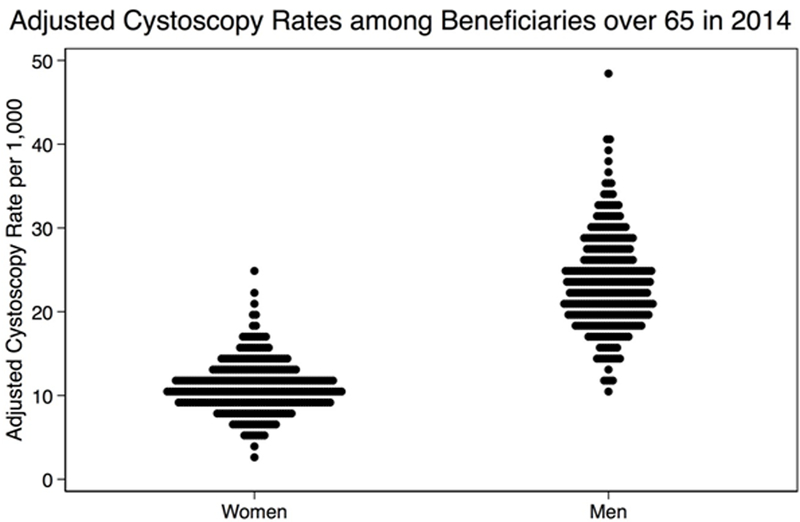
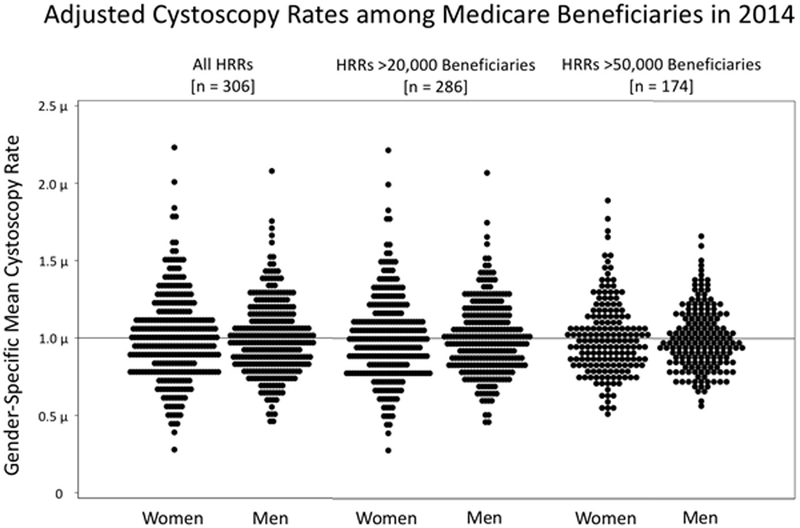
Overall, 173,551 women (n = 14.8 million) and 286,090 men (n = 11.5 million) underwent cystoscopy in 2014. While women received less cystoscopies compared to men (mean 11.0 vs 23.5 per 1000, P < .001), there was greater variation in cystoscopy rates among women (coefficient of variation 27.5 vs 23.5, P = .010). When restricting to ICD-9 codes for hematuria only, women continued to demonstrate greater variation in cystoscopy rates (coefficient of variation 27.8 vs 24.2, P = .022). Findings were robust across larger HRR sizes-thereby removing some random variation seen in smaller HRRs-as well as across years 2010, 2011, 2012, and 2013.
Cystoscopy rates are lower in women than men, likely due to their lower bladder cancer incidence. However, there is greater variation in cystoscopy rates among women with symptoms of bladder cancer. This may reflect increased provider uncertainty whether to refer and work-up women with suspected bladder cancer.
评估疑似膀胱癌的女性和男性之间膀胱镜检查率的地域差异,以深入了解膀胱镜检查评估中的性别差异。
我们对2014年在306个医院转诊区域(HRR)接受治疗的所有按服务收费的医疗保险受益人进行了横断面研究。对于每个HRR,我们计算了按年龄和种族调整后的女性和男性膀胱镜检查率作为主要结果。该比率是因膀胱癌症状接受膀胱镜检查的受益人数量(使用手术和ICD-9诊断代码)除以HRR中的所有受益人。我们使用变异系数来比较膀胱镜检查率的相对变异性。
总体而言,2014年有173,551名女性(共1480万)和286,090名男性(共1150万)接受了膀胱镜检查。虽然女性接受膀胱镜检查的次数少于男性(平均每1000人分别为11.0次和23.5次,P < .001),但女性膀胱镜检查率的变异性更大(变异系数为27.5对23.5,P = .010)。仅限制使用ICD-9血尿代码时,女性膀胱镜检查率的变异性仍然更大(变异系数为27.8对24.2,P = .022)。在较大规模的HRR中以及2010年、2011年、2012年和2013年期间,研究结果都是稳健的,从而消除了在较小HRR中出现的一些随机变异。
女性的膀胱镜检查率低于男性,可能是因为她们的膀胱癌发病率较低。然而,有膀胱癌症状的女性中膀胱镜检查率的变异性更大。这可能反映出医疗服务提供者在是否转诊和检查疑似膀胱癌女性方面的不确定性增加。