Queiroz Veronica Neves Fialho, da Costa Luiz Guilherme Villares, Barbosa Rogerio Póvoa, Takaoka Flávio, De Baerdemaeker Luc, Cesar Daniel Souza, D'Orto Ulisses Cardoso, Galdi José Roberto, Gottumukkala Vijaya, Cata Juan P, Hemmes Sabrine N T, Hollman Markus W, Kalmar Alain, Moura Lucas A B de, Mariano Renato M, Matot Idit, Mazzinari Guido, Mills Gary H, Posso Irimar de Paula, Teruya Alexandre, Vidal Melo Marcos Francisco, Sprung Juraj, Weingarten Toby N, Treschan Tanja A, Koopman Seppe, Eidelman Leonid, Chen Lee-Lynn, Lee Jae-Woo, Ariño Irujo Jose J, Tena Beatriz, Groeben Harald, Pelosi Paolo, de Abreu Marcelo Gama, Schultz Marcus J, Serpa Neto Ary
Department of Anesthesiology, Hospital Israelita Albert Einstein, São Paulo, Brazil.
Department of Anesthesiology and Perioperative Medicine, Ghent University Hospital, Ghent University, Ghent, Belgium.
BMJ Open. 2018 Aug 23;8(8):e021643. doi: 10.1136/bmjopen-2018-021643.
Robotic-assisted surgery (RAS) has emerged as an alternative minimally invasive surgical option. Despite its growing applicability, the frequent need for pneumoperitoneum and Trendelenburg position could significantly affect respiratory mechanics during RAS. AVATaR is an international multicenter observational study aiming to assess the incidence of postoperative pulmonary complications (PPC), to characterise current practices of mechanical ventilation (MV) and to evaluate a possible association between ventilatory parameters and PPC in patients undergoing RAS.
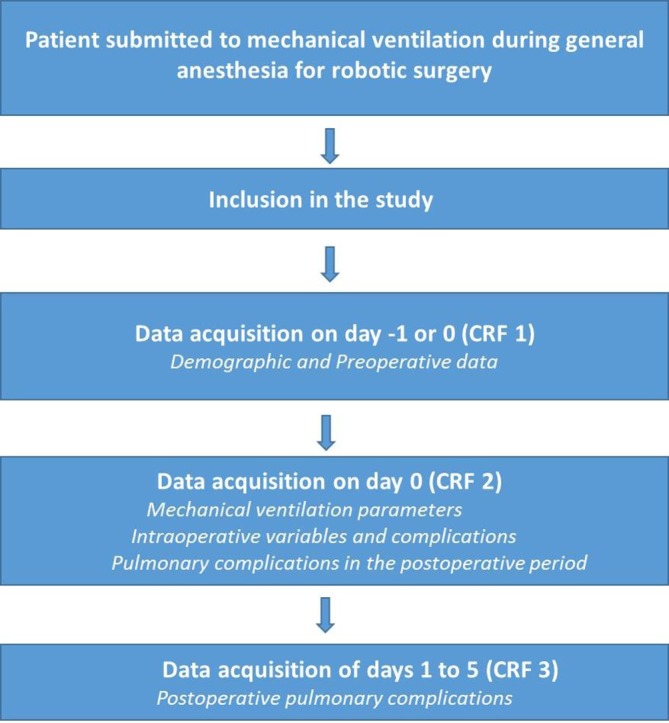
AVATaR is an observational study of surgical patients undergoing MV for general anaesthesia for RAS. The primary outcome is the incidence of PPC during the first five postoperative days. Secondary outcomes include practice of MV, effect of surgical positioning on MV, effect of MV on clinical outcome and intraoperative complications.
This study was approved by the Institutional Review Board of the Hospital Israelita Albert Einstein. The study results will be published in peer-reviewed journals and disseminated at international conferences.
NCT02989415; Pre-results.
机器人辅助手术(RAS)已成为一种替代性的微创外科手术选择。尽管其适用性不断增加,但RAS期间频繁需要气腹和头低脚高位可能会显著影响呼吸力学。AVATaR是一项国际多中心观察性研究,旨在评估术后肺部并发症(PPC)的发生率,描述机械通气(MV)的当前实践情况,并评估接受RAS患者的通气参数与PPC之间的可能关联。
AVATaR是一项针对接受RAS全身麻醉下MV的手术患者的观察性研究。主要结局是术后前五天内PPC的发生率。次要结局包括MV的实践情况、手术体位对MV的影响、MV对临床结局的影响以及术中并发症。
本研究已获得以色列艾伯特爱因斯坦医院机构审查委员会的批准。研究结果将发表在同行评审期刊上,并在国际会议上传播。
NCT02989415;预结果。