Bhattacharyya Dipto, Duta Swarnalee, Yu Sang-Mi, Jeong Sang Chul, Lee Yong Hoon
Division of Biotechnology, Chonbuk National University, Iksan 54596, Korea.
Freshwater Bioresources Utilization Division, Nakdonggang National Institute of Biological Resources, Sangju 37242, Korea.
Plant Pathol J. 2018 Aug;34(4):286-296. doi: 10.5423/PPJ.OA.03.2018.0047. Epub 2018 Aug 1.
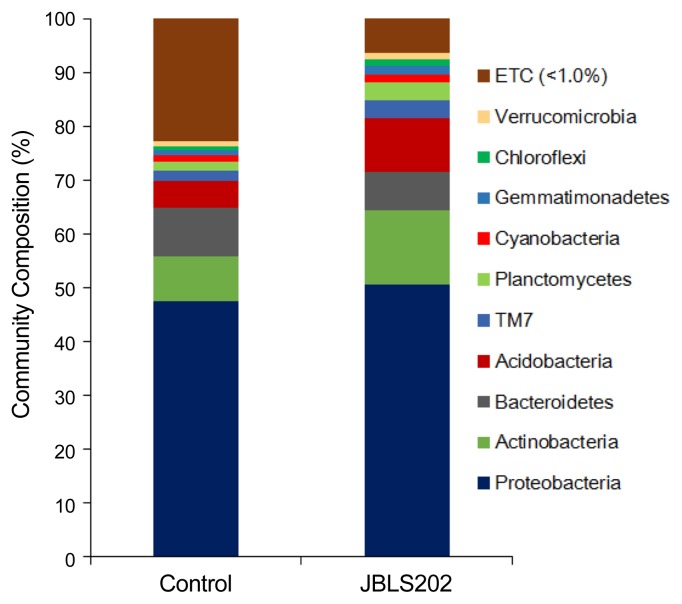
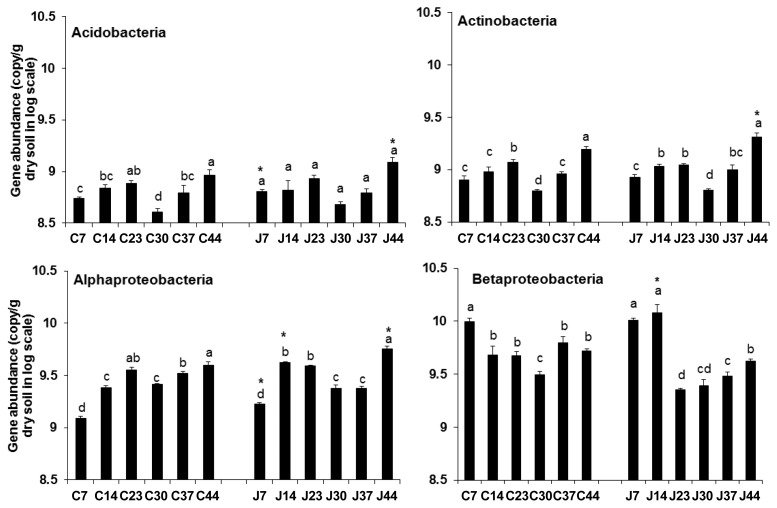
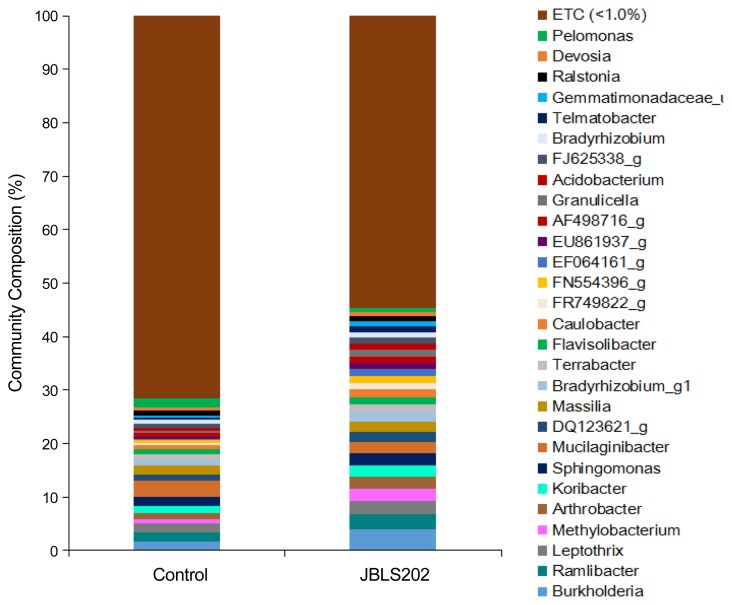
Maintenance of a beneficial microbial community, especially in the rhizosphere, is indispensable for plant growth and agricultural sustainability. In this sense, plant growth-promoting rhizobacteria (PGPR) have been extensively studied for their role in plant growth promotion and disease resistance. However, the impact of introducing PGPR strains into rhizosphere microbial communities is still underexplored. We previously found that the JBLS202 strain (JBLS202) promoted growth of Kimchi cabbage and altered the relative abundance of total bacteria and spp in the treated rhizosphere. To extend these findings, we used pyrosequencing to analyze the changes in bacterial communities in the rhizosphere of Kimchi cabbage after introduction of JBLS202. The alterations were also evaluated by taxon-specific real-time PCR (qPCR). The pyrosequencing data revealed an increase in total bacteria abundance, including specific groups such as Proteobacteria, Acidobacteria, and Actinobacteria, in the treated rhizosphere. Time-course qPCR analysis confirmed the increase in the abundance of Acidobacteria, Actinobacteria, Alphaproteobacteria, and Betaproteobacteria. Furthermore, genes involved in nitrogen cycling were upregulated by JBLS202 treatment indicating changes in ecological function of the rhizosphere soil. Overall, these results indicate that introduction of JBLS202 alters both the composition and function of the rhizosphere bacterial community, which can have direct and indirect effects on plant growth. Therefore, we propose that long-term changes in bacterial composition and community-level function need to be considered for practical use of PGPRs.
维持有益的微生物群落,尤其是根际中的微生物群落,对于植物生长和农业可持续性至关重要。从这个意义上说,植物促生根际细菌(PGPR)因其在促进植物生长和抗病方面的作用而受到广泛研究。然而,将PGPR菌株引入根际微生物群落的影响仍未得到充分探索。我们之前发现JBLS202菌株(JBLS202)促进了泡菜的生长,并改变了处理过的根际中总细菌和特定菌属的相对丰度。为了扩展这些发现,我们使用焦磷酸测序分析了引入JBLS202后泡菜根际细菌群落的变化。还通过分类群特异性实时定量PCR(qPCR)评估了这些变化。焦磷酸测序数据显示,在处理过的根际中,包括变形菌门、酸杆菌门和放线菌门等特定菌群在内的总细菌丰度有所增加。时间进程qPCR分析证实了酸杆菌门、放线菌门、α-变形菌纲和β-变形菌纲丰度的增加。此外,参与氮循环的基因在JBLS202处理后上调,表明根际土壤的生态功能发生了变化。总体而言,这些结果表明引入JBLS202会改变根际细菌群落的组成和功能,这可能对植物生长产生直接和间接影响。因此,我们建议在实际应用PGPR时需要考虑细菌组成和群落水平功能的长期变化。