Centre for Forensic and Family Psychology, University of Nottingham, Yang Fujia Building, Jubilee Campus, Wollaton Road, Nottingham, NG8 1BB, UK.
Faculty of Psychology and Educational Sciences, Parenting and Special Education Research Unit, KU Leuven, Leuven, Belgium.
J Autism Dev Disord. 2019 Feb;49(2):481-494. doi: 10.1007/s10803-018-3722-7.
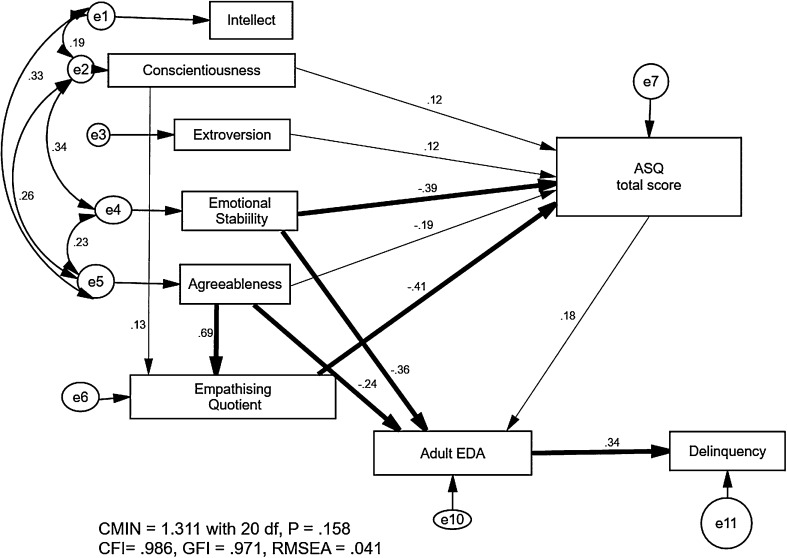
Pathological ("extreme") demand avoidance (PDA) involves obsessively avoiding routine demands and extreme emotional variability. It is clinically linked to autism spectrum disorder (ASD). The observer-rated EDA Questionnaire (EDA-Q) for children was adapted as an adult self-report (EDA-QA), and tested in relation to personality and the short-form Autism Screening Questionnaire (ASQ). Study 1 (n = 347) found the EDA-QA reliable, univariate, and correlated with negative affect, antagonism, disinhibition, psychoticism, and ASQ scores. Study 2 (n = 191) found low agreeableness, greater Emotional Instability, and higher scores on the full ASQ predicted EDA-QA. PDA can screened for using this tool, occurs in the general population, and is associated with extremes of personality. Future studies will examine if PDA occurs in other clinical populations.
病理性(“极端”)回避需求(PDA)包括过分回避日常需求和极端情绪变化。它与自闭症谱系障碍(ASD)有临床关联。用于儿童的观察性 EDA 问卷(EDA-Q)被改编为成人自陈式问卷(EDA-QA),并与个性和短版自闭症筛查问卷(ASQ)进行了测试。研究 1(n=347)发现 EDA-QA 可靠、单变量,与负性情绪、敌对、去抑制、精神病和 ASQ 分数相关。研究 2(n=191)发现较低的宜人性、更大的情绪不稳定性和 ASQ 总分较高预测 EDA-QA。可以使用此工具筛查 PDA,它存在于普通人群中,并与人格极端有关。未来的研究将检查 PDA 是否存在于其他临床人群中。