Laboratory of System Physiology, Department of Biomedical Engineering, Graduate School of Medicine, University of Tokyo , Tokyo , Japan.
Laboratory of Functional Biology, Graduate School of Biostudies, Kyoto University , Kyoto , Japan.
Am J Physiol Heart Circ Physiol. 2018 Nov 1;315(5):H1477-H1485. doi: 10.1152/ajpheart.00204.2018. Epub 2018 Aug 24.
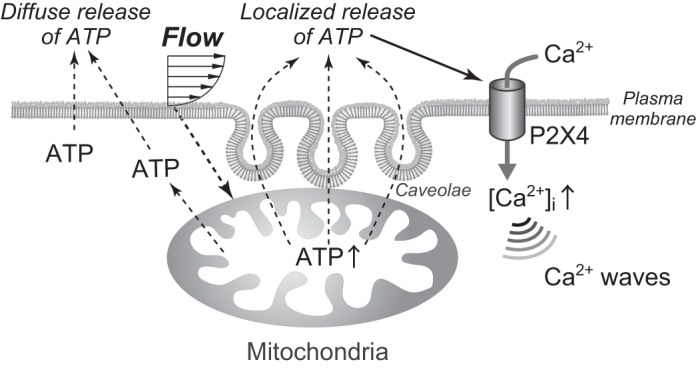
Vascular endothelial cells (ECs) sense and transduce hemodynamic shear stress into intracellular biochemical signals, and Ca signaling plays a critical role in this mechanotransduction, i.e., ECs release ATP in the caveolae in response to shear stress and, in turn, the released ATP activates P2 purinoceptors, which results in an influx into the cells of extracellular Ca. However, the mechanism by which the shear stress evokes ATP release remains unclear. Here, we demonstrated that cellular mitochondria play a critical role in this process. Cultured human pulmonary artery ECs were exposed to controlled levels of shear stress in a flow-loading device, and changes in the mitochondrial ATP levels were examined by real-time imaging using a fluorescence resonance energy transfer-based ATP biosensor. Immediately upon exposure of the cells to flow, mitochondrial ATP levels increased, which was both reversible and dependent on the intensity of shear stress. Inhibitors of the mitochondrial electron transport chain and ATP synthase as well as knockdown of caveolin-1, a major structural protein of the caveolae, abolished the shear stress-induced mitochondrial ATP generation, resulting in the loss of ATP release and influx of Ca into the cells. These results suggest the novel role of mitochondria in transducing shear stress into ATP generation: ATP generation leads to ATP release in the caveolae, triggering purinergic Ca signaling. Thus, exposure of ECs to shear stress seems to activate mitochondrial ATP generation through caveola- or caveolin-1-mediated mechanisms. NEW & NOTEWORTHY The mechanism of how vascular endothelial cells sense shear stress generated by blood flow and transduce it into functional responses remains unclear. Real-time imaging of mitochondrial ATP demonstrated the novel role of endothelial mitochondria as mechanosignaling organelles that are able to transduce shear stress into ATP generation, triggering ATP release and purinoceptor-mediated Ca signaling within the cells.
血管内皮细胞(ECs)感知血流产生的切变力,并将其转化为细胞内生化信号,而 Ca 信号在这种力转导中起着关键作用,即 ECs 会在受到切变力时通过 caveolae 释放 ATP,而释放的 ATP 会激活 P2 嘌呤能受体,导致细胞外 Ca 流入细胞内。然而,切变力引发 ATP 释放的确切机制仍不清楚。在这里,我们证明了细胞内的线粒体在这个过程中起着关键作用。我们将培养的人肺动脉内皮细胞暴露于流量加载装置中的受控切变力下,并使用基于荧光共振能量转移的 ATP 生物传感器实时成像来检测线粒体 ATP 水平的变化。细胞一接触到流动,线粒体 ATP 水平就会立即增加,这种增加是可逆的,并且依赖于切变力的强度。线粒体电子传递链和 ATP 合酶的抑制剂,以及 caveolin-1(caveolae 的主要结构蛋白)的敲低,消除了切变力诱导的线粒体 ATP 生成,导致 ATP 释放和 Ca 流入细胞的丧失。这些结果表明了线粒体在将切变力转化为 ATP 生成中的新作用:ATP 生成导致 caveolae 中的 ATP 释放,触发嘌呤能 Ca 信号。因此,内皮细胞暴露于切变力似乎通过 caveolae 或 caveolin-1 介导的机制激活了线粒体 ATP 的生成。新的和值得注意的是,血管内皮细胞如何感知血流产生的切变力并将其转化为功能反应的机制仍不清楚。线粒体 ATP 的实时成像显示了内皮细胞线粒体作为机械信号细胞器的新作用,它们能够将切变力转化为 ATP 生成,从而触发细胞内的 ATP 释放和嘌呤能受体介导的 Ca 信号。