Nicu Elena A, Rijkschroeff Patrick, Wartewig Eva, Nazmi Kamran, Loos Bruno G
Department of Periodontology, Academic Centre for Dentistry Amsterdam (ACTA), University of Amsterdam and VU University Amsterdam, Gustav Mahlerlaan 3004, 1081, LA, Amsterdam, The Netherlands.
Opris Dent SRL, Sibiu, Romania.
BMC Oral Health. 2018 Aug 24;18(1):149. doi: 10.1186/s12903-018-0615-2.
Maintaining oral health is a continuous and dynamic process that also involves the immune system. Polymorphonuclear neutrophils (PMNs) migrate from blood circulation and become apparent in the oral fluid. Controversies exist regarding the specific role of the oral PMNs (oPMNs) in the presence of chronic oral inflammation, such as periodontitis. In this study we characterized cell counts, activation status, apoptosis, and reactive oxygen species (ROS) generation by oPMNs and circulatory (cPMNs), and the salivary protease activity, in subjects with and without periodontitis.
Venous blood and oral rinse samples were obtained from 19 patients with untreated periodontitis and 16 control subjects for PMN isolation. Apoptosis and expression of cell activation markers CD11b, CD63, and CD66b were analyzed using flow cytometry. Constitutive ROS generation was detected using dihydrorhodamine123. Additionally, ROS production in response to stimulation was evaluated in samples incubated with 10 μM phorbol myristate acetate (PMA) or Fusobacterium nucleatum. Total protease activity was measured using substrate PEK-054.
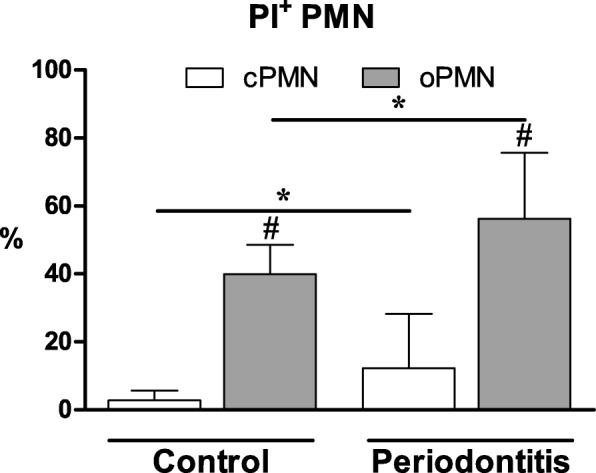
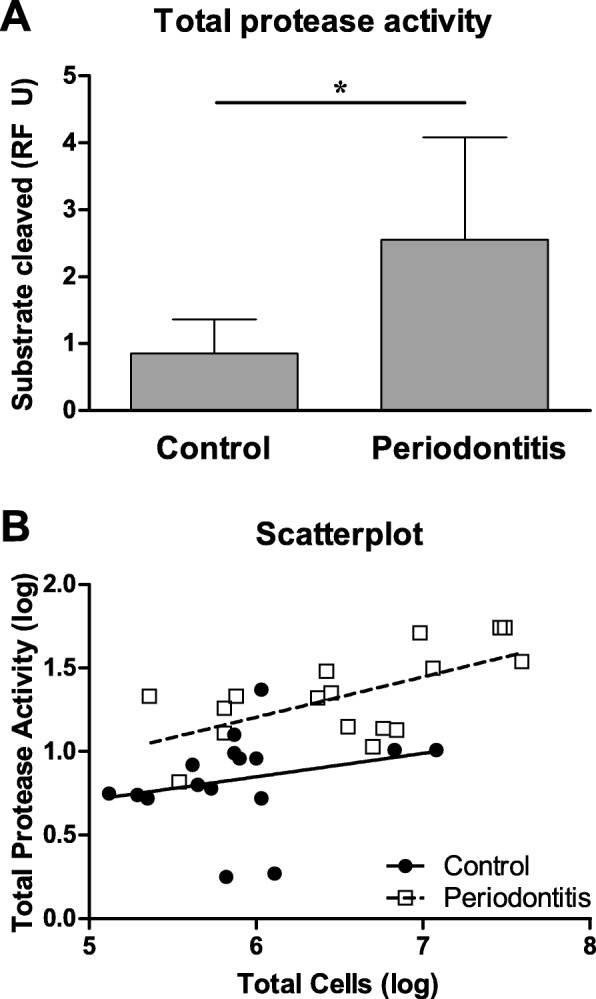
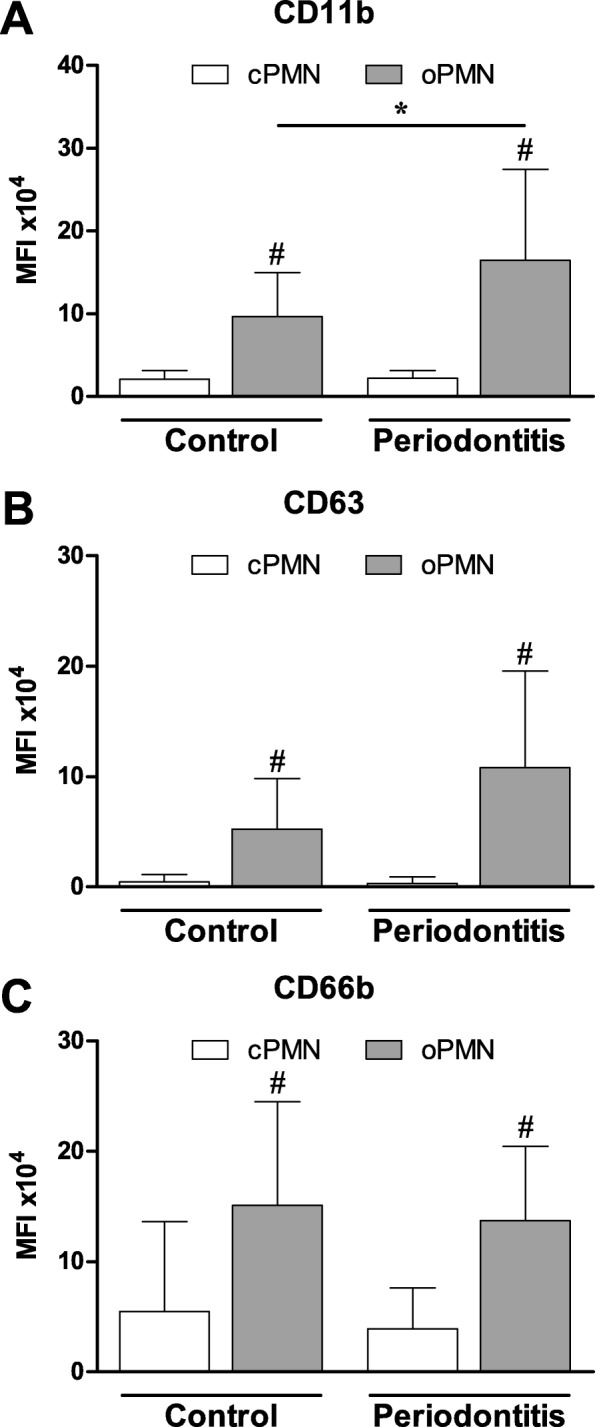
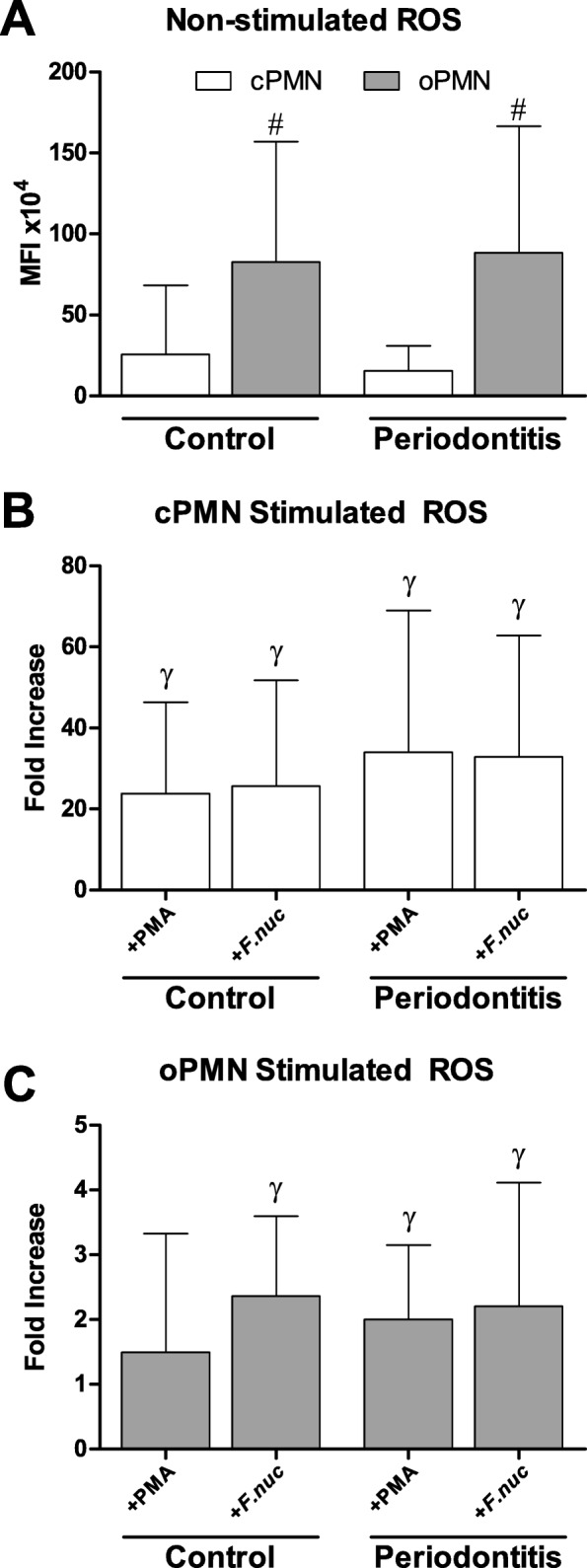
Periodontitis patients presented with over 4 times higher oPMN counts compared to controls (p = 0.007), which was a predictor for the total protease activity (r = 0.399, P = 0.007). More oPMNs were apoptotic in periodontitis patients compared to the controls (P = 0.004). All three activation markers were more expressed on the oPMNs compared to the cPMNs (p < 0.05), and a higher expression of CD11b on the oPMNs from periodontitis patients was observed compared to the control subjects (P = 0.024). Constitutive ROS production per oPMN was higher compared to the cPMN (P < 0.001). Additional analysis showed that the oPMNs retained their ability to respond to stimulation, with no apparent differences between the periodontitis and control subjects.
Higher numbers of oral PMNs, being more apoptotic and having increased levels of degranulation markers were found in periodontitis compared to periodontal health. However, since the oPMNs in periodontitis were responsive to ex vivo stimulation, we conclude that the oPMNs are active in the oral ecosystem. It is currently unknown whether the oPMN counts, which correlated with the detected protease levels, are detrimental in the long term for the oral mucosa integrity.
This study was retrospectively registered at the ISRCTN registry (trial ID ISRCTN15252886 ). Registration date August 11, 2017.
保持口腔健康是一个持续且动态的过程,这一过程也涉及免疫系统。多形核中性粒细胞(PMN)从血液循环中迁移出来并在口腔液体中显现。关于口腔PMN(oPMN)在慢性口腔炎症(如牙周炎)存在时的具体作用存在争议。在本研究中,我们对患有和未患有牙周炎的受试者的oPMN和循环PMN(cPMN)的细胞计数、激活状态、凋亡及活性氧(ROS)生成,以及唾液蛋白酶活性进行了特征分析。
从19名未经治疗的牙周炎患者和16名对照受试者中采集静脉血和口腔冲洗样本以分离PMN。使用流式细胞术分析细胞凋亡及细胞激活标志物CD11b、CD63和CD66b的表达。使用二氢罗丹明123检测组成型ROS生成。此外,在与10μM佛波酯肉豆蔻酸酯乙酸酯(PMA)或具核梭杆菌孵育的样本中评估刺激后ROS的产生。使用底物PEK - 054测量总蛋白酶活性。
与对照组相比,牙周炎患者的oPMN计数高出4倍以上(p = 0.007),这是总蛋白酶活性的一个预测指标(r = 0.399,P = 0.007)。与对照组相比,牙周炎患者中更多的oPMN发生凋亡(P = 0.004)。与cPMN相比,所有三种激活标志物在oPMN上的表达更高(p < 0.05),并且观察到牙周炎患者的oPMN上CD11b的表达高于对照受试者(P = 0.024)。每个oPMN的组成型ROS产生高于cPMN(P < 0.001)。进一步分析表明,oPMN保留了对刺激作出反应的能力,牙周炎患者和对照受试者之间没有明显差异。
与牙周健康相比,牙周炎患者中发现口腔PMN数量更多、凋亡更多且脱颗粒标志物水平升高。然而,由于牙周炎中的oPMN对体外刺激有反应,我们得出结论,oPMN在口腔生态系统中是活跃的。目前尚不清楚与检测到的蛋白酶水平相关的oPMN计数从长期来看是否对口腔黏膜完整性有害。
本研究在国际标准随机对照试验编号注册库(试验编号ISRCTN15252886)进行了回顾性注册。注册日期为2017年8月11日。