Institute of Materials Research, German Aerospace Center (DLR), Linder Höhe, 51147, Cologne, Germany.
Helmholtz-Zentrum Geesthacht, Max-Planck-Straße 1, 21502, Geesthacht, Germany.
Nat Commun. 2018 Aug 24;9(1):3426. doi: 10.1038/s41467-018-05819-9.
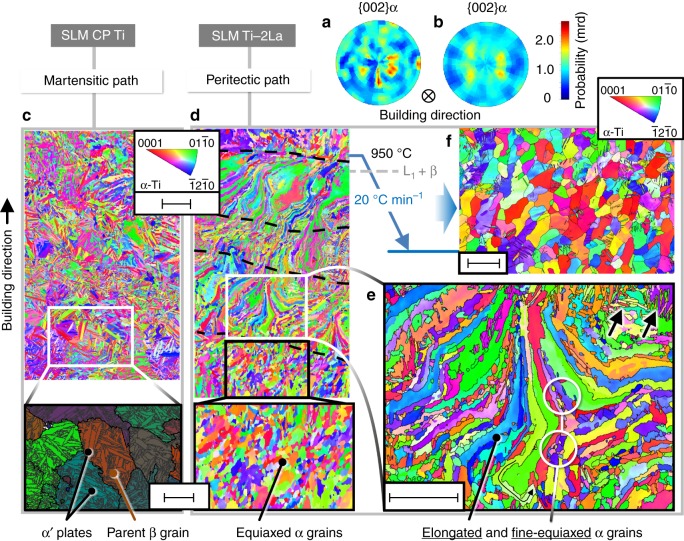
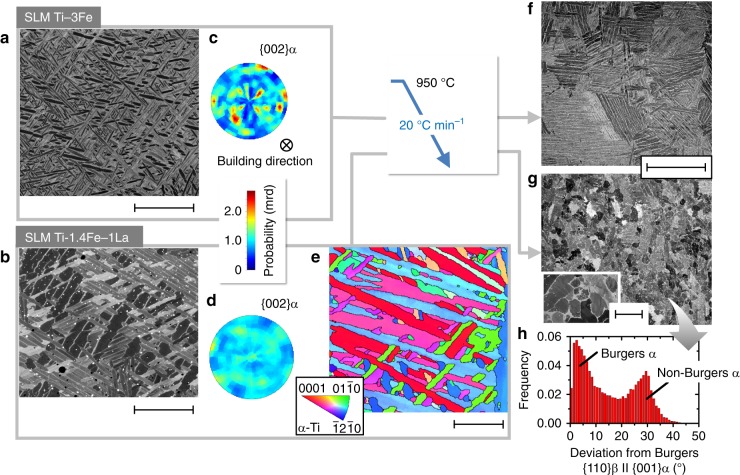
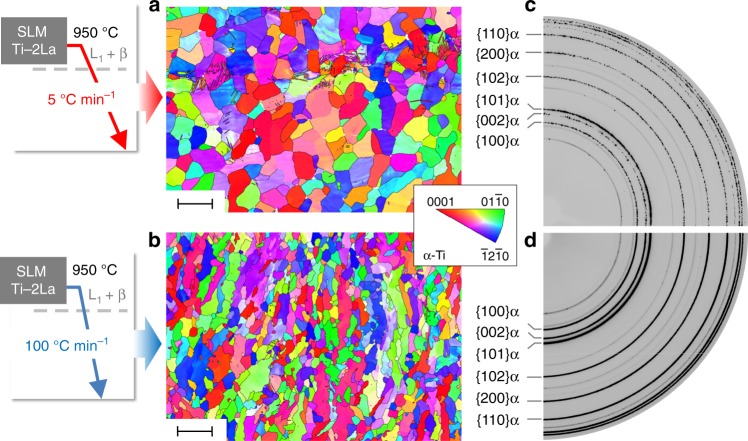
Metal-based additive manufacturing (AM) permits layer-by-layer fabrication of near net-shaped metallic components with complex geometries not achievable using the design constraints of traditional manufacturing. Production savings of titanium-based components by AM are estimated up to 50% owing to the current exorbitant loss of material during machining. Nowadays, most of the titanium alloys for AM are based on conventional compositions still tailored to conventional manufacturing not considering the directional thermal gradient that provokes epitaxial growth during AM. This results in severely textured microstructures associated with anisotropic structural properties usually remaining upon post-AM processing. The present investigations reveal a promising solidification and cooling path for α formation not yet exploited, in which α does not inherit the usual crystallographic orientation relationship with the parent β phase. The associated decrease in anisotropy, accompanied by the formation of equiaxed microstructures represents a step forward toward a next generation of titanium alloys for AM.
金属增材制造(AM)允许逐层制造具有复杂几何形状的近净形状金属部件,而这些形状是传统制造的设计限制无法实现的。由于目前在加工过程中材料的大量损失,采用 AM 可使钛基部件的生产成本降低高达 50%。如今,大多数用于 AM 的钛合金仍然基于传统成分,这些成分是为传统制造量身定制的,没有考虑到在 AM 过程中引发外延生长的定向热梯度。这导致在 AM 后处理过程中通常会出现严重的织构化微观结构和各向异性结构性能。目前的研究揭示了一种有前途的尚未被开发的α形成的凝固和冷却路径,在这种路径中,α不会继承与母体β相的通常晶体取向关系。各向异性的相应降低伴随着等轴微观结构的形成,这标志着向 AM 的下一代钛合金迈出了一步。