Cheng Dezhi, He Zhifeng, Zheng Liangcheng, Xie Deyao, Dong Shangwen, Zhang Peng
Department of Thoracic Surgery, Tianjin Medical University General Hospital, Tianjin, China,
Department of Thoracic Cardiovascular, The First Affiliated Hospital of Wenzhou Medical University, Wenzhou, China.
Onco Targets Ther. 2018 Aug 14;11:4869-4876. doi: 10.2147/OTT.S166412. eCollection 2018.
Non-small-cell lung cancer (NSCLC) constitutes the leading cause of cancer death in humans. Previous studies revealed the essential role of the protein arginine methyltransferase 7 () in promoting metastasis in breast cancer. However, its function and potential mechanism in NSCLC remain unclear.
The gene expression of between lung cancer tissues and normal tissues was studied with online database (http://medicalgenome.kribb.re.kr/GENT/). NSCLC cell lines with specific gene overexpression were constructed with lentivirus transduction. Matrigel invasion and colony formation assays were performed to evaluate the invasion and colony formation abilities. Co-immunoprecipitation coupled with mass spectrometry analysis was performed to explore the potential interaction proteins of . Bioinformatic analysis was performed with Gene Ontology and Kyoto Encyclopedia of Genes and Genomes databases.
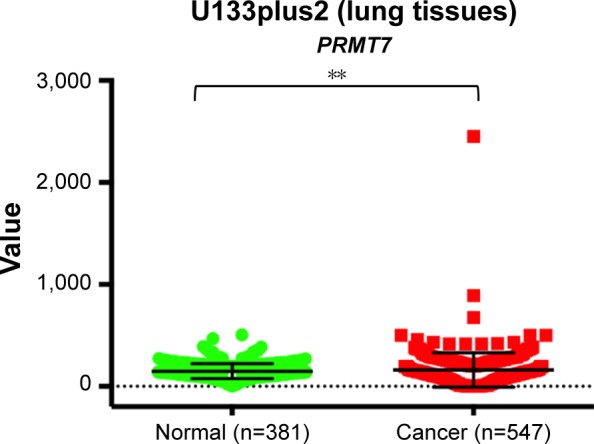
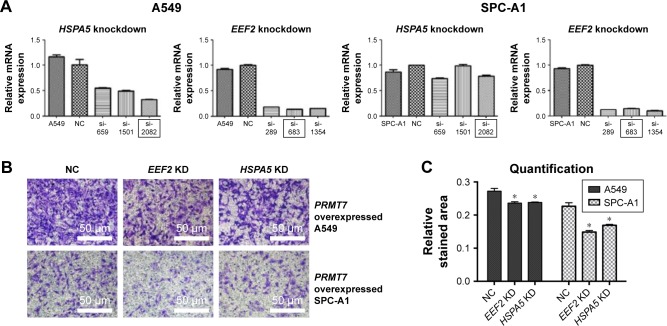
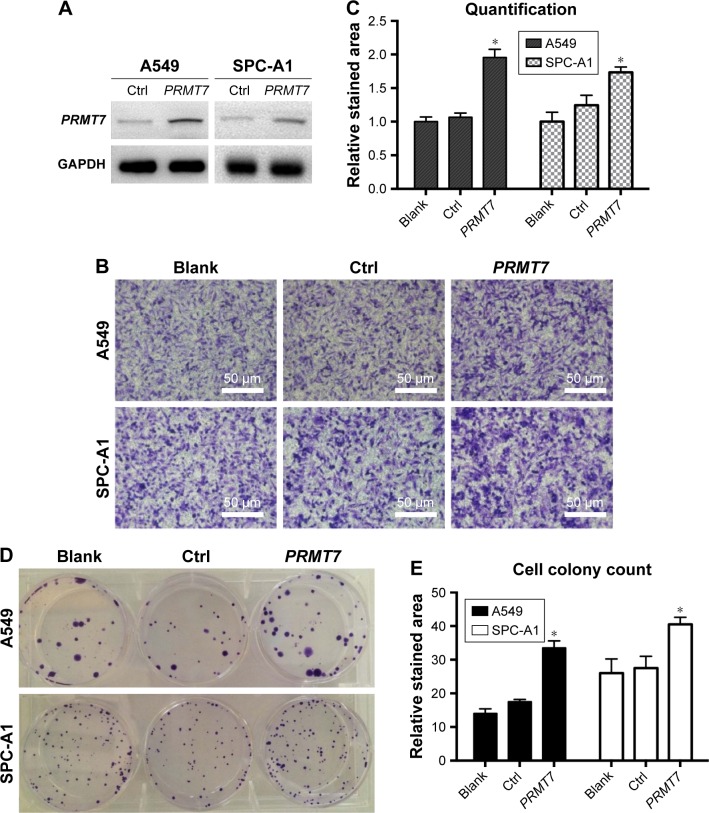
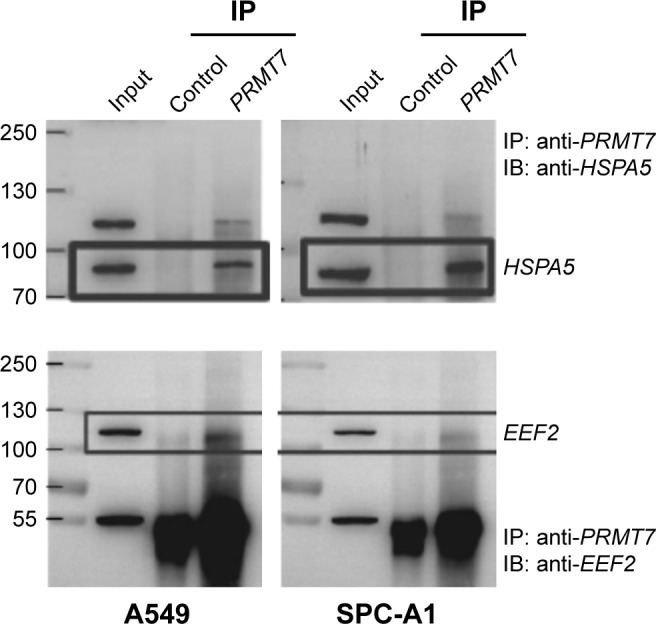
Online analysis of gene expression patterns revealed the relatively high expression of in lung cancer tissues. overexpression was able to promote the invasion and colony formation of A549 and SPC-A1 cells. A total of 19 in-common proteins shared by both NSCLC cell lines were identified to be interacting with and found to participate in a wide variety of pathways and protein-protein interactions according to bioinformatic analysis. Among them, and were further investigated for their essential roles in promoted NSCLC cell invasion.
Our results suggested overexpression was able to promote metastasis in NSCLC possibly through the interaction with and , which provides the potential mechanism of oncogenesis in lung cancer.
非小细胞肺癌(NSCLC)是人类癌症死亡的主要原因。先前的研究揭示了蛋白质精氨酸甲基转移酶7()在促进乳腺癌转移中的重要作用。然而,其在NSCLC中的功能和潜在机制仍不清楚。
基因表达模式的在线分析显示肺癌组织中相对高表达。过表达能够促进A549和SPC-A1细胞的侵袭和集落形成。共鉴定出两种NSCLC细胞系共有的19种共同蛋白与相互作用,并根据生物信息学分析发现它们参与多种途径和蛋白质-蛋白质相互作用。其中,和进一步研究了它们在促进NSCLC细胞侵袭中的重要作用。
我们的结果表明过表达可能通过与和相互作用促进NSCLC转移,这为肺癌的肿瘤发生提供了潜在机制。