Waring Timothy, Acheson James
1School of Economics and Mitchell Center for Sustainability Solutions, University of Maine, Orono, ME 04469 USA.
2Department of Anthropology and School of Marine Sciences, University of Maine, Orono, ME 04469 USA.
Sustain Sci. 2018;13(1):21-34. doi: 10.1007/s11625-017-0501-x. Epub 2017 Nov 17.
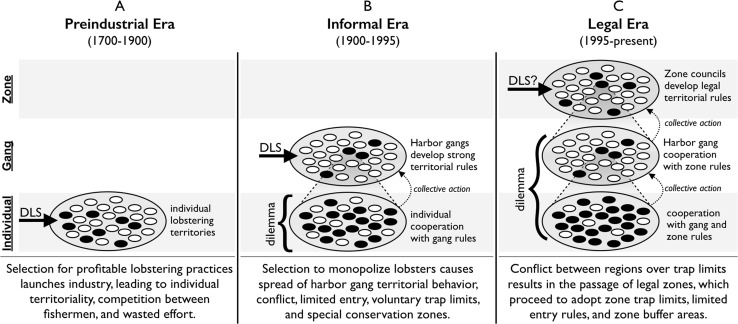
Relatively little is known about how resource conservation practices and institutions emerge. We examine the historical emergence of territoriality and conservation rules in Maine's lobstering industry, using a cultural evolutionary perspective. Cultural evolution suggests that cultural adaptations such as practices and institutions arise as a result of evolutionary selection pressure. The cultural multilevel selection framework of Waring et al. (Ecol Soc, 2015) further proposes that group cultural adaptations tend to emerge at a level of social organization corresponding to the underlying dilemma. Drawing on detailed history and ethnography, we conduct a retrospective assessment to determine which levels of social organization experienced selection pressures that might explain the emergence of lobstering territoriality and conservation practices we observe in history. The evidence strongly suggests that informal territoriality evolved by selection on harbor gang behavior, while some conservation practices spread via selection at other levels from individuals to regional lobstering zones. We identify two apparent historical shifts in the dominant level of selection for these practices over the history of the industry and discuss the implications of this trajectory for the evolution of lobster management in the Gulf of Maine.
关于资源保护实践和制度是如何出现的,人们所知甚少。我们从文化进化的角度,研究缅因州龙虾捕捞业中领地意识和保护规则的历史演变。文化进化表明,诸如实践和制度等文化适应是进化选择压力的结果。沃林等人(《生态学会》,2015年)的文化多层次选择框架进一步提出,群体文化适应往往会在与潜在困境相对应的社会组织层面出现。借助详细的历史和人种志资料,我们进行了一项回顾性评估,以确定哪些社会组织层面经历了可能解释我们在历史中观察到的龙虾捕捞领地意识和保护实践出现的选择压力。证据有力地表明,非正式的领地意识是通过对港口帮派行为的选择而演变的,而一些保护实践则通过从个人到区域龙虾捕捞区等其他层面的选择而传播。我们确定了在该行业历史上这些实践的主导选择层面出现的两个明显的历史转变,并讨论了这一轨迹对缅因湾龙虾管理演变的影响。