Frantzeskaki Niki, van Steenbergen Frank, Stedman Richard C
1Dutch Research Institute For Transitions, Faculty of Social Sciences, Erasmus University Rotterdam, Burgemeester Oudlaan 40, 3000DR Rotterdam, The Netherlands.
2Human Dimensions Research Unit, Department of Natural Resources, Cornell University, Ithaca, USA.
Sustain Sci. 2018;13(4):1045-1059. doi: 10.1007/s11625-018-0562-5. Epub 2018 Apr 27.
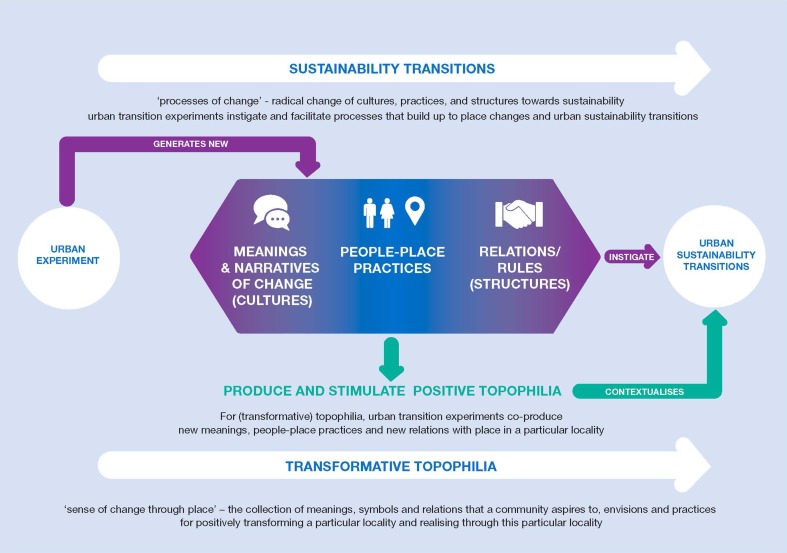
Experimentation as a means of governance for sustainability transitions has been advocated for years by transition scholars and geography scholars. We propose that examining the impact of experimentation requires an understanding of its embeddedness in place as a socio-spatial context. This notion of embeddedness, which conceptually aligns well with the understanding of sense of place, is under-examined in sustainability transitions literature. By conjoining the sense of place and sustainability transition literatures, we conceptualize that sense of place can be one outcome of experimentation fostering sustainability transitions. We examine urban living labs as an open format of urban experimentation, where multiple actors interact with the aim to co-design, test, and implement governance innovations. From the literature, we have distilled three phenomena that relate to a sense of place as mechanisms for transformation: a symbolic understanding or meaning of place; a narrative of place that connects to a transformative vision; and new types of relations between people and place. With this conceptual lens, we analyze our case study, an urban living lab called The Resilience Lab in a neighborhood of the city of Rotterdam, The Netherlands. Drawing from a longitudinal case study research, we contend that urban living labs can connect a sense of change (transformation) with a sense of place by co-creating new narratives of place, by co-producing knowledge on new practices and new relations between people and place, and by allowing the co-design or (re)establishment of places with symbolic meaning. As such, urban living labs facilitate urban sustainability transitions.
多年来,转型学者和地理学者一直倡导将实验作为实现可持续发展转型的治理手段。我们认为,要考察实验的影响,就需要理解其作为社会空间背景在特定地点的嵌入性。这种嵌入性概念在概念上与地方感的理解相契合,但在可持续发展转型文献中却未得到充分研究。通过将地方感文献和可持续发展转型文献结合起来,我们认为地方感可以是促进可持续发展转型的实验的一个结果。我们将城市生活实验室视为城市实验的一种开放形式,在其中多个行为者相互作用,旨在共同设计、测试和实施治理创新。从文献中,我们提炼出三种与地方感相关的现象,作为转型机制:对地方的象征性理解或意义;与变革愿景相联系的地方叙事;以及人与地方之间的新型关系。借助这一概念视角,我们分析了我们的案例研究,即荷兰鹿特丹市一个街区的名为“韧性实验室”的城市生活实验室。基于纵向案例研究,我们认为城市生活实验室可以通过共同创造新的地方叙事、共同产生关于新实践以及人与地方之间新关系的知识,以及允许共同设计或(重新)建立具有象征意义的地方,将变革感(转型)与地方感联系起来。因此,城市生活实验室促进了城市可持续发展转型。