Morales-Mantilla Daniel E, King Katherine Y
1Program in Immunology and Center for Cell and Gene Therapy, Section of Infectious Diseases, Department of Pediatrics, Baylor College of Medicine, Houston, TX 77030 USA.
2Pediatric Infectious Diseases, Baylor College of Medicine, 1102 Bates St. Suite 1150, Houston, TX 77030 USA.
Curr Stem Cell Rep. 2018;4(3):264-271. doi: 10.1007/s40778-018-0139-3. Epub 2018 Jul 23.
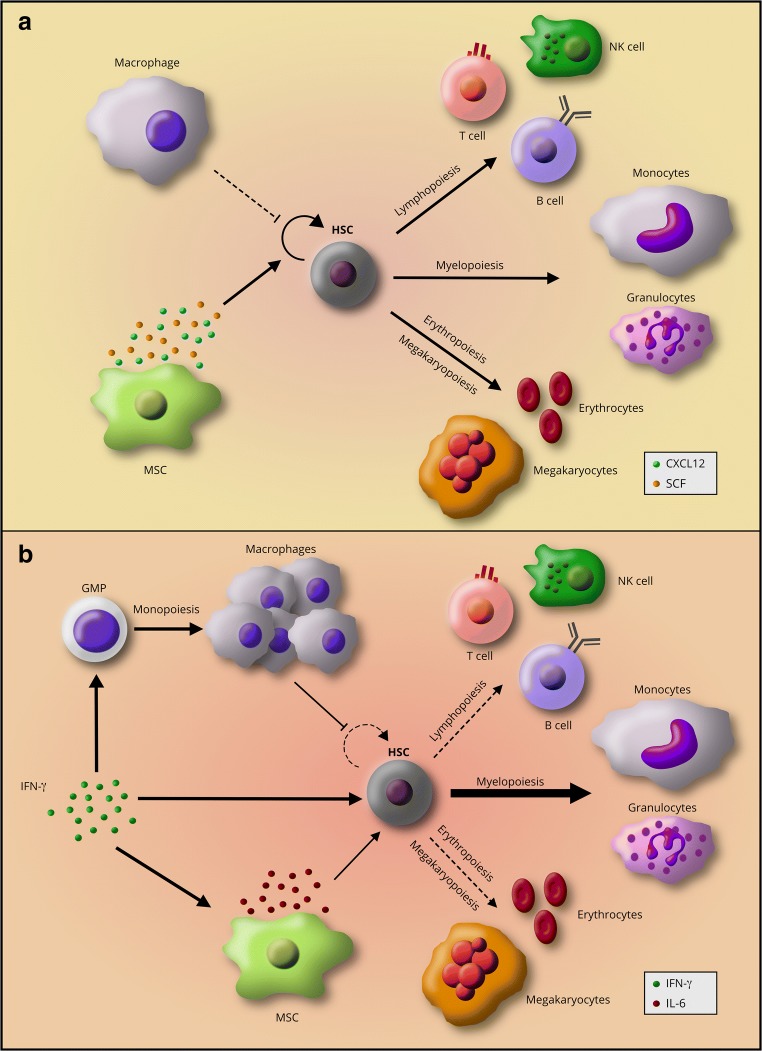
Interferon-gamma (IFN-γ) is a pro-inflammatory cytokine that participates in the regulation of hematopoietic stem cells (HSC) during development and under homeostatic conditions. IFN-γ also plays a key pathogenic role in several diseases that affect hematopoiesis including aplastic anemia, hemophagocytic lymphohistiocytosis, and cirrhosis of the liver.
Studies have shown that increased IFN-γ negatively affects HSC homeostasis, skewing HSC towards differentiation over self-renewal and eventually causing exhaustion of the HSC compartment.
Here, we explore the mechanisms by which IFN-γ regulates HSC in both normal and pathological conditions. We focus on the role of IFN-γ signaling in HSC fate decisions, and the transcriptional changes it elicits. Elucidating the mechanisms through which IFN-γ regulates HSCs may lead to new therapeutic options to prevent or treat adverse hematologic effects of the many diseases to which IFN-γ contributes.
干扰素-γ(IFN-γ)是一种促炎细胞因子,在发育过程和稳态条件下参与造血干细胞(HSC)的调节。IFN-γ在包括再生障碍性贫血、噬血细胞性淋巴组织细胞增生症和肝硬化在内的几种影响造血的疾病中也起着关键的致病作用。
研究表明,IFN-γ水平升高会对HSC稳态产生负面影响,使HSC倾向于分化而非自我更新,最终导致HSC库耗竭。
在此,我们探讨IFN-γ在正常和病理条件下调节HSC的机制。我们关注IFN-γ信号在HSC命运决定中的作用及其引发的转录变化。阐明IFN-γ调节HSC的机制可能会带来新的治疗选择,以预防或治疗IFN-γ所涉及的许多疾病的不良血液学影响。