Smell & Taste Clinic, Department of Otorhinolaryngology, TU Dresden, Dresden, Germany.
Gösta Ekman Laboratory, Department of Psychology, Stockholm University, Stockholm, Sweden.
PLoS One. 2018 Aug 27;13(8):e0202969. doi: 10.1371/journal.pone.0202969. eCollection 2018.
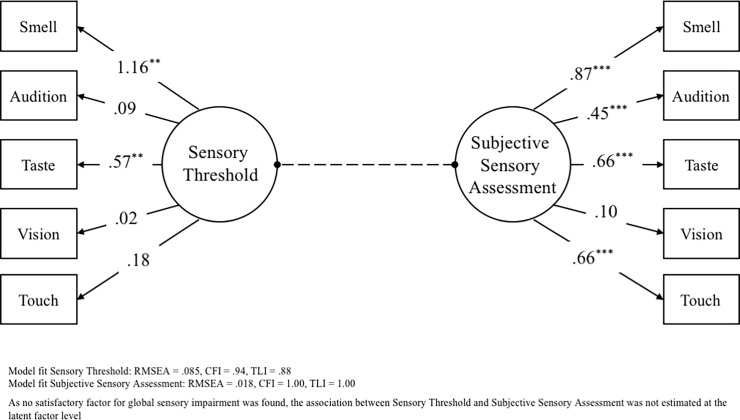
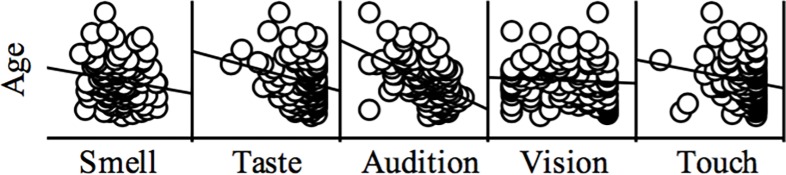
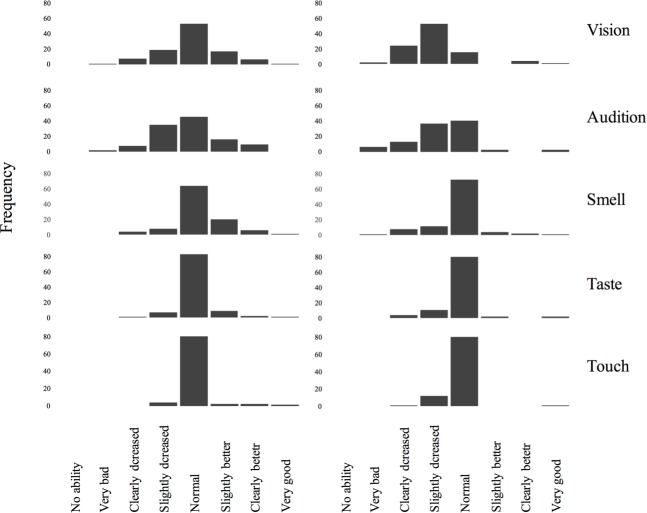
Age-related sensory impairment is a slow and gradual progress, which affects multiple modalities. Two contradictory hypotheses exist about the age-related decline of sensory thresholds. The common factor theory assumes one underlying factor-which accounts for the loss of several sensory modalities simultaneously-and the specific factor theory predicts that the sensory decline is uncorrelated between different modalities. In this study, we aimed to explore whether (i) there is a common factor of sensory thresholds in older people, (ii) older people assume that sensory decline in one modality also affects other modalities, (iii) there is a relation between sensory threshold and the subjective assessment of sensory function. This was accomplished by collecting both threshold measures and self-reported ratings for smell, hearing, taste, vision, and touch function in a group of 104 older people (mean age: 67.2 years; SD: 9.85; range: 50-100 years). Results indicated that there was no common factor of sensory thresholds, hence an impairment in one modality did not necessarily imply a shortfall in other modalities. In contrast, our results suggested one or two common factor(s) for the participants' ratings. Participants who reported a diminished function in one sense tended to generalize this rating to the other senses as well. The correspondence between subjective ratings and sensory thresholds was relatively good for vision and audition, although no correlations were observed for the other domains. These findings have implications for clinicians, suggesting that subjective measures should be combined with sensory threshold measurements when evaluating sensory dysfunction. Also, these data convey a positive message for older people and their physicians by showing that loss in one sensory modality does not necessarily generalize to losses across all sensory modalities.
年龄相关性感觉障碍是一个缓慢而渐进的过程,影响多种感觉模式。关于感觉阈限的年龄相关性下降,存在两种相互矛盾的假设。共同因素理论假设存在一个潜在的因素,该因素可以同时解释几种感觉模式的丧失;而特定因素理论则预测不同感觉模式之间的感觉下降是不相关的。在这项研究中,我们旨在探讨以下问题:(i)老年人的感觉阈限是否存在共同因素;(ii)老年人是否认为一种感觉模式的下降也会影响其他感觉模式;(iii)感觉阈限与感觉功能的主观评估之间是否存在关系。我们通过收集 104 名老年人(平均年龄:67.2 岁;标准差:9.85;范围:50-100 岁)的阈限测量值和自我报告的嗅觉、听觉、味觉、视觉和触觉功能评分来实现这一目标。结果表明,感觉阈限没有共同因素,因此一种感觉模式的损伤不一定意味着其他感觉模式的不足。相反,我们的结果表明,参与者的评分可能存在一个或两个共同因素。报告一种感觉功能下降的参与者往往会将这种评分推广到其他感觉。主观评分与感觉阈限之间的相关性在视觉和听觉方面相对较好,尽管其他领域没有观察到相关性。这些发现对临床医生具有重要意义,表明在评估感觉功能障碍时,主观测量应与感觉阈限测量相结合。此外,这些数据为老年人及其医生传达了一个积极的信息,即一种感觉模式的丧失不一定会普遍导致所有感觉模式的丧失。